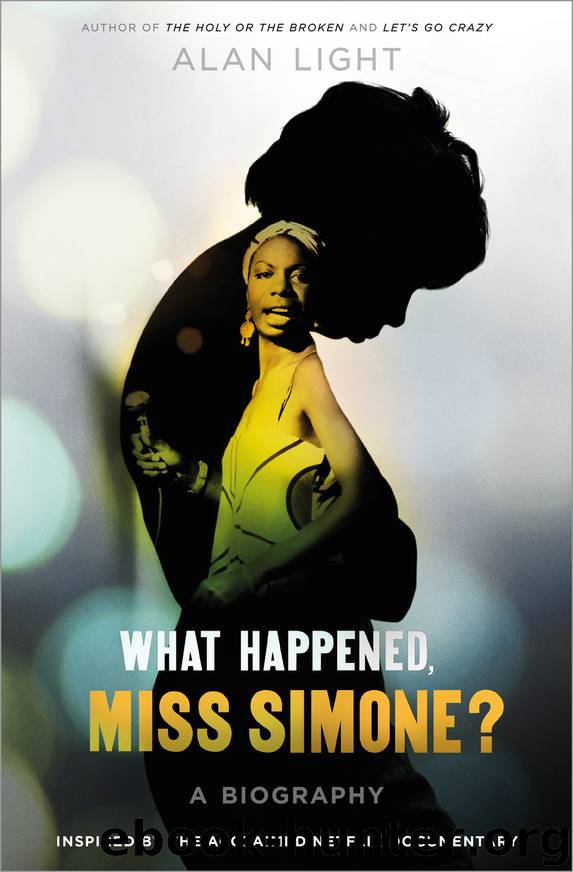
What Happened, Miss Simone? by Alan Light
Author:Alan Light
Language: eng
Format: epub
Publisher: Crown/Archetype
Published: 2016-02-09T05:00:00+00:00
At this moment, Stroud didn’t seem overly concerned with his wife’s mental state. Keeping her on track was a matter of continuity rather than an urgent crisis. “I didn’t picture it as a problem,” he said. “I pictured it as a situation that could be managed like I did everything else. I figured with enough success that would alleviate a lot of these phobias that she had, and ghosts. She never frightened me—she frustrated me.”
One achievement capped the up-and-down year of 1967: she received word that her recording of “Go to Hell” from the Silk & Soul album had been nominated for a Grammy Award in the category of Best Female Rhythm & Blues Vocal Performance. Ultimately, she lost the award to Aretha Franklin.
Simone ended the year spending the holidays with her family, seemingly in fine (and apparently sometimes marijuana-assisted) spirits, still fragile but on good terms with her husband and her parents. On Christmas night, she wrote to Stroud to express how much she had missed him—not just during this trip but for months. She wanted to close the distance between them, writing that “unless I get to you soon, I feel as though I’ll dissolve and never be heard of any more and people won’t even remember that there was a me.”
A few days later, she described an idyllic scene with her parents, helping her mother with the wash at the laundromat and watching her father play guitar (“I don’t think I’d ever realized what a great musician he is”). She sounded thrilled to be at such ease around her family, jokingly suggesting that Stroud start managing her father. “This vacation is wonderful,” she wrote, “I’m really enjoying myself.”
—
After an active, productive year, Simone was becoming very aware that she was employing a lot of bodies between her band, her business, and her home staff, which meant increasing pressure to continue generating income for everyone.
“There are nineteen people who depend on me for their livelihood—that’s a hell of a lot of people,” she said. “Because I know that if I say, ‘Look, I’m too tired to work tonight,’ I’m gonna get it from both ends. Nobody is gonna understand or care that I’m too tired. I’m very aware of that. Now, I would like some freedom somewhere, where I didn’t feel those pressures, and I think that some songs would flow out of me then, because they wouldn’t have to come.”
The rigor of her schedule was increasingly heightened by the emotional demands of being a public figure and overseeing a growing business. “As the fame grew, and the loss of privacy, her life was not her own, but it was that of the public,” said her sister Frances. “She got to a place where she felt all the burden of supporting thirteen or fourteen people. She would talk about her musicians and their families, and all of her other staff and their families, because their livelihood was dependent on her livelihood. So then she felt responsible for all of those different sectors.
Download
This site does not store any files on its server. We only index and link to content provided by other sites. Please contact the content providers to delete copyright contents if any and email us, we'll remove relevant links or contents immediately.
Cecilia; Or, Memoirs of an Heiress — Volume 2 by Fanny Burney(32090)
Cecilia; Or, Memoirs of an Heiress — Volume 3 by Fanny Burney(32067)
Fanny Burney by Claire Harman(26730)
We're Going to Need More Wine by Gabrielle Union(19171)
Plagued by Fire by Paul Hendrickson(17541)
All the Missing Girls by Megan Miranda(16721)
Cat's cradle by Kurt Vonnegut(15557)
For the Love of Europe by Rick Steves(14919)
Bombshells: Glamour Girls of a Lifetime by Sullivan Steve(14220)
Leonardo da Vinci by Walter Isaacson(13519)
4 3 2 1: A Novel by Paul Auster(12623)
The remains of the day by Kazuo Ishiguro(9224)
Adultolescence by Gabbie Hanna(9022)
Note to Self by Connor Franta(7752)
Diary of a Player by Brad Paisley(7720)
Giovanni's Room by James Baldwin(7551)
What Does This Button Do? by Bruce Dickinson(6316)
Ego Is the Enemy by Ryan Holiday(5631)
Born a Crime by Trevor Noah(5490)
