Tolstoy and the Religious Culture of His Time by Medzhibovskaya Inessa;
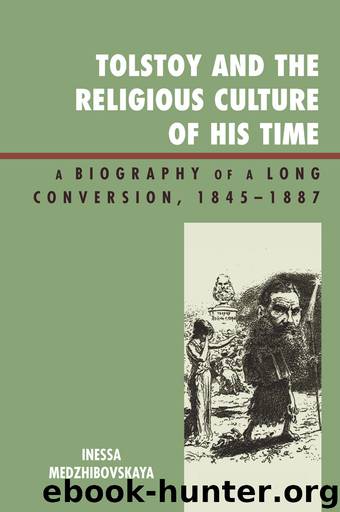
Author:Medzhibovskaya, Inessa; [Medzhibovskaya, Inessa]
Language: eng
Format: epub
ISBN: 467183
Publisher: Lexington Books
INTERLOCUTORS AND LONELY SEEKERS:
THE KNOWLEDGE OF FAITH
Given the variety of debates in Anna Karenina on burning social issues of the day, from feminism, to historical painting, to agricultural efficiency and political representation, and the war against Turkey, with the exception of public conversions at the proverbial English Club of the new Evangelicals, the absence of public debates on faith, the novel’s final focus, is especially noticeable. Tolstoy more than recompensed the omission in his colloquy “Interlocutors” (1877–78). As in the first conversion document, his philosophical letter to Strakhov of 1875, the seeking philosopher in “Interlocutors” is again the same age as Tolstoy (forty-nine at the time). “I, Ivan Il’ich, 49 years old” is the last entry on the list of the dialogue’s dramatis personae (17: 369–85). A congregation of jurors representing all flanks of rational knowledge (razumnoe znanie) and theology, who judge what he has to say in support of immortality, thrusts a very distraught protagonist into the epicenter of a fierce dispute. A young logical positivist, an idealist philosopher, a natural scientist, a dialectician-theologist, and a highly placed ecclesiastic assure a distraught Ivan Il’ich of his salvation from their admittedly limited perspectives. All participants deliberate on issues that torture Ivan Il’ich, such as immortality and the place of reason in faith. A Yunovich, who must be Soloviev’s teacher of philosophy, Pamfil Yurkevich, described as a “keen sophist of faith,” attacks Ivan Il’ich, saying that his faith is subdued by ratiocination.72 A monk, Father Pimen, whose prototype fell asleep during Tolstoy’s visit to Optina Pustyn, shakes off his reverie to vouch for Ivan Il’ich’s salvation because of his kindness (“he is kind, however; he will be saved”). The views of the dramatis personae in the colloquy overlap, in part because Tolstoy does not wish to sustain strict divisions between views. Ivan Il’ich leans toward the arguments of a “healthy idealist,” encrypted “Strem,” most likely the character Stremov in Anna Karenina (18: 310–15), a cynical and worldly peace-loving bureaucrat who combines the views of thinkers with whom Tolstoy is mostly sympathetic, namely, “Fet-Strakhov-Schopenhauer-Kant” (17: 369). “Strem” is trying to prove the impossibility of faith, which is contrary to pure reason, and argues that “in true reason,” a small degree of faith is inevitable in essense and “in the enormity of its fruit” (17: 370).
When Ivan Il’ich demands a definition of faith, which Tolstoy fruitlessly demanded of Fet and Strakhov in letters written during these same years, every flank provides its own convincing reason for disbelief, belief against reason, or belief in spite of reason. Not giving up, Ivan Il’ich denies that new faith is consummated in a Mill-style social beehive, in Virchow’s regeneration of cells, or in social communes.73 Of special interest are the sketches of a thirty-seven-year-old Malikov, a social utopian and positivist who preaches Godmanhood and a thirty-five-year-old Bibikov who clamors for “the rejection of all foundations.” A seventy-year-old monk named Father Pimen, who is there to preach humility and love and oppose with his kindness the smart sophists,
Download
This site does not store any files on its server. We only index and link to content provided by other sites. Please contact the content providers to delete copyright contents if any and email us, we'll remove relevant links or contents immediately.
Cecilia; Or, Memoirs of an Heiress — Volume 2 by Fanny Burney(31947)
Cecilia; Or, Memoirs of an Heiress — Volume 3 by Fanny Burney(31932)
Fanny Burney by Claire Harman(26597)
We're Going to Need More Wine by Gabrielle Union(19035)
Plagued by Fire by Paul Hendrickson(17405)
All the Missing Girls by Megan Miranda(15962)
Cat's cradle by Kurt Vonnegut(15339)
Bombshells: Glamour Girls of a Lifetime by Sullivan Steve(14058)
For the Love of Europe by Rick Steves(13942)
Leonardo da Vinci by Walter Isaacson(13319)
4 3 2 1: A Novel by Paul Auster(12377)
The remains of the day by Kazuo Ishiguro(8981)
Adultolescence by Gabbie Hanna(8923)
Note to Self by Connor Franta(7663)
Diary of a Player by Brad Paisley(7564)
Giovanni's Room by James Baldwin(7330)
What Does This Button Do? by Bruce Dickinson(6195)
Ego Is the Enemy by Ryan Holiday(5417)
Born a Crime by Trevor Noah(5376)
