Time's Monster by Priya Satia
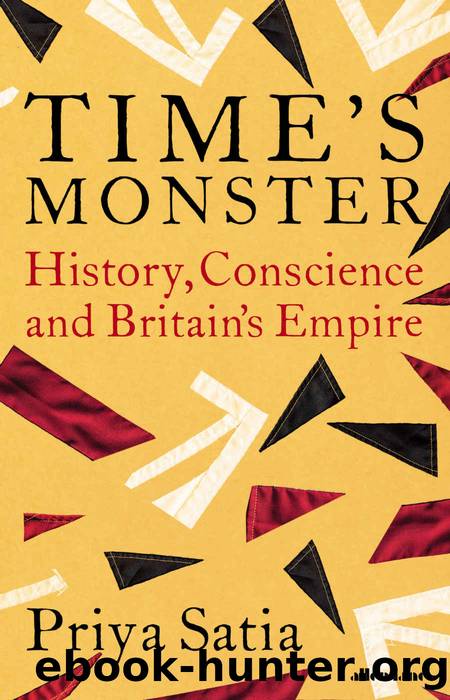
Author:Priya Satia [Satia, Priya]
Language: eng
Format: azw3, mobi, epub
ISBN: 9780141993935
Publisher: Penguin Books Ltd
Published: 2020-10-20T00:00:00+00:00
CHAPTER FIVE
´´ The Division of Progress
Serious nationalism is tied to internationalism.
âBenedict Anderson
´´ The empire did end, after a fashion, despite repeated renewals of its script. It ended in fits and starts, cracking first in 1776, and still cracking today as Scotland and Northern Ireland confront the implications of Brexit. The story of modern empire flowed, in a sense, from the opening crack in 1776: The need for a historical narrative to explain and make good on that loss drove much of British imperial activity afterwards. The empire continued to crack, and each desperately contained rebellion prompted further soul-searching about the historical necessity of the empire. The end of formal empire in Iraq in 1932 was a sham, a morphing of direct empire into indirect and even covert rule. More credible, if ephemeral, was the revolutionary end of British rule in Iraq in 1958.
In general, the reality of postâWorld War II decolonization was attenuated, for the British especially, by the idea of the Commonwealth. This body had been inaugurated between the wars to frame the shifting relationship between Britain and the âwhite dominions.â As Canada, New Zealand, and Australia asserted their autonomy, the Commonwealth preserved the imperial bond in other ways. Economic ties with colonies and dominions remained important, particularly the imperial trade bloc known as the sterling area. Until the 1970s, Britain stood back from the emerging institutions of the European Union, maintaining its orientation towards the empire. British imperialism had always been flexible, granting real and nominal autonomy as needed in order to better preserve the imperial bond. Informal, indirect, and covert forms of imperial rule were part of its tool kit. Against this backdrop, there was little reason to think that granting independence to India in 1947 would substantively alter its relationship to Britain. Indeed, many could reasonably read the moment of formal decolonization as yet another strategy for keeping the moral case for empire intact while maintaining the relationship in substance. That India became a member of the Commonwealth was spun as the culmination of liberal empire, another signal transition moment in its unfolding. There was no embarrassment in it. The postwar Labour government was deeply committed to this narrative and its incorporation of the notion of âcolonial developmentââthat the empire could produce commodities that would earn much-needed dollars. In 1960, while the former Labour prime minister Clement Atlee extolled the empire for âvoluntarilyâ surrendering sovereignty to its colonies, the ruling prime minister, Harold Macmillan, spun the âwind of changeâ blowing through Africa as fulfillment of the imperial narrative.
Such narratives of continuities with the past, real or imagined, framed understandings of decolonization. The British did not simply let go of the empire after the Second World Warâwhatever Atlee claimed. They fought hard and long to hold on to some colonies, such as Kenya and Malaya. In others, the promise of substantive continuity allowed more graceful transition. In India, the anticolonial movement forced the British out, despite efforts to crush it with massive force. As prime minister during the war, Churchill refused to countenance loss of the âjewelâ anchoring the empire.
Download
Time's Monster by Priya Satia.mobi
Time's Monster by Priya Satia.epub
This site does not store any files on its server. We only index and link to content provided by other sites. Please contact the content providers to delete copyright contents if any and email us, we'll remove relevant links or contents immediately.
The Vikings: Conquering England, France, and Ireland by Wernick Robert(84601)
Ali Pasha, Lion of Ioannina by Eugenia Russell & Eugenia Russell(40384)
The Conquerors (The Winning of America Series Book 3) by Eckert Allan W(39076)
The Vikings: Discoverers of a New World by Wernick Robert(37048)
Cecilia; Or, Memoirs of an Heiress — Volume 1 by Fanny Burney(32724)
Cecilia; Or, Memoirs of an Heiress — Volume 2 by Fanny Burney(32090)
Cecilia; Or, Memoirs of an Heiress — Volume 3 by Fanny Burney(32067)
Empire of the Sikhs by Patwant Singh(23206)
The Secret History by Donna Tartt(19472)
Hans Sturm: A Soldier's Odyssey on the Eastern Front by Gordon Williamson(18725)
Cat's cradle by Kurt Vonnegut(15558)
Pimp by Iceberg Slim(14800)
Sapiens: A Brief History of Humankind by Yuval Noah Harari(14555)
Norse Mythology by Gaiman Neil(13573)
Talking to Strangers by Malcolm Gladwell(13556)
Leonardo da Vinci by Walter Isaacson(13521)
4 3 2 1: A Novel by Paul Auster(12623)
Underground: A Human History of the Worlds Beneath Our Feet by Will Hunt(12234)
The Radium Girls by Kate Moore(12183)
