The Voting Rights War by Gloria J. Browne-Marshall
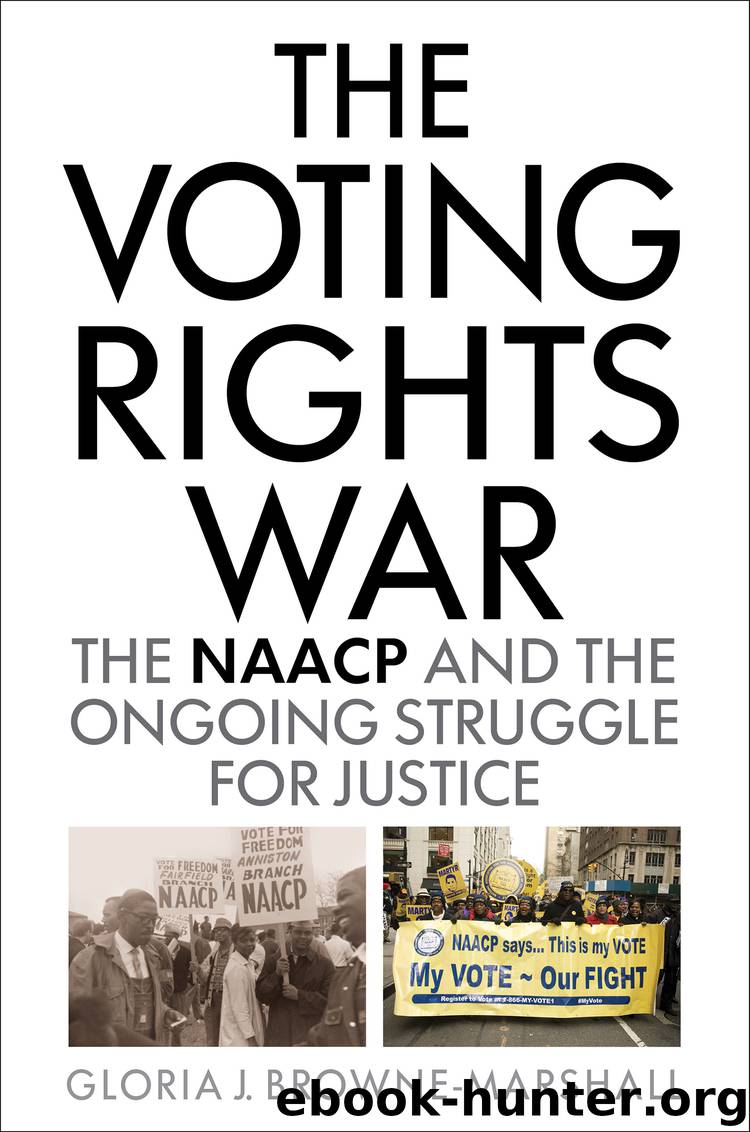
Author:Gloria J. Browne-Marshall [Browne-Marshall, Gloria J.]
Language: eng
Format: epub
Publisher: Rowman & Littlefield Publishers
Published: 2016-04-07T04:00:00+00:00
6
The Voting Rights Act
Stony the road we trod, Bitter the chastening rod,
Felt in the days when hope unborn had died.
—James Weldon Johnson, “Lift Every Voice and Sing” (1899)
There was a sacred price paid to achieve the Voting Rights Act of 1965. “Few events in American political life have had as profound or as far-reaching consequences as has passage of the Voting Rights Act of 1965.”1 The NAACP and the Justice Department of the United States would bring about sweeping changes only because of the passage of the Voting Rights Act. In 1962 the NAACP LDF had twenty-nine cases before the Supreme Court, more than any other law firm in the country except the Solicitor General’s Office of the federal government.2
The NAACP LDF assisted local NAACP attorneys C. B. King and D. L. Hollowell in their suit against the White elected officials of Albany, Georgia, who had maintained segregated voting locations, in Anderson v. Courson.3 Race was a factor in every aspect of voting. In Anderson v. Martin (1964), the NAACP brought a lawsuit successfully challenging a Louisiana law that required ballots to specify the race of the candidates running for office. Louisiana defended its measure as necessary information for the electorate; moreover, “the labeling applie[d] equally to Negro and white.” However, the history of racism in America would undermine the chances for Black, as opposed to White, candidates.
The NAACP LDF persuaded a unanimous court in Anderson v. Martin that it was a violation of the Fourteenth Amendment rights of Dupuy H. Anderson to require a candidate’s race to be on the campaign ballot.4 Jack Greenberg, LDF director, argued that the only reason to include race on a ballot was for discriminatory purposes, “so that people can react to it.”5 The Supreme Court struck down Louisiana’s statute as a violation of the equal protection clause.
In Virginia, voting records and property tax assessments were segregated by race. E. Leslie Hamm sued. In Hamm v. Virginia State Board of Elections (1964), the Supreme Court affirmed the trial court’s decision to desegregate this basic information. The court said, “Separation of white and colored on the poll tax, residence-certificate and registration lists as well as on the assessment rolls renders these provisions invalid under the equal protection clause of the Fourteenth amendment.” Jack Greenberg argued the case for the plaintiffs.
However, the tactic of states’ demanding membership lists and accusing the NAACP of hiding communist activity had taken a toll on the organization. Membership in the NAACP was down. Finally, in 1964, the Supreme Court ruled in favor of the NAACP in its fourth appeal in the 1956 case NAACP v. Alabama. The organization did not have to reveal its membership list, and it could continue doing business in the South without fear of White elected officials intent on reprisal against either the organization or its membership.6
As Black politicians rose to power, buoyed by the Voting Rights Act of 1965, the NAACP and NAACP LDF began their next fifty years of fighting to enforce legislation gained by tireless advocacy and the blood of the slaughtered.
Download
This site does not store any files on its server. We only index and link to content provided by other sites. Please contact the content providers to delete copyright contents if any and email us, we'll remove relevant links or contents immediately.
The Vikings: Conquering England, France, and Ireland by Wernick Robert(84609)
Ali Pasha, Lion of Ioannina by Eugenia Russell & Eugenia Russell(40387)
The Conquerors (The Winning of America Series Book 3) by Eckert Allan W(39188)
The Vikings: Discoverers of a New World by Wernick Robert(37052)
Cecilia; Or, Memoirs of an Heiress — Volume 1 by Fanny Burney(32726)
Cecilia; Or, Memoirs of an Heiress — Volume 2 by Fanny Burney(32090)
Cecilia; Or, Memoirs of an Heiress — Volume 3 by Fanny Burney(32068)
Empire of the Sikhs by Patwant Singh(23210)
The Secret History by Donna Tartt(19480)
Hans Sturm: A Soldier's Odyssey on the Eastern Front by Gordon Williamson(18729)
Cat's cradle by Kurt Vonnegut(15567)
Pimp by Iceberg Slim(14805)
Sapiens: A Brief History of Humankind by Yuval Noah Harari(14559)
Norse Mythology by Gaiman Neil(13581)
Talking to Strangers by Malcolm Gladwell(13562)
Leonardo da Vinci by Walter Isaacson(13535)
4 3 2 1: A Novel by Paul Auster(12628)
Underground: A Human History of the Worlds Beneath Our Feet by Will Hunt(12239)
The Radium Girls by Kate Moore(12197)
