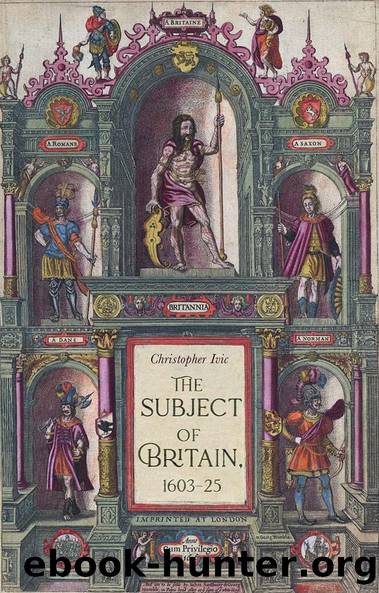
The subject of Britain, 1603â25 by Christopher Ivic
Author:Christopher Ivic [Ivic, Christopher]
Language: eng
Format: epub
Tags: History, Europe, Great Britain, General, Modern, 17th Century, Renaissance
ISBN: 9781526152695
Google: ThAFEAAAQBAJ
Publisher: Manchester University Press
Published: 2020-11-03T01:01:16+00:00
4
âOur downfall Birthdomeâ: reimagining nationhood in Macbeth
âLike to his Iland, gyrt in with the Oceanâ (3H6, TLN 2619)
Why would an English playwright whose plays not only depict intra-island warfare and border transgressions between the geographically contiguous nations that constitute Great Britainâs political landscape but also include as stage props maps of all or parts of Britain delineate his native land an island?1 Writing in 1604, Bacon informs King James of the âpoints wherein the nations [England and Scotland] stand already unitedâ; included among these points is â[i]n continentâ. âFor the Continentâ, he adds, âthere are no natural boundaries of mountains, or seas, or navigable riversâ.2 Shakespeareâs plays often present not Britain but England in a continent-like manner, detached from neighbouring Scotland and Wales. By no means was Shakespeare alone among his contemporaries in giving voice to such imagined geographies.3 Edmund Spenser addresses Queen Elizabeth in the Proem to book one of The Faerie Queene as âGreat Ladie of the greatest Isleâ.4 Does âIsleâ here signify England, or does âthe greatest Isleâ refer to Great Britain? If the latter, then Spenser has amplified the dominion of a monarch whose rule did not encompass an entire âIsleâ.
Labelling Shakespeareâs inscriptions of England as an island-nation or island-realm Anglocentric, as many critics have, offers a partial understanding of the cultural and historical significance of what Kate Chedgzoy terms âthe geopolitical metaphor of insularityâ.5 Shakespeareâs use of this metaphor obscures Englandâs, Scotlandâs and Walesâs cohabitation of a land-mass that contemporaries struggled to assign a single name, describing it variously as Albion, Britain, Britannia, Great Britain, etc. Imagining England as an isle, as numerous characters in Shakespeareâs plays do, seems even more incongruous given the historical context in which these plays were written. Although Wales had been politically incorporated into the English state under King Henry VIII, Scotland was a separate, sovereign, unconquered kingdom, notwithstanding a long history of English claims to suzerainty. The playsâ geopolitical elisions are, of course, complicated by the powerful presence of characters representative of Englandâs island neighbours and by the voices of a few of the playwrightâs non-English characters. Consider, for example, Nerissaâs question to Portia concerning âFauconbridge, the yong Baron of Englandâ: â[w]hat thinke you of the Scottish Lorde his neighbour?â6 And there is Glendour/Glendoure/Glendowerâs revision of the Gauntean islanding of England: âthe Sea,/That chides the Bankes of England, Scotland, and Walesâ (1H4, TLN 1569â70), spoken in a scene set in Wales and in the presence of an onstage map. The words âWalesâ, âWelshâ, âWelshmanâ and âWelshwomanâ, and âScotlandâ, âScot(s)â, âScotchâ and âScottishâ, surface again and again in Shakespeareâs plays as do references to non-English geographical place names within Britain, including Berwick (3H6), Brecknock (R3), Caernarvonshire (H8), Haverfordwest (R3), Milford Haven (R3, Cym), Monmouth (1H6, H5 â geographically English, culturally and historically Welsh),7 Pembroke (R3, H8), the rivers Wye and Severn (1H4, Cym), not to mention the various Scottish place names that surface in The Tragedie of Macbeth. Clearly Shakespeare had a better geographical knowledge of the three-nation island of Great Britain than he did of Bohemia.
Download
This site does not store any files on its server. We only index and link to content provided by other sites. Please contact the content providers to delete copyright contents if any and email us, we'll remove relevant links or contents immediately.
The Vikings: Conquering England, France, and Ireland by Wernick Robert(84415)
Ali Pasha, Lion of Ioannina by Eugenia Russell & Eugenia Russell(40331)
The Conquerors (The Winning of America Series Book 3) by Eckert Allan W(38001)
The Vikings: Discoverers of a New World by Wernick Robert(37020)
Cecilia; Or, Memoirs of an Heiress — Volume 1 by Fanny Burney(32652)
Cecilia; Or, Memoirs of an Heiress — Volume 2 by Fanny Burney(32019)
Cecilia; Or, Memoirs of an Heiress — Volume 3 by Fanny Burney(32004)
Empire of the Sikhs by Patwant Singh(23145)
The Secret History by Donna Tartt(19351)
Hans Sturm: A Soldier's Odyssey on the Eastern Front by Gordon Williamson(18659)
Cat's cradle by Kurt Vonnegut(15463)
Pimp by Iceberg Slim(14706)
Sapiens: A Brief History of Humankind by Yuval Noah Harari(14475)
Norse Mythology by Gaiman Neil(13470)
Talking to Strangers by Malcolm Gladwell(13465)
Leonardo da Vinci by Walter Isaacson(13423)
4 3 2 1: A Novel by Paul Auster(12535)
Underground: A Human History of the Worlds Beneath Our Feet by Will Hunt(12168)
The Radium Girls by Kate Moore(12106)
