The Most Dangerous Art by Loewen Donald;
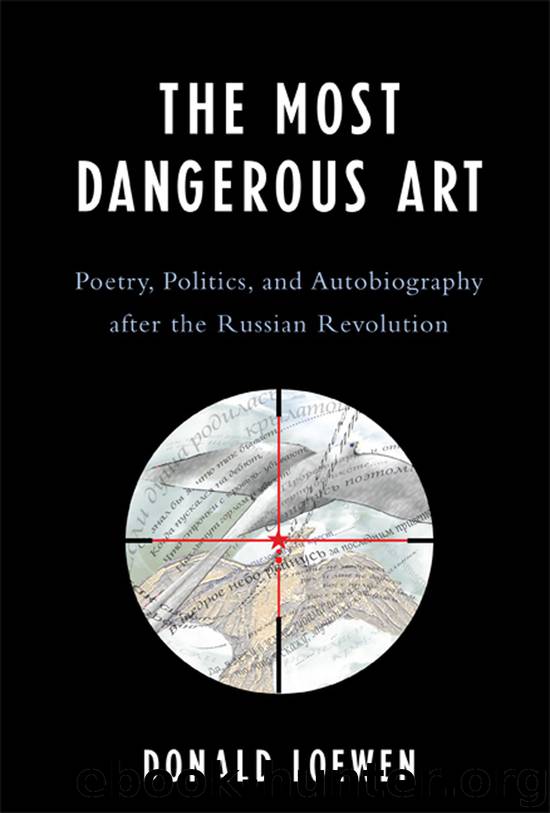
Author:Loewen, Donald;
Language: eng
Format: epub
ISBN: 9780739157909
Publisher: Lexington Books
Having deprived me of seas, of land and air escapes
And having given only violent earth for the foot’s support,
What have you achieved? A brilliant result:
Moving lips you could not take away.74
5
The Poet’s Birthright
If anyone could match the intensity of Mandelstam’s “Fourth Prose” it was Marina Tsvetaeva. When she turned her attention to autobiographical prose in the 1930s, Tsvetaeva approached it with the energy and passion of her best poetry. The result was a prose so essential, so much a renunciation of all superfluity, that no less a critic than Joseph Brodsky said that Tsvetaeva achieved a sharpness of focus greater “than anyone in Russian and, it would seem, world literature.”1 Like Mandelstam and Pasternak, Tsvetaeva used her autobiographical writing to consider what it meant to be a poet in an age when poetry had gone dangerously out of fashion. Tsvetaeva’s circumstances were rather different, however. As an émigré, Tsvetaeva was separated physically from the literary convulsions that threatened poetry in the Soviet Union, and in the late 1920s Tsvetaeva was able to publish poetry that solidified her reputation within the Russian exile communities in Berlin, Prague, Paris and beyond.
But that is only part of the story. Like Pasternak and Mandelstam, Tsvetaeva found that politics and life have a way of breaking into a poet’s world and forcing change. By the early 1930s, she was caught up in a complex blend of government and literary politics that made it increasingly difficult for her to publish her poems. The exile community in Paris included representatives from many of the political and literary movements that had jostled for space before the Revolution and their displacement in a shared exile did not miraculously resolve their differences. Tsvetaeva understood this complexity fully but had little patience for it. She never tried to ally herself with any movement, either literary or political. Instead, she considered it her responsibility to seek justice and to express compassion for the weak and falsely accused, regardless of their political affiliations.
Tsvetaeva’s sometimes blatant disregard for the political implications of what she said and wrote caused consternation and even resentment within the exile community, whose members were both divided and defined by political allegiance. She was impossible to categorize politically, and this ambiguity—together with the kind of poetry she wrote—helped keep her an outsider in the émigré community. Her poetry was considered too “difficult” for easy consumption, especially by the many journal editors for whom literature was only a secondary interest. As a result, Tsvetaeva felt herself increasingly cut off in a dual exile, isolated from her homeland and ignored by most of the substantial Russian émigré population.
Prose became a form of survival for Tsvetaeva, something that she could still publish as a way to earn money and to make her family’s desperate financial situation at least temporarily tolerable. “The emigration is making a prose writer of me,” she wrote to her friend Anna Tesková in November, 1933. “Of course, the prose is also mine, and the best in the world after poetry.
Download
This site does not store any files on its server. We only index and link to content provided by other sites. Please contact the content providers to delete copyright contents if any and email us, we'll remove relevant links or contents immediately.
The Vikings: Conquering England, France, and Ireland by Wernick Robert(84466)
Ali Pasha, Lion of Ioannina by Eugenia Russell & Eugenia Russell(40350)
The Conquerors (The Winning of America Series Book 3) by Eckert Allan W(38301)
The Vikings: Discoverers of a New World by Wernick Robert(37030)
Cecilia; Or, Memoirs of an Heiress — Volume 1 by Fanny Burney(32682)
Cecilia; Or, Memoirs of an Heiress — Volume 2 by Fanny Burney(32040)
Cecilia; Or, Memoirs of an Heiress — Volume 3 by Fanny Burney(32025)
Empire of the Sikhs by Patwant Singh(23164)
The Secret History by Donna Tartt(19387)
Hans Sturm: A Soldier's Odyssey on the Eastern Front by Gordon Williamson(18686)
Cat's cradle by Kurt Vonnegut(15487)
Pimp by Iceberg Slim(14733)
Sapiens: A Brief History of Humankind by Yuval Noah Harari(14498)
Norse Mythology by Gaiman Neil(13498)
Talking to Strangers by Malcolm Gladwell(13487)
Leonardo da Vinci by Walter Isaacson(13438)
4 3 2 1: A Novel by Paul Auster(12557)
Underground: A Human History of the Worlds Beneath Our Feet by Will Hunt(12191)
The Radium Girls by Kate Moore(12127)
