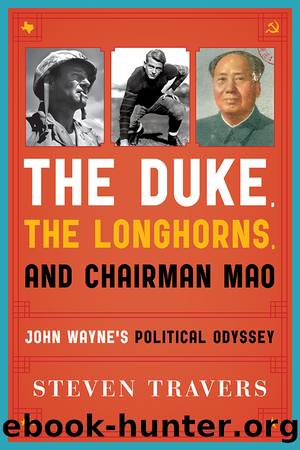
The Duke, the Longhorns, and Chairman Mao by Steven Travers
Author:Steven Travers [Travers, Steven]
Language: eng
Format: epub
Publisher: Taylor Trade Publishing
Published: 2014-01-15T00:00:00+00:00
7
Republican Duke
John Wayne was displeased that his agent, Charlie Feldman, helped Sinatraâs friend, presidential candidate John Kennedy, âfind girlsâ during trips to Los Angeles.
âThe countryâs going soft,â he exclaimed.
He supported Vice President Nixon in his campaign against Kennedy, whom he despised for his âlace curtain arrogance and unctuous liberalism.â He felt Kennedy was just a product of his fatherâs money machine, lacking moral vision, a âsnot-nosed kid who couldnât keep his dick in his pants.â Disgusted when he heard that Kennedy had won a Pulitzer Prize for a book he did not write (Theodore Sorenson penned Profiles in Courage), he paid $152,000 for a full-page advertisement in Henry Luceâs July edition of Life magazine, urging the nation to uphold its traditional values.
The Republicans, staunch defenders of freedom from the communist threat, were called the witch-hunters of McCarthyism, losing the presidential election in 1960, senatorial midterms in 1962, and then virtually everything in 1964. Nixon, who kept a paid Soviet spy, Alger Hiss, from possibly becoming secretary-general of the United Nations, was held in the crosshairs of the left for more than two decades until he was hunted down and disgraced for doing precisely what Attorney General Robert Kennedy did seven years earlier. The newspaper that made Nixon a crusade (the Washington Post), employer of the two reporters (Robert Woodward and Carl Bernstein) who dogged him like Ahab chasing the great white whale, was the same organization that, twelve years earlier, was like the three monkeys who âsee no evilâ when right under their own noses John F. Kennedy, Joseph P. Kennedy, Lyndon Johnson, Mayor Richard Daley, and the Democratic Party stole the 1960 presidential election from Nixon (âThey stole it fair and square,â Nixon aide Murray Chotiner famously said in Oliver Stoneâs Nixon).
John Kennedy in the White House and the rise of the civil rights movement added luster to Hollywood liberalism. The cultural critics âcontinued to rise.â The American right bided its time.
Boston Red Sox legend Ted Williams retired from baseball a little over a month before Kennedy was elected. This represented a true changing of the guard, one Boston superstar stepping aside after a lifetime of sports accomplishment, matched by few, if any, while a new Bostonian ascended to the Oval Office.
Williams had feuded with the Boston press for twenty-one years. They hounded him for not visiting his mother in the off-season, for fishing in the Florida Keys when his wife was giving birth, for not joining the military as fast as Bob Feller, for not tipping his cap, for spitting in the wind, and for arguing with writers. Williams had joined the military. Unlike Joe DiMaggio, who played baseball in Hawaii, or Willie Mays, who set stateside camp home-run records for the U.S. Army team during the Korean War, Williams signed on as a marine fighter pilot. The odds of even making it past flight school were long, but they needed pilots and took men who had not gone to college (like George H. W. Bush, a Connecticut prep school graduate who did not play baseball at Yale until after the war).
Download
This site does not store any files on its server. We only index and link to content provided by other sites. Please contact the content providers to delete copyright contents if any and email us, we'll remove relevant links or contents immediately.
Cecilia; Or, Memoirs of an Heiress — Volume 2 by Fanny Burney(31944)
Cecilia; Or, Memoirs of an Heiress — Volume 3 by Fanny Burney(31929)
Fanny Burney by Claire Harman(26597)
We're Going to Need More Wine by Gabrielle Union(19034)
Plagued by Fire by Paul Hendrickson(17405)
All the Missing Girls by Megan Miranda(15954)
Cat's cradle by Kurt Vonnegut(15335)
Bombshells: Glamour Girls of a Lifetime by Sullivan Steve(14057)
For the Love of Europe by Rick Steves(13907)
Leonardo da Vinci by Walter Isaacson(13316)
4 3 2 1: A Novel by Paul Auster(12375)
The remains of the day by Kazuo Ishiguro(8975)
Adultolescence by Gabbie Hanna(8922)
Note to Self by Connor Franta(7663)
Diary of a Player by Brad Paisley(7559)
Giovanni's Room by James Baldwin(7326)
What Does This Button Do? by Bruce Dickinson(6195)
Ego Is the Enemy by Ryan Holiday(5413)
Born a Crime by Trevor Noah(5375)
