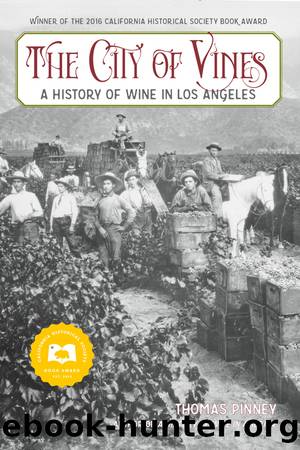
The City of Vines by Thomas Pinney
Author:Thomas Pinney [Pinney, Thomas]
Language: eng
Format: epub
ISBN: 9781597143981
Published: 0101-01-01T00:00:00+00:00
LEAVING THE CITY
A large quantity of wine was made in the city of Los Angeles after 1890, but not much of it from grapes grown there. The rising pressures of urban development meant that Los Angeles wine was, increasingly, wine from the county, not the city. To the south of Los Angeles the town of Downey was a minor center of winemaking. John Downey, governor of California from 1860 to 1862, in 1865 had subdivided the Santa Gertrudis Ranch and named the town for himself. He also grew grapes and made wineâan estimated 50,000 gallons in 1868.29 So the town was born to wine. In the â90s there was a scattering of vineyards around Downey, and an Italian named Monteleone making wine there; but the big enterprise was the Downey Vintage Company, also known as the F. B. Weis Winery, after its founder. Weis died in 1894, but the winery continued to be operated by his widow, Margaret. In 1902 she is reported as planning a crush of some 2,000 tonsâenough to yield 300,000 gallons of wine, mostly fortified. In the next year, however, after reportedly planning to add another 50 acres to her vineyards, she announced that she would make no more wine but would, in order to make more money, sell her grapes to others.30 Santa Fe Springs, not far from Downey, also had four or five vineyards in the â90s; Artesia had even more, but there does not appear to have been any winemaking carried on in these two southern suburbs except at the Artesia Vineyard Company and the Santa Fe Winery.
The main action lay to the north and east of Los Angeles. Burbank (one of the new towns created by the boom of the â80s) had attracted a number of Italians: Matteo Brusso, Giovanni Gai, John Grangetto, and J. Randisi, all winemakers. Not far away, at West Glendale, Charles Pironi had his vineyard and winery. The scene was not wholly Italian. The biggest of the Burbank wineries began with the partnership of three Irishmen: John McClure, John Kenealy, and Richard Dillon. They were associated in business as dry goods merchants in Los Angeles but were interested in the possibilities of winegrowing. In 1878 they took out, under the homestead law, 160 acres of raw land from the government at what was then called Roscoe and is now Sun Valley, over the Verdugo Hills north of Burbank. The vineyard that McClure planted prospered, a winery was built, and in 1886 the dry goods store was sold; the three Irishmen were now known as winemakers.31 The vineyard was not irrigated, and although L. J. Rose had almost twenty years earlier shown that grapes would succeed without irrigation in Los Angeles County, McClureâs example was regarded as something new. A Los Angeles paper described the âviticultural experimentâ thus:
Download
This site does not store any files on its server. We only index and link to content provided by other sites. Please contact the content providers to delete copyright contents if any and email us, we'll remove relevant links or contents immediately.
The Vikings: Conquering England, France, and Ireland by Wernick Robert(84474)
Ali Pasha, Lion of Ioannina by Eugenia Russell & Eugenia Russell(40355)
The Conquerors (The Winning of America Series Book 3) by Eckert Allan W(38356)
The Vikings: Discoverers of a New World by Wernick Robert(37033)
Cecilia; Or, Memoirs of an Heiress — Volume 1 by Fanny Burney(32686)
Cecilia; Or, Memoirs of an Heiress — Volume 2 by Fanny Burney(32046)
Cecilia; Or, Memoirs of an Heiress — Volume 3 by Fanny Burney(32029)
Empire of the Sikhs by Patwant Singh(23167)
The Secret History by Donna Tartt(19395)
Hans Sturm: A Soldier's Odyssey on the Eastern Front by Gordon Williamson(18688)
Cat's cradle by Kurt Vonnegut(15493)
Pimp by Iceberg Slim(14739)
Sapiens: A Brief History of Humankind by Yuval Noah Harari(14506)
Norse Mythology by Gaiman Neil(13506)
Talking to Strangers by Malcolm Gladwell(13494)
Leonardo da Vinci by Walter Isaacson(13444)
4 3 2 1: A Novel by Paul Auster(12561)
Underground: A Human History of the Worlds Beneath Our Feet by Will Hunt(12192)
The Radium Girls by Kate Moore(12134)
