Talk on the Wild Side: Why Language Can't Be Tamed by Lane Greene
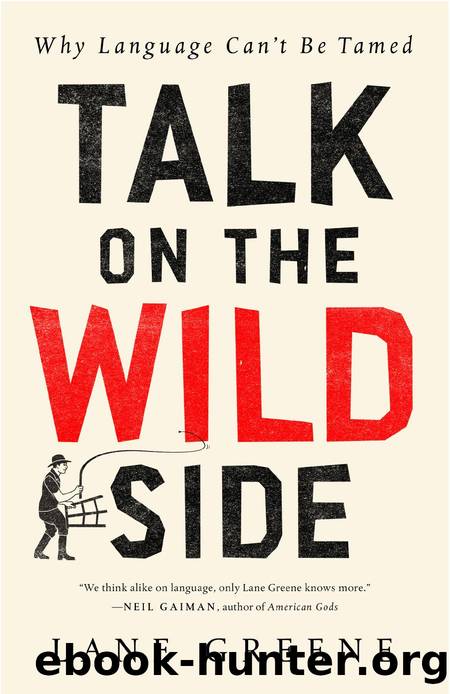
Author:Lane Greene
Language: eng
Format: mobi
ISBN: 9781610398336
Publisher: The Economist
Published: 2018-11-06T00:00:00+00:00
* * *
Buxom, but never nice 113
People who learn Chinese describe two big challenges in doing so.
One is the incredibly difficult script of the written language. Learners
must memorise thousands of characters for basic literacy, and even
this will leave them turning to a dictionary over and over to read an
everyday text like a newspaper article. It is safe to say that this is one of
the most fiendishly complicated writing systems ever devised. It has
its defenders, mostly proud Chinese themselves â but not even they
would call it straightforward and easy.
The other big challenge with Chinese comes not in writing but in
speech: tones. Mandarin, the most common spoken variety, has four
tones â level, rising, dipping and falling pitch â over the course of
pronouncing a vowel. To Chinese-speakers, tone is as important for
meaning as vowel quality is in English; you can no more mix up shÃ
and shì and expect to be understood than an English-speaker can mix
up âbitâ and âbeetâ. Tones are crucial to the system, and a nightmare for
most Western learners.
But, says the enervated Chinese learner, once youâve got a grip on
the tones, and once youâve got a basic vocabulary built up, there comes
a strange and happy surprise. Many people put it starkly: Chinese has
âno grammarâ. Unlike, say, French or Italian, which require you to
memorise bucketloads of endings to form a past tense or a subjunctive,
or German, which requires the mastery of a syntax that can leave verbs
at the very end of hugely long clauses, Chinese seems simple. Itâs just
word word word word word.
Can it really be that Chinese is so childish, though? How did such
a sophisticated and ancient culture get built with a language that
foreigners describe as being as simple as snapping Legos together?
The answer is that of course itâs not really all that simple, itâs just that
Chinese puts its complexity in different places; namely, it doesnât have
all those endings that make acquiring Latin and Greek, German and
Russian a long slog of memorisation.
For example, there is no obligatory marking of plurals in Chinese:
, transcribed as qìchÄ and pronounced like âtchee-cherâ, can mean
âcarâ or âcarsâ. (This can be shortened to just
, chÄ, too.) How on earth,
then, do the Chinese know how many cars someoneâs got? Simple: they
use context, plus a few simple strategies for clearing up ambiguity
where context isnât enough: wÅ yÎ u chÄ, said with no other context
Download
This site does not store any files on its server. We only index and link to content provided by other sites. Please contact the content providers to delete copyright contents if any and email us, we'll remove relevant links or contents immediately.
Whiskies (Collins Gem) by dominic roskrow(45548)
Spell It Out by David Crystal(36252)
Cecilia; Or, Memoirs of an Heiress — Volume 1 by Fanny Burney(32746)
Cecilia; Or, Memoirs of an Heiress — Volume 2 by Fanny Burney(32106)
Cecilia; Or, Memoirs of an Heiress — Volume 3 by Fanny Burney(32089)
Beautiful Disaster by McGuire Jamie(25474)
Trainspotting by Irvine Welsh(22023)
Chic & Unique Celebration Cakes by Zoe Clark(20177)
The Secret History by Donna Tartt(19502)
How High Can a Kangaroo Hop? by Jackie French(18862)
Twilight of the Idols With the Antichrist and Ecce Homo by Friedrich Nietzsche(18793)
All the Missing Girls by Megan Miranda(16809)
Cat's cradle by Kurt Vonnegut(15583)
Ready Player One by Cline Ernest(15169)
For the Love of Europe by Rick Steves(14997)
Fifty Shades Freed by E L James(13373)
4 3 2 1: A Novel by Paul Auster(12638)
Crooked Kingdom: Book 2 (Six of Crows) by Bardugo Leigh(12469)
Grundlagen Kreatives Schreiben (German Edition) by Helfferich Pia(10527)
