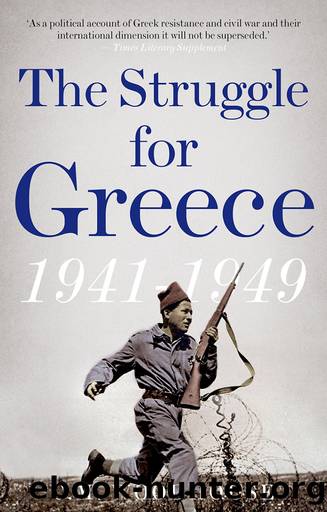
Struggle for Greece : 1941 - 1949 (9781787382558) by Woodhouse C. M
Author:Woodhouse, C. M.
Language: eng
Format: epub
Publisher: Oxford Univ Pr
Published: 2018-11-15T00:00:00+00:00
Captured guerrilla weapons.
Greek Army entrenchments, Karpenisi, 1948.
Final assault on Vitsi, August 1949.
Bust of General Van Fleet, unveiled at Kastoria, 1951.
The most constructive efforts to promote reconciliation were made in the field of trade-union organisation. This problem went to the heart of Greek politics, for the General Confederation of Greek Workers (GSEE) was divided on essentially political lines.45 The leadership of EEAM, though dominated by the Communists Theos and Nepheloudis, also included Reformists like Kalomoiris and Stratis, and even supporters of right-wing parties like Photis Makris. Outside EEAM there were both Reformists and survivors of the paternalist organisation of the era of Metaxas. After Citrine's mission at the end of January had made some progress in healing the divisions left open by the December events, he agreed to send a further mission under his deputy, Vincent Tewson, to complete the task. Tewson arrived in Athens towards the end of February, expecting to supervise the election of a new Executive and Secretariat, but he found a state of embittered deadlock. The elections were never held. Instead, Tewson negotiated a second agreement on 25 February, and left behind his junior colleague, Victor Feather, who negotiated a third agreement on 28 February. The effect was to recognise the new provisional Executive and Secretariat which had been installed by Plastiras's Minister of Labour in January. But although all the agreements were given legislative sanction by the Government in March, they were not recognised by the Communists, who still dominated the trade unions outside Athens.
The political importance of Greece was shown even more emphatically by the visits of Churchill twice, Eden three times, and Macmillan at least half a dozen times in the first six months of liberation. The financial problems of the country attracted the services of several outstanding officials from the Treasury. In many other official and semi-official fieldsâfor example, the British Council and the Press and Information Officesâpersonal appointments were made which were appreciated by the Greeks as a recognition of their standing in the allied world. On the other hand, the narrow mediocrity of the staffs available to Scobie and Leeper, at least until it was too late, was in striking contrast. It suggested that Greece had not been expected to present either military or diplomatic problems, which was a serious error of judgment.
A wide range of technical missions operated in Greece. Military Liaison, under a British general, co-ordinated relief supplies until UNRRA could begin operations. There were training and supply missions to each of the armed services. There was a police mission, a financial mission, a Co-operative Society mission and later a legal mission. All of these aimed to make possible a peaceful reconstruction of Greek life, avoiding recrimination and revenge. They consistently discouraged all provocation of the Left. The police mission, for example, declined to allow the Greek police to be armedâalthough the head of the mission came from the only armed police force in the United Kingdom, the Royal Ulster Constabulary. British troops frequently intervened to curb the excesses of anti-Communist bands.
Download
This site does not store any files on its server. We only index and link to content provided by other sites. Please contact the content providers to delete copyright contents if any and email us, we'll remove relevant links or contents immediately.
The Vikings: Conquering England, France, and Ireland by Wernick Robert(84476)
Ali Pasha, Lion of Ioannina by Eugenia Russell & Eugenia Russell(40355)
The Conquerors (The Winning of America Series Book 3) by Eckert Allan W(38412)
The Vikings: Discoverers of a New World by Wernick Robert(37033)
Cecilia; Or, Memoirs of an Heiress — Volume 1 by Fanny Burney(32687)
Cecilia; Or, Memoirs of an Heiress — Volume 2 by Fanny Burney(32046)
Cecilia; Or, Memoirs of an Heiress — Volume 3 by Fanny Burney(32030)
Empire of the Sikhs by Patwant Singh(23167)
The Secret History by Donna Tartt(19398)
Hans Sturm: A Soldier's Odyssey on the Eastern Front by Gordon Williamson(18689)
Cat's cradle by Kurt Vonnegut(15494)
Pimp by Iceberg Slim(14742)
Sapiens: A Brief History of Humankind by Yuval Noah Harari(14507)
Norse Mythology by Gaiman Neil(13507)
Talking to Strangers by Malcolm Gladwell(13494)
Leonardo da Vinci by Walter Isaacson(13444)
4 3 2 1: A Novel by Paul Auster(12563)
Underground: A Human History of the Worlds Beneath Our Feet by Will Hunt(12192)
The Radium Girls by Kate Moore(12135)
