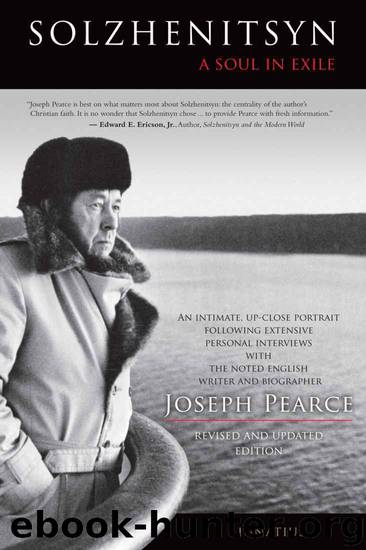
Solzhenitsyn by Joseph Pearce
Author:Joseph Pearce [Pearce, Joseph]
Language: eng
Format: mobi, epub
Tags: Spiritual & Religion
ISBN: 9781586174965
Publisher: Ignatius Press
Published: 2011-04-15T04:00:00+00:00
CHAPTER THIRTEEN
“I FEEL SORRY FOR RUSSIA”
During 1969, the West continued to court Solzhenitsyn. His books were selling strongly in Europe and America, and Western publishers were clamoring and competing for new translations of his work. Two of his plays, Candle in the Wind and The Love Girl and the Innocent, were published in Frankfurt and London, respectively. Scarcely did the liberal intelligentsia in the West suspect that Solzhenitsyn, far from being a champion of Western values, was as little enamored of capitalist consumerism as he was of communist totalitarianism.
His own views were still developing at this time, but they sprang from Russian tradition and had little in common with the materialism that was in the ascendancy in Europe and the United States. Rooted in the spiritual struggles in the camps, Solzhenitsyn’s central belief was in selfless self-limitation as opposed to the selfish gratification of needless wants. As he watched Russians gorging themselves on gadgets and other consumer goods, taking their lead from the West, he felt a sense of nausea. This was not what life was about.
It was only a matter of time before his views brought him into conflict not only with his old enemies in the communist hierarchy but with his old friends among the liberal dissidents. The conflict came to a head in September 1969 when Solzhenitsyn’s differences with the editors of Novy Mir were made public. The cause of the dispute was a polemical debate that Novy Mir had been conducting with the monthly magazine Molodaya Gvardia (Young Guard). The disagreement arose from two articles by the literary critic Victor Chalmayev, published the previous year in Molodaya Gvardia. Chalmayev’s views were dubbed “National Bolshevik” by his opponents and were essentially a reactionary mishmash of garbled Marxism and Russian patriotism, a confusion of mutually contradictory premises. Chalmayev had denounced the West as being hopelessly corrupt and degenerate, “choking on a surfeit of hate” and the fount of all evil. Attempting to build bridges with it by importing its technology or, even worse, its consumer goods or its culture would be both wrong and dangerous. The only result would be that the West’s poison would spread to the East. Compared with the corrupt decadence of the West, the traditions of Russia were pure and ethical, fed by a “sacred spring”. In recent years, this Russian spirit had degenerated under the trivializing impact of Western imports such as television, cinema, and the mass media, but it could be revitalized by returning to its roots, drawing inspiration from the Russian village, the moral and spiritual values of the Russian people, and the pure idioms of popular speech. Chalmayev referred mystically to the sacramental power of the native soil and even invoked Holy Russia with her “saints and just men born of a yearning for miracles and loving kindness”. All this, Chalmayev asserted in a bizarre leap of logic, had culminated in the glorious Russian Revolution, that “sacramental act” which was the finest expression and the crowning moment in a thousand years of Russian history.
Download
This site does not store any files on its server. We only index and link to content provided by other sites. Please contact the content providers to delete copyright contents if any and email us, we'll remove relevant links or contents immediately.
Cecilia; Or, Memoirs of an Heiress — Volume 2 by Fanny Burney(31928)
Cecilia; Or, Memoirs of an Heiress — Volume 3 by Fanny Burney(31915)
Fanny Burney by Claire Harman(26581)
We're Going to Need More Wine by Gabrielle Union(19020)
Plagued by Fire by Paul Hendrickson(17391)
All the Missing Girls by Megan Miranda(15888)
Cat's cradle by Kurt Vonnegut(15295)
Bombshells: Glamour Girls of a Lifetime by Sullivan Steve(14037)
For the Love of Europe by Rick Steves(13809)
Leonardo da Vinci by Walter Isaacson(13291)
4 3 2 1: A Novel by Paul Auster(12354)
The remains of the day by Kazuo Ishiguro(8945)
Adultolescence by Gabbie Hanna(8902)
Note to Self by Connor Franta(7656)
Diary of a Player by Brad Paisley(7539)
Giovanni's Room by James Baldwin(7299)
What Does This Button Do? by Bruce Dickinson(6185)
Ego Is the Enemy by Ryan Holiday(5390)
Born a Crime by Trevor Noah(5354)
