Saul Bellow's Heart by Bellow Greg
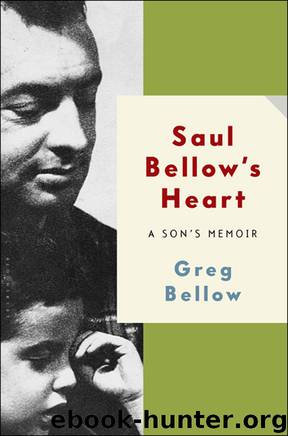
Author:Bellow, Greg [Bellow, Greg]
Language: eng
Format: epub
Tags: Literature, Biography, Non Fiction
Publisher: Bloomsbury USA
Published: 2013-04-26T06:00:00+00:00
“OLD SAUL”:
THE LITERARY PATRIARCH
Chapter Eight
A Failure at Spirituality: 1977–86
After the festivities in Stockholm, Saul was particularly fatigued in spirit when he returned to Chicago. Even the spiritual ideas of Rudolf Steiner, the Austrian philosopher Saul had studied for a number of years, who held complex notions about the possibility of an expanded consciousness that continued after physical death, were proving insufficient to ward off his deepening pessimism.
Steiner claimed to be a clairvoyant and had developed a theory of an evolving consciousness that included individual and collective memories as well as past, present, and, most crucial to Saul, future lives. The possibility of spiritual self-improvement offered Saul a way to try to cleanse his soul, an antidote to the contamination wrought by fame and fortune. My father found little solace in organized religion, but he had a lifelong preoccupation with death. Steiner claimed that anyone who takes the time and effort to develop their faculties can gain such expanded capacities. In private, Saul put Steiner’s meditative techniques into regular practice for years. Steiner’s books were all over his apartment, left open and upside down, as if he had just paused after reading a passage.
At Saul’s recommendation I read a few of Steiner’s complex books and it became clear to me that the idea of the human soul returning, over and over, in a more refined state of enlightenment held a great appeal to a man left bereft and lonely after the loss of family and friends. As his interest in Steiner deepened, the phrase inner life came to be replaced by the human soul in our conversations, and he infused the term with a spiritual component that convinced me he had come to believe in the soul’s immortality. This made me uneasy; I was more comfortable with the idea of a self without transcendental aspects. However, unlike our other disagreements where my father tried to prevail, he was perfectly tolerant of my resistance. I always suspected that Saul’s uncharacteristic lack of argumentative ardor reflected his lingering doubts about spirituality.
Saul could not have chosen a greater challenge to his logical abilities than to convince himself of Steiner’s ideas about a spiritual life after physical death. The doubts Saul and I shared about what could be explained, including the limits we found in logic, cemented our relationship. I found that view confirmed in several revealing conversations soon after my fortieth birthday. I expressed a brief interest in philosophy and asked Saul to recommend some readings to me, which pleased him. I became puzzled by what seemed to me Hegel’s logical contradiction about Napoleon and the end of history, and asked Saul to explain it. He replied, “These guys [philosophers] just think themselves into corners they can’t get out of.”
I found our shared skepticism about how great thinkers are removed from life’s everyday problems most clearly exemplified near the end of The Adventures of Augie March. On a sea voyage Augie meets Bateshaw, a philosophical shipmate preoccupied with abstract theories about improving the human condition.
Download
This site does not store any files on its server. We only index and link to content provided by other sites. Please contact the content providers to delete copyright contents if any and email us, we'll remove relevant links or contents immediately.
Cecilia; Or, Memoirs of an Heiress — Volume 2 by Fanny Burney(32090)
Cecilia; Or, Memoirs of an Heiress — Volume 3 by Fanny Burney(32067)
Fanny Burney by Claire Harman(26730)
We're Going to Need More Wine by Gabrielle Union(19172)
Plagued by Fire by Paul Hendrickson(17541)
All the Missing Girls by Megan Miranda(16722)
Cat's cradle by Kurt Vonnegut(15558)
For the Love of Europe by Rick Steves(14921)
Bombshells: Glamour Girls of a Lifetime by Sullivan Steve(14220)
Leonardo da Vinci by Walter Isaacson(13520)
4 3 2 1: A Novel by Paul Auster(12623)
The remains of the day by Kazuo Ishiguro(9225)
Adultolescence by Gabbie Hanna(9022)
Note to Self by Connor Franta(7753)
Diary of a Player by Brad Paisley(7720)
Giovanni's Room by James Baldwin(7553)
What Does This Button Do? by Bruce Dickinson(6316)
Ego Is the Enemy by Ryan Holiday(5634)
Born a Crime by Trevor Noah(5490)
