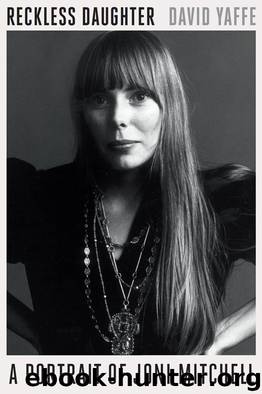
Reckless Daughter by David Yaffe
Author:David Yaffe
Language: eng
Format: epub
Publisher: HarperCollins Canada
Published: 2017-09-07T04:00:00+00:00
20 HEJIRA AND THE ART OF LOSING
The art of losing isn’t hard to master; so many things seem filled with the intent to be lost that their loss is no disaster,” wrote Elizabeth Bishop in the poet’s final volume, published in 1976. Joni’s music seemed, from the very beginning, to capture this uneasy truth, how quickly life teaches us to get good at the art of losing, how many things—places, and people, as well as beloved possessions—seem filled with the intent to be lost. For Joni, 1976 was a year to master the art of losing more and more. She had already given up her daughter, left lovers in the dust, and abandoned a two-month tour that was supposed to go much longer. One thing she was certain she needed to lose was her ego—that beast fed and inflated by cocaine.
You don’t know what you’ve got till it’s gone, she’d already told us, yet she wasn’t done losing. There was so much yet to be lost in the future: her entire soprano range, much of her audience, her critical grace. Starting with The Hissing of Summer Lawns, some of the reviews were becoming increasingly obtuse, the more adventurous she became. Joni was in the sweepstakes to lose big; the higher the art, the greater the loss. Indeed, for Joni, loss often is where the creativity starts. It had been this way ever since polio robbed her of her dreams of being an athlete. In her childhood, when Joni returned from the ward and found she was no longer picked first for the teams, she turned inward and eventually found that she was an artist. A Joni Mitchell without polio might well have been a Joni Mitchell who could never reach the depths and darkness of Blue.
Running out on her Hissing of Summer Lawns tour was a loss of a different kind, certainly a financial loss for the members of the L.A. Express (and for her, of course). And yet those months of free time—first with fellow travelers, then on her own—led to discoveries that might have never happened if life went on as planned. And they certainly would not have led to the perfect storm of Hejira (1976), an album that is as loved by her most ardent fans as Blue, and sometimes makes it to the very top of various lists of favorite Joni Mitchell albums. Perry Meisel, an NYU English professor, slammed Hejira in the pages of The Village Voice for failing to live up to Freud and literary theory. Meisel becomes worked up about her look, reminds everyone about the Rolling Stone smear, and disses her clothes before ripping apart her language:
Hejira presents the Queen of El Lay more explicitly in the guise of a poet than ever before, festooned with cape, beret, slanted pinky, and the backdrop of a resolutely abstract landscape. Well, that’s the way poets are supposed to look, I guess, and Mitchell’s (self-)portrait here seems to be a little too aware of that.
Download
This site does not store any files on its server. We only index and link to content provided by other sites. Please contact the content providers to delete copyright contents if any and email us, we'll remove relevant links or contents immediately.
Cecilia; Or, Memoirs of an Heiress — Volume 2 by Fanny Burney(31959)
Cecilia; Or, Memoirs of an Heiress — Volume 3 by Fanny Burney(31945)
Fanny Burney by Claire Harman(26607)
We're Going to Need More Wine by Gabrielle Union(19052)
Plagued by Fire by Paul Hendrickson(17417)
All the Missing Girls by Megan Miranda(16050)
Cat's cradle by Kurt Vonnegut(15365)
For the Love of Europe by Rick Steves(14172)
Bombshells: Glamour Girls of a Lifetime by Sullivan Steve(14081)
Leonardo da Vinci by Walter Isaacson(13341)
4 3 2 1: A Novel by Paul Auster(12403)
The remains of the day by Kazuo Ishiguro(9004)
Adultolescence by Gabbie Hanna(8930)
Note to Self by Connor Franta(7673)
Diary of a Player by Brad Paisley(7587)
Giovanni's Room by James Baldwin(7352)
What Does This Button Do? by Bruce Dickinson(6210)
Ego Is the Enemy by Ryan Holiday(5455)
Born a Crime by Trevor Noah(5385)
