Plato's Arguments for Forms by Robert William Jordan;
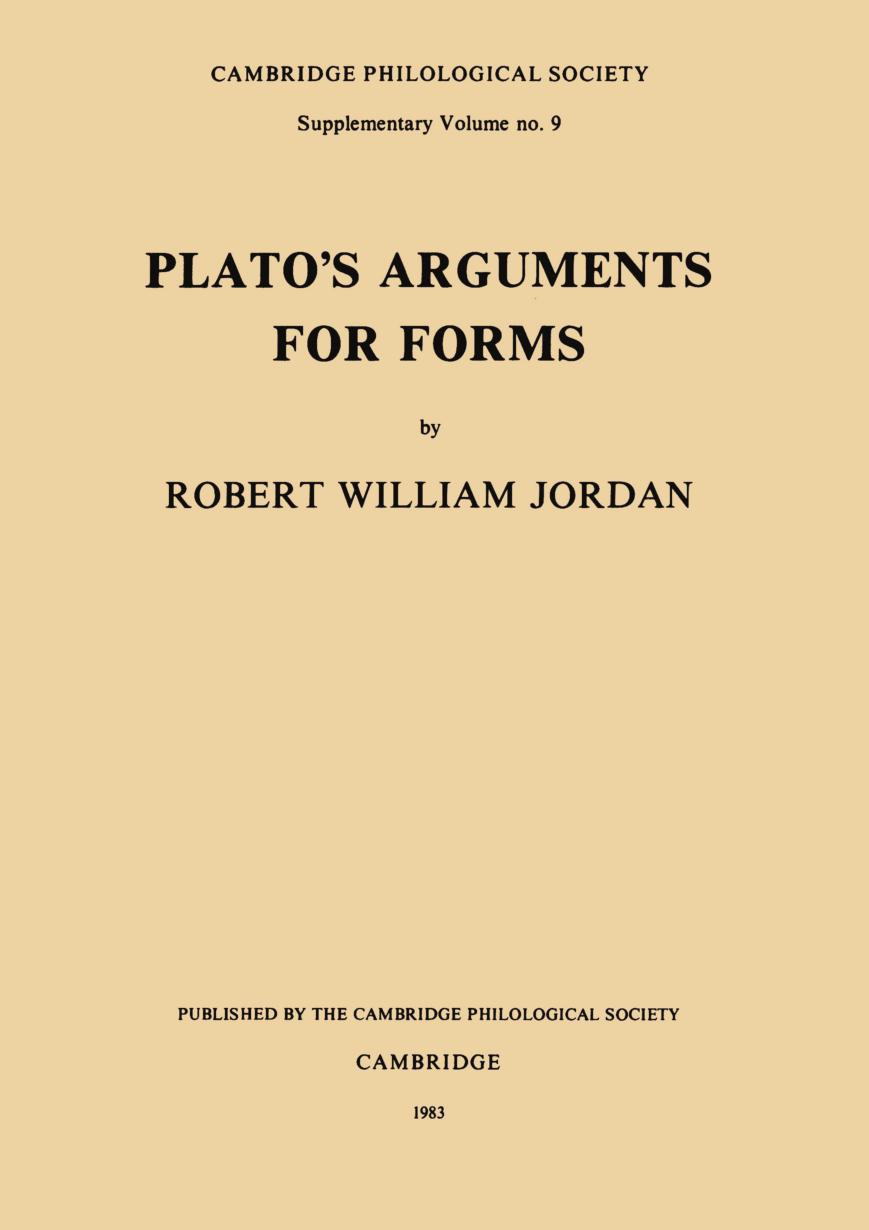
Author:Robert William Jordan;
Language: eng
Format: epub, pdf
Tags: -
Publisher: Casemate Publishers & Book Distributors, LLC
NOTES
1. Aristotleâs Metaphysics 193.
2. Ross 193. Hardie also says that these two passages state âarguments along similar linesâ (13).
3. Aristotleâs Metaphysics Books M and N 153.
4. This point is noticed by Fine, âKnowledge and Belief in Republic Vâ 137 and n. 22.
5. âPlatoâs Distinction between Being and Becomingâ 83.
6. âA Proof in the Peri IdeoÉ 307-8.
7. Gosling, Plato, see esp. 156, 175 and 188; Vlastos, âA Metaphysical Paradoxâ 54. For Vlastos, âPlato recognizes only one kind of knowledgeâ, âDegrees Of Realityâ 73.
8. Gosling, Plato 142.
9. On âpatterns of becomingâ, see Bolton 72-4.
10. Irwinâs view is also set out briefly in his Platoâs Moral Theory.
11. Platoâs Moral Theory 148.
12. âPlatoâs argument for Forms did not rely ⦠on s-change in the sensible worldâ. âPlatoâs Heracliteanismâ 12.
13. âPlatoâs Heracliteanismâ 6.
14. Cf. Bolton 74-6.
15. See 357 n. 1.
16. Boltonâs reconstruction of the argument has the advantage that it renders the argument valid; but it has the very considerable disadvantage that it requires us to read âfalse beliefâ for âbeliefâ throughout (see 77, esp. n. 24).
17. See Annas 153.
18. Owen, âProof 308.
19. Gosling, âDoxa and Dynamis in Platoâs Republicâ 121; Murphy, Platoâs Republic 105.
20. Fine (137 n. 22) makes the point that we must supply the premiss âthere is knowledgeâ for the argument to be valid. She compares here not only Timaeus 51 d, but also Parmenides 135ac. We may also compare Phaedo 74b2, where, as we saw in chapter 1, Socrates simply expects his interlocutor to agree that we have knowledge of the equal.
21. Gosling, âDoxa and Dynamisâ 129. Fine (125) rightly makes the point that other interpretations violate the condition of uncontroversiality. Kahn prefers to translate is-v by âis the caseâ, rather than âis trueâ; but nothing hangs on this for our present purposes.
22. Gosling, âDoxa and Dynamisâ 127, regards this passage as simply confused. Fineâs attempt to construe ânothingâ as ânothing trueâ (131) is most implausible. It may indeed be the case, as she claims, that if I maintain that âjustice is a vegetableâ, this âdoes not amount to a claim about justice at all; it displays total ignorance of justiceâ. But she has made no attempt to come to terms with what Plato says here about believing one thing and believing no thing. Yet this is one of the main reasons for supposing is-e in play here.
23. See Kahn 121.
24. This is the point in the argument at which Plato moves from talking about opposites (beautiful and its opposite, and so on) to talking about being and not being (beautiful and so on).
25. Thus Vlastos turns at this point to the Symposium for elucidation of this (âDegrees of Realityâ 66).
26. Owen, âProof 307 n. 1. See too Murphy, esp. 110-1. Plato does, however, mention that Forms are unchanging at 479a2-3.
27. âRepublic V: Ta Polla Kalaâ 125.
28. âJ. Gosling on Ta Polla Kalaâ 128.
29. See 129-30.
30. Moravesik writes âtemporal being is not complete being, what is temporal, both is and is notâ (11). F. C. White, âThe Phaedo and Republic V on Essencesâ 154, inadvertently points to one reason why Plato may emphasize change through time.
Download
Plato's Arguments for Forms by Robert William Jordan;.pdf
This site does not store any files on its server. We only index and link to content provided by other sites. Please contact the content providers to delete copyright contents if any and email us, we'll remove relevant links or contents immediately.
The Vikings: Conquering England, France, and Ireland by Wernick Robert(84384)
Ali Pasha, Lion of Ioannina by Eugenia Russell & Eugenia Russell(40320)
The Conquerors (The Winning of America Series Book 3) by Eckert Allan W(37984)
The Vikings: Discoverers of a New World by Wernick Robert(37007)
Cecilia; Or, Memoirs of an Heiress — Volume 1 by Fanny Burney(32638)
Cecilia; Or, Memoirs of an Heiress — Volume 2 by Fanny Burney(32013)
Cecilia; Or, Memoirs of an Heiress — Volume 3 by Fanny Burney(31997)
Empire of the Sikhs by Patwant Singh(23137)
The Secret History by Donna Tartt(19311)
Hans Sturm: A Soldier's Odyssey on the Eastern Front by Gordon Williamson(18651)
Cat's cradle by Kurt Vonnegut(15446)
Pimp by Iceberg Slim(14680)
Sapiens: A Brief History of Humankind by Yuval Noah Harari(14465)
Norse Mythology by Gaiman Neil(13459)
Talking to Strangers by Malcolm Gladwell(13445)
Leonardo da Vinci by Walter Isaacson(13413)
4 3 2 1: A Novel by Paul Auster(12519)
Underground: A Human History of the Worlds Beneath Our Feet by Will Hunt(12146)
The Radium Girls by Kate Moore(12096)
