Passion for History: Conversations With Denis Crouzet by Natalie Zemon Davis & Denis Crouzet
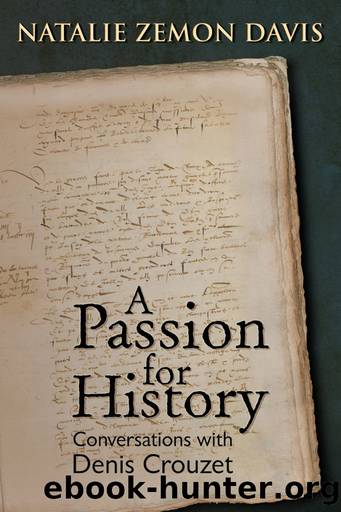
Author:Natalie Zemon Davis & Denis Crouzet [Davis, Natalie Zemon & Crouzet, Denis]
Language: eng
Format: epub
Tags: Historiography, Judaism, General, History/Non-Fiction, History, World, Religion
ISBN: 9781935503576
Google: MwtDEAAAQBAJ
Publisher: PennStateUP
Published: 2010-01-25T21:01:36.961641+00:00
DC: Yes, but they havenât met with the same startling enthusiasm that greeted them in the United States, or at least not yet. Whether thatâs a good or a bad thing, I wonât say.
NZD: Queer theory takes French post-structuralism and deconstruction as important ancestors, so it should have French echoes! Queer theory goes well beyond earlier approaches to the history of sexuality, in which sexual practices and identities were thought of as partly constructed over time and related to different historical milieux. The main debates in the 1970s and 1980s concerned the amount of construction: how much input was there from biology? Was there an identifiable current of, say, homoerotic culture in the West from antiquity on? But whatever the fluidity in sexual practices and identities, the binary of heterosexuality/homosexuality was the main frame.
Queer theory effaces that binary. It argues for no ânaturalâ or biologically determined sexuality. Oneâs DNA has no necessary consequences for oneâs identity or oneâs sexual preference or practices. Iâm not sure how psychoanalytic theory plays into queer theory, but you can see that it argues for particularity and particular choices. To me, it seems a reaction in gay studies to the kind of routine repeating of questions and approaches that I mentioned as a danger in the history of women and gender. In that sense, queer theory has cleared the air and challenged historiographical categories, and it has prompted some interesting writing in philosophical and literary criticism. But itâs hard to see how its radical and individualist particularity can be a practical guide to historians, who really do need to look at the play of culture and social experience in defining possibilities in a particular period. And some recent work by geneticists and specialists on infant physiology is showing a whole new way to think of the nature/nurture binaryâmuch more porousness and interchange between genetic codes and life experience than believed before.
DC: I would like to ask you the following question: In France, despite the big projects to which youâve contributed, such as the Histoire des femmes, directed by Georges Duby and Michelle Perrot, there doesnât exist as strong a commitment to the history of women, perhaps because of certain methodological shortcomings.28 Take, for example, the awkward translation of âgenderâ as genre. There have been noteworthy works for sure, butâperhaps because French university life has been and remains more or less secretly misogynisticâthere still hasnât been a truly original work, properly speaking, for the early modern period. We could cite Ãliane Viennotâs book, but it remains very much a classic in the sense you spoke of earlier, because it treated Queen Margotâ¦
NZD: A very good book!
DC: Certainly, but itâs worth pointing out that itâs a work of a historian of literature. Tell me precisely what you see it contributes, if anything, in terms of methodology.
NZD: Methodological shortcomings of the history of women? I donât think thatâs the issue in France, for there are, as Iâve just tried to suggest, several ways in which the history of women and gender can be practiced.
Download
This site does not store any files on its server. We only index and link to content provided by other sites. Please contact the content providers to delete copyright contents if any and email us, we'll remove relevant links or contents immediately.
The Vikings: Conquering England, France, and Ireland by Wernick Robert(84417)
Ali Pasha, Lion of Ioannina by Eugenia Russell & Eugenia Russell(40332)
The Conquerors (The Winning of America Series Book 3) by Eckert Allan W(38001)
The Vikings: Discoverers of a New World by Wernick Robert(37022)
Cecilia; Or, Memoirs of an Heiress — Volume 1 by Fanny Burney(32653)
Cecilia; Or, Memoirs of an Heiress — Volume 2 by Fanny Burney(32020)
Cecilia; Or, Memoirs of an Heiress — Volume 3 by Fanny Burney(32004)
Empire of the Sikhs by Patwant Singh(23145)
The Secret History by Donna Tartt(19351)
Hans Sturm: A Soldier's Odyssey on the Eastern Front by Gordon Williamson(18660)
Cat's cradle by Kurt Vonnegut(15465)
Pimp by Iceberg Slim(14706)
Sapiens: A Brief History of Humankind by Yuval Noah Harari(14475)
Norse Mythology by Gaiman Neil(13470)
Talking to Strangers by Malcolm Gladwell(13467)
Leonardo da Vinci by Walter Isaacson(13423)
4 3 2 1: A Novel by Paul Auster(12536)
Underground: A Human History of the Worlds Beneath Our Feet by Will Hunt(12168)
The Radium Girls by Kate Moore(12106)
