Longfellow by Charles C. Calhoun
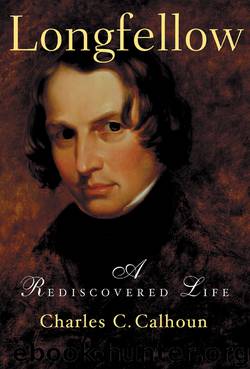
Author:Charles C. Calhoun [Calhoun, Charles C.]
Language: eng
Format: epub
ISBN: 978-0-8070-7041-3
Publisher: Beacon Press
Published: 2004-09-24T04:00:00+00:00
“The Slave in the Dismal Swamp” was “a shameless medley of the grossest misrepresentation”—Poe denied bloodhounds had ever been used to chase runaways in the South—and “The Quadroon Girl” a tired piece of abolitionist propaganda. Longfellow had written “incendiary doggrel” [sic], and Poe dismissed the volume “with no more profound feeling than that of contempt.”
That Poe—irritated by the relentless moralizing of the New England “clique”—was offended by Longfellow’s critique of his slave-owning fellow citizens is not surprising. But the depth of his “contempt” was profound indeed, possibly pathological, and it clearly stung Longfellow. He kept above the fray, but several of his friends—including Hillard and Sumner—fired back at Poe in what came to be known as “the Longfellow War.”
It had begun in October 1839 with a short review of Hyperion in Burton’s Gentleman’s Magazine, a respectable monthly to which Poe regularly contributed. Longfellow’s unshapely romance was a “farrago,” evincing a lack of “the great labor requisite for the stern demands of high art.” In the same columns, in February 1840, Poe took on Voices of the Night. He admitted he had admired “Hymn to the Night” upon first reading it in a newspaper and had even concluded that “a poet of high genius had at length risen amongst us.” Yet he had had second thoughts upon reading the new collection. “[H]e appears to us singularly deficient in all those important faculties which give artistical power. . . . He has no combining or binding force. He has absolutely nothing of unity.” Some of Poe’s criticism hit the mark: he found Longfellow’s archaizing inversions of normal word order (“Spake full well . . .”) “preposterous” for a nineteenth-century poet. But he went on to make a much more serious charge. Longfellow’s “Midnight Mass for the Dying Year” had been plagiarized from Tennyson’s “The Death of the Old Year.” The similarity of metaphor and rhythmical structure in the two poems was no mere coincidence, but an example of “the most barbarous class of literary robbery.”
In truth the two poems have little in common other than the familiar poetic conceit of personifying the outgoing year as an old man. But it became clear over the next five years that the vehemence of Poe’s attacks on Longfellow’s reputation were often in reverse proportion to evidentiary truth. Amid the transatlantic adulation that Longfellow had received by the early 1840s, Poe had managed to find a weak spot: Longfellow was a chronic borrower—of European themes, of traditional European meters, of a poetic diction in which echoes of a hundred other poets sounded. But this was not plagiarism. The previous century would have praised this practice as imitation, in the long-established Renaissance sense of the term. Yet Poe was living at a time when literature was becoming commodified, when the market economy was transforming writers from gentlemen-amateurs into producers who had a right to the products of their own labors. In Poe’s day, the issue of international copyright was being debated, and Romanticism too condemned the absence of originality.
Download
This site does not store any files on its server. We only index and link to content provided by other sites. Please contact the content providers to delete copyright contents if any and email us, we'll remove relevant links or contents immediately.
Cecilia; Or, Memoirs of an Heiress — Volume 2 by Fanny Burney(32086)
Cecilia; Or, Memoirs of an Heiress — Volume 3 by Fanny Burney(32063)
Fanny Burney by Claire Harman(26722)
We're Going to Need More Wine by Gabrielle Union(19168)
Plagued by Fire by Paul Hendrickson(17536)
All the Missing Girls by Megan Miranda(16691)
Cat's cradle by Kurt Vonnegut(15554)
For the Love of Europe by Rick Steves(14902)
Bombshells: Glamour Girls of a Lifetime by Sullivan Steve(14217)
Leonardo da Vinci by Walter Isaacson(13507)
4 3 2 1: A Novel by Paul Auster(12610)
The remains of the day by Kazuo Ishiguro(9218)
Adultolescence by Gabbie Hanna(9021)
Note to Self by Connor Franta(7748)
Diary of a Player by Brad Paisley(7717)
Giovanni's Room by James Baldwin(7540)
What Does This Button Do? by Bruce Dickinson(6315)
Ego Is the Enemy by Ryan Holiday(5619)
Born a Crime by Trevor Noah(5488)
