It's the End of the World : But What Are We Really Afraid Of? (9781783964758) by Roberts Adam
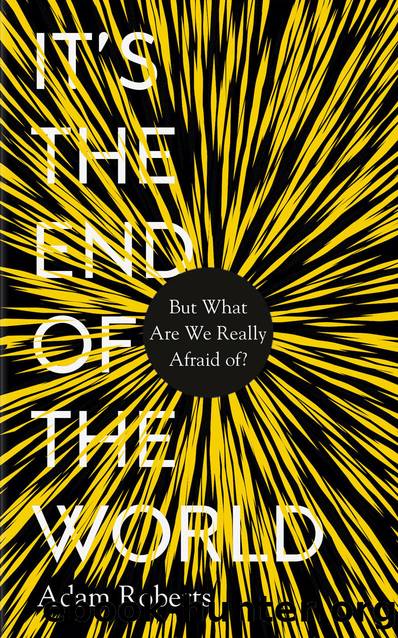
Author:Roberts, Adam
Language: eng
Format: epub
ISBN: 9781783964758
Publisher: Lightning Source Inc
In statistical terms it was the greatest natural disaster since the Black Death, yet the Great Influenza Epidemic (or Pandemic) of 1918â19 has vanished from public consciousness. Unlike the war that immediately preceded it, the flu has left scarcely a trace in modern literature; historical accounts of it are sparse. One of its few chroniclers claimed that âthe Spanish Lady inspired no songs, no legends, no work of artâ.*
Why didnât the Spanish flu leave a greater cultural footprint? Where are all the great novels and films about that appalling global catastrophe? The answer may have to do with timing. The Great War had facilitated the spread of the disease, since it involved millions of people being moved around the globe, as troops or refugees. But the Great War also dominated the post-war imagination in a way that the Great Flu did not. War gave us heroes and antagonists, enemies with faces against which we could pit ourselves; flu gave us none of those things.
This collective amnesia ended in 2020 with the arrival of a new virus, Covid-19. In the global lockdown that followed, the long history of flu and flu-like viruses came crashing back into our lives, and the entire planet revised their knowledge of epidemiology. Our lives were entirely changed by the trauma of loved ones getting sick and dying, but also by the disruption of lockdown, which overnight completely transformed our societies.
Itâs too early to say how coronavirus will factor into our ongoing general fascination with the end of the world. But it illustrates a core truth about human beings: we are our interactions with others â our friendships and sex lives, our workplace interactions and social media, our family and friends and the kindnesses we show strangers. Those who live as hermits, sealed away from human interaction, are the exceptions to the norm. Our existence is woven from a great many human intimacies â we require them to acquire empathy and social skills, to love and even to speak. That network of various intimacies defines us, but it is also what disease is: not merely the potential infections of particular germs or viruses, but the actualisation of contagion in the world.
And this is the crucial thing. Our understanding of disease, and our improved medical science, make the gloomier prognostications of science fiction doom-sayers less and less likely. No plague will kill 4,999 out of every 5,000 humans â as weâve seen, even if the numbers are high, in terms of percentage of population itâs likely to be very low. It feels like being a hostage to fortune, writing as I am in the middle of the Covid-19 lockdown, but it is true nonetheless: disease by itself wonât bring about the end of the world. But the world that emerges, post lockdown, will surely look different, and perhaps very different, to the one we knew before. We will learn new modes of remote social interaction, distanced and masked, separated into more atomised little units. Plague may not prove the end of the world â but it might be the end of the world as we know it.
Download
This site does not store any files on its server. We only index and link to content provided by other sites. Please contact the content providers to delete copyright contents if any and email us, we'll remove relevant links or contents immediately.
The Vikings: Conquering England, France, and Ireland by Wernick Robert(84460)
Ali Pasha, Lion of Ioannina by Eugenia Russell & Eugenia Russell(40348)
The Conquerors (The Winning of America Series Book 3) by Eckert Allan W(38245)
The Vikings: Discoverers of a New World by Wernick Robert(37029)
Cecilia; Or, Memoirs of an Heiress — Volume 1 by Fanny Burney(32679)
Cecilia; Or, Memoirs of an Heiress — Volume 2 by Fanny Burney(32038)
Cecilia; Or, Memoirs of an Heiress — Volume 3 by Fanny Burney(32023)
Empire of the Sikhs by Patwant Singh(23163)
The Secret History by Donna Tartt(19382)
Hans Sturm: A Soldier's Odyssey on the Eastern Front by Gordon Williamson(18684)
Cat's cradle by Kurt Vonnegut(15485)
Pimp by Iceberg Slim(14729)
Sapiens: A Brief History of Humankind by Yuval Noah Harari(14495)
Norse Mythology by Gaiman Neil(13494)
Talking to Strangers by Malcolm Gladwell(13485)
Leonardo da Vinci by Walter Isaacson(13437)
4 3 2 1: A Novel by Paul Auster(12556)
Underground: A Human History of the Worlds Beneath Our Feet by Will Hunt(12188)
The Radium Girls by Kate Moore(12126)
