I Hope I Don't Intrude: Privacy and its Dilemmas in Nineteenth-Century Britain by Vincent David;
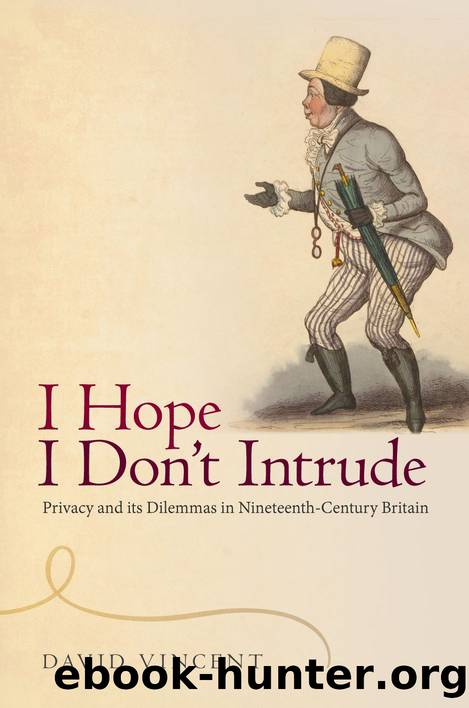
Author:Vincent, David; [Vincent, David]
Language: eng
Format: epub
ISBN: 9780198725039
Publisher: OxfordUP
Published: 2015-02-27T00:00:00+00:00
Respectability was rarely an ambition and still less an achievement of those who ran the scandal press. Even where they told themselves and their readers that they were embarked on a high moral cause, they were too easily seduced by the prospect of quick financial gain and too indifferent to the means by which they achieved it. Charles Westmacott, who we saw publishing the Egan-like English Spy alongside Pryâs theatrical success in 1825, was a case in point. He moved on to edit The Age, whose public exposure of the misdeeds of the famous was combined with the private extraction of payments to keep their names out of the paper.148 The law needed to be deployed when the fall in the cost of this material threatened to create a large market among the newly educated, but there was always a danger of recreating the War of the Unstamped when journalists were able to turn their persecution into a generator of sales amongst a readership by no means attuned to the new systems of public civility. Better to hope that the prospect of mass circulation would bring into the market highly capitalized entrepreneurs craving social acceptability and disinclined to put at risk their investment by irresponsible behaviour. Thus papers such as The News of the World that were beginning to take root as the Paul Pry nuisance reached its climax, retained the interest in crime and sex without engaging in the wholesale invasion of personal privacy.149 In the case of gossip, as with other areas of entertainment and consumption, the market became segmented. It continued in the form of society journalism such as Henry Labouchèreâs Truth, which combined news of the fashionable world and occasional exposés of financial or political misbehaviour.150
Nonetheless, the âcompound of infidelity, Chartism and debaucheryâ had a longer and more vigorous life than appeared likely in the immediate aftermath of Pryâs success on the London stage. It did so because its practitioners had discovered a truth that was to be re-learned by successive generations of scandal-mongers in every period and medium. The best way to transgress decency was to appropriate the mantle of moral courage. If everything was a campaign, the invasion of personal lives could be blurred with the exposure of the misbehaviour of public figures. It was possible simultaneously to uphold and transgress the conventions of privacy if both were done with spirit and conviction. The audience conspired in this enterprise if it fed at low cost their appetite for sex and sensation and at the same time flattered them as ethical actors. The âPaul Pry nuisanceâ did not represent simply the dark side of the spirit of inquiry. Rather it embodied the exuberant combination of intrusion and apology turned towards the generation of profit on the wrong side of respectability.
Thus the periodicals not only invoked Dryden and Mill on their mastheads but repeatedly laid claim in their columns to their modernity and bravery. They would expose concealed misdeeds whatever the consequence for their own well-being.
Download
This site does not store any files on its server. We only index and link to content provided by other sites. Please contact the content providers to delete copyright contents if any and email us, we'll remove relevant links or contents immediately.
The Vikings: Conquering England, France, and Ireland by Wernick Robert(84450)
Ali Pasha, Lion of Ioannina by Eugenia Russell & Eugenia Russell(40340)
The Conquerors (The Winning of America Series Book 3) by Eckert Allan W(38186)
The Vikings: Discoverers of a New World by Wernick Robert(37028)
Cecilia; Or, Memoirs of an Heiress — Volume 1 by Fanny Burney(32666)
Cecilia; Or, Memoirs of an Heiress — Volume 2 by Fanny Burney(32030)
Cecilia; Or, Memoirs of an Heiress — Volume 3 by Fanny Burney(32013)
Empire of the Sikhs by Patwant Singh(23161)
The Secret History by Donna Tartt(19377)
Hans Sturm: A Soldier's Odyssey on the Eastern Front by Gordon Williamson(18683)
Cat's cradle by Kurt Vonnegut(15480)
Pimp by Iceberg Slim(14723)
Sapiens: A Brief History of Humankind by Yuval Noah Harari(14493)
Norse Mythology by Gaiman Neil(13493)
Talking to Strangers by Malcolm Gladwell(13481)
Leonardo da Vinci by Walter Isaacson(13436)
4 3 2 1: A Novel by Paul Auster(12554)
Underground: A Human History of the Worlds Beneath Our Feet by Will Hunt(12183)
The Radium Girls by Kate Moore(12125)
