History of Medieval India by Satish Chandra
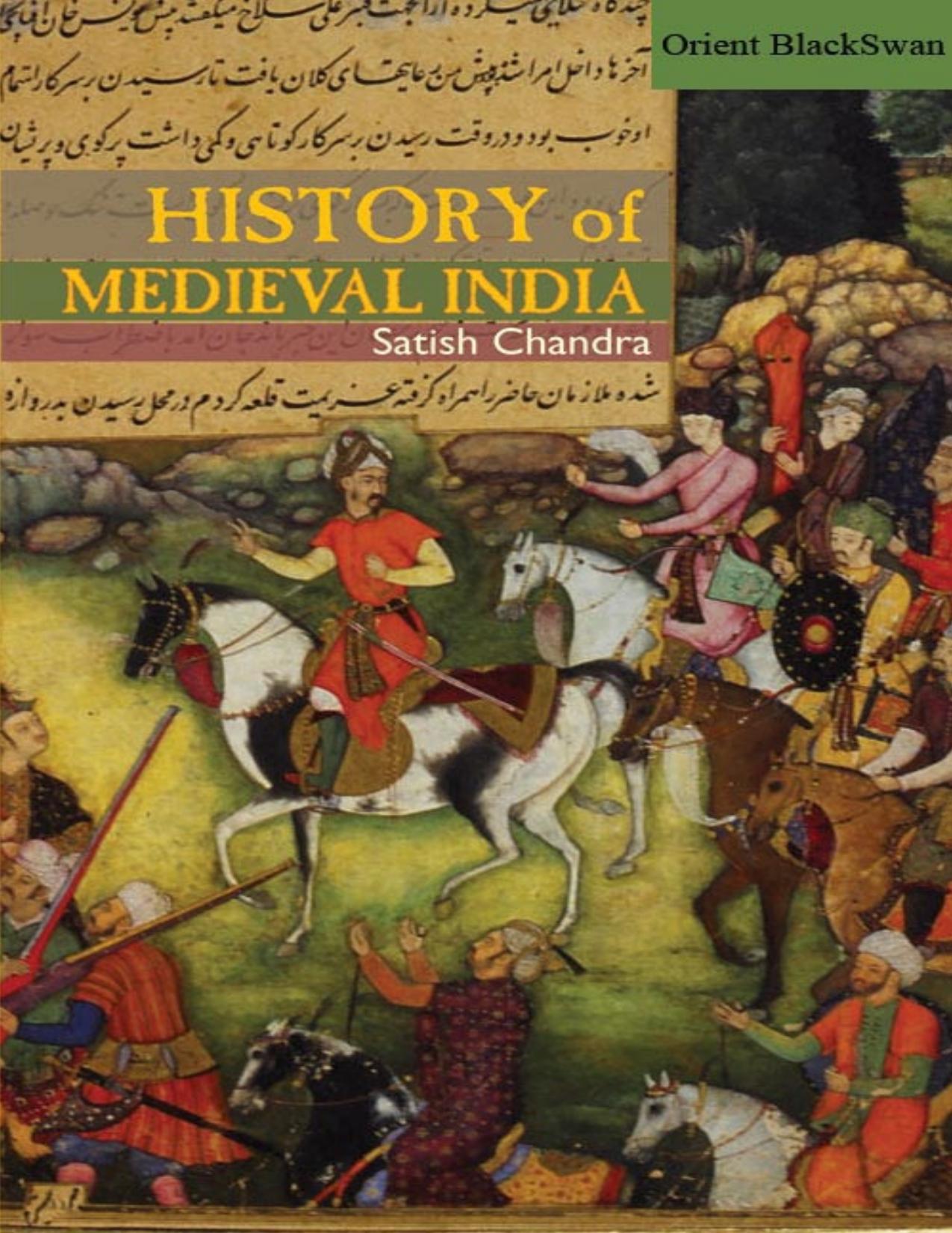
Author:Satish Chandra
Language: eng
Format: azw3, pdf
Tags: History of Medieval India
Publisher: Orient Blackswan
Published: 2018-08-26T16:00:00+00:00
THE VAISHNAVITE MOVEMENT
Apart from the non-sectarian movement led by Kabir and Nanak, the Bhakti movement in north India developed around the worship of Rama and Krishna, two of the incarnations of the god Vishnu. The childhood escapades of the boy Krishna and his dalliance with the milk-maids of Gokul, especially with Radha, became the themes of a remarkable series of saint-poets who lived and preached during the fifteenth and early sixteenth centuries. They used the love between Radha and Krishna in an allegorical manner to depict the relationship of love, in its various aspects, between the individual soul and the supreme soul. Like the early Sufis, Chaitanya popularised musical gathering or kirtan as a special form of mystic experience in which the outside world disappeared by dwelling on God’s name. According to Chaitanya, worship consisted of love and devotion and song and dance which produced a state of ecstasy in which the presence of God, whom he called Hari, could be realised. Such a worship could be carried out by all, irrespective of caste or creed.
The writings of Narsinha Mehta in Gujarat, of Meera in Rajasthan, of Surdas in western Uttar Pradesh and of Chaitanya in Bengal and Orissa reached extraordinary heights of lyrical fervour and of love which transcended all boundaries, including those of caste and creed. These saints were prepared to welcome into their fold everyone, irrespective of caste or creed. This is seen most clearly in the life of Chaitanya. Born and schooled in Nadia which was the centre of Vedantic rationalism, Chaitanya’s tenor of life was changed when he visited Gaya at the age of twenty-two and was initiated into the Krishna cult by a recluse. He became a god-intoxicated devotee who incessantly uttered the name of Krishna. Chaitanya is said to have travelled all over India, including Vrindavan, where he revived the Krishna cult. But most of his time was spent at Gaya. He exerted an extraordinary influence, particularly in the eastern parts of India, and attracted a wide following, including some Muslims and people from the low castes. He did not reject the scriptures or idol-worship, though he cannot be classified as a traditionalist.
All the saint-poets mentioned above remained within the broad framework of Hinduism. Their philosophic beliefs were a brand of Vedantic monism which emphasized the fundamental unity of God and the created world. The Vedantist philosophy had been propounded by a number of thinkers, but the one who probably influenced the saint-poets the most was Vallabha, a Tailang Brahman, who lived in the last part of the fifteenth and the early part of the sixteenth century.
The approach of these saint-poets was broadly humanistic. They emphasized the broadest human sentiments—the sentiments of love and beauty in all their forms. Like the other non- sectarians, they were not able to make an effective breach in the caste system. However, they softened its rigour and built a platform for unity which could be apprehended by wider sections.
The basic concepts of the saint-poets were reciprocated to a remarkable degree by the Sufi poets and saints of the period.
Download
This site does not store any files on its server. We only index and link to content provided by other sites. Please contact the content providers to delete copyright contents if any and email us, we'll remove relevant links or contents immediately.
The Vikings: Conquering England, France, and Ireland by Wernick Robert(84249)
Ali Pasha, Lion of Ioannina by Eugenia Russell & Eugenia Russell(40263)
The Conquerors (The Winning of America Series Book 3) by Eckert Allan W(37476)
The Vikings: Discoverers of a New World by Wernick Robert(36981)
Cecilia; Or, Memoirs of an Heiress — Volume 1 by Fanny Burney(32563)
Cecilia; Or, Memoirs of an Heiress — Volume 2 by Fanny Burney(31962)
Cecilia; Or, Memoirs of an Heiress — Volume 3 by Fanny Burney(31945)
Empire of the Sikhs by Patwant Singh(23090)
The Secret History by Donna Tartt(19105)
Hans Sturm: A Soldier's Odyssey on the Eastern Front by Gordon Williamson(18596)
Cat's cradle by Kurt Vonnegut(15365)
Pimp by Iceberg Slim(14523)
Sapiens: A Brief History of Humankind by Yuval Noah Harari(14394)
Norse Mythology by Gaiman Neil(13379)
Talking to Strangers by Malcolm Gladwell(13378)
Leonardo da Vinci by Walter Isaacson(13342)
4 3 2 1: A Novel by Paul Auster(12405)
Underground: A Human History of the Worlds Beneath Our Feet by Will Hunt(12101)
The Radium Girls by Kate Moore(12036)
