Hawthorne's Habitations by Milder Robert;
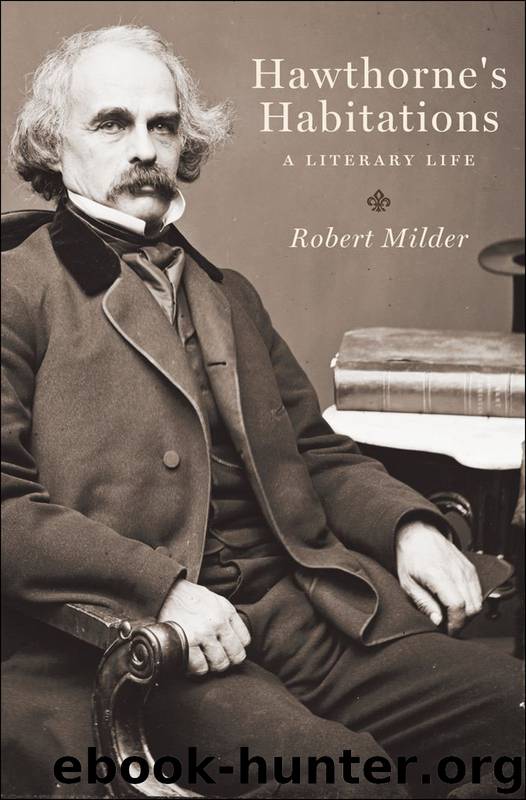
Author:Milder, Robert;
Language: eng
Format: epub
Publisher: Oxford University Press, Incorporated
Published: 2013-03-18T16:00:00+00:00
Spheres of Influence
The events are purely mental…. Three persons of essentially different characters and purposes, are placed together; the law of spiritual influence, the magnetism of soul on soul begins to operate; and the processes of thought and emotions are then presented in perfect logical order to their inevitable catastrophe.
—E. P. Whipple, unsigned review of The Blithedale Romance
Friends of Fuller often described her effect on people as magnetic. To be intimate with Fuller was to be brought within her gravitational field and exposed to the force of her personality. James Freeman Clarke spoke of “the magnetism by which she drew [her friends] toward herself,” Emerson of the young women who gathered around her as “quite reduced … to satellites” (MMFO 1:75, 280). Both men were appealing to the language of animal magnetism, or mesmerism, a phenomenon widely popular in the later 1830s and 1840s whether as a stage entertainment, a medical treatment (Fuller and Sophia Hawthorne both consulted mesmerists for headaches), or a science or pseudoscience that seemed to enlarge the realm of natural laws and blur the boundaries between the material and the spiritual.
Aside from lending an aura of romance to his realistic materials, mesmerism supplied Hawthorne with a figurative language for exploring the psychodynamics of his characters’ relationships and of human relationships generally. In this latter respect, it reached beyond individual psychology to a theory of motivation, and beyond that to suppositions about the processes and ends of natural life and their connection to spiritual life. The cosmological pretensions originally attached to mesmerism—its notion of an all-pervasive “universal fluid”23—were of scant interest to Hawthorne except as they evoked the prospect of empty materialism. What intrigued him was mesmeric possession as an extreme instance of, and a ruling metaphor for, the play of dominations that seemed at work in human interactions, which he signified in Blithedale through the motifs of magnetism and “spheres of influence.”
Rooted in the body (sexuality), magnetism in Blithedale is a charismatic power that radiates outward through the entire personality with a force that varies in individuals from the weak to the spellbinding. Zenobia and Hollingsworth have powerful magnetism. Coverdale calls Hollingsworth’s a species of “necromancy” in its hold on Zenobia and Priscilla (3:124), but he feels it, too, as Hollingsworth tries to enlist him in his reformist cause. Coverdale himself has but “a feeble degree of magnetism,” as he says apropos of Priscilla’s tepid response to his offered hand (3:168); he has still less when illness wastes his physical substance and temporarily endows him with the powers of a “mesmerical clairvoyant” receiving the impress of others (3:47). “The spheres of our companions have, at such periods,” he writes, “a vastly greater influence upon our own, than when robust health gives us a repellent and self-defensive energy” (3:46).
Coverdale’s “spheres” are not the contemporary domains of gender performance; as Richard H. Brodhead observes, they are “fields of force—zones of charged energies that repel or attract one another, and that interpenetrate one another in such a way that the force of the weaker field gets captured by and reorganized on the lines of the stronger.
Download
This site does not store any files on its server. We only index and link to content provided by other sites. Please contact the content providers to delete copyright contents if any and email us, we'll remove relevant links or contents immediately.
Cecilia; Or, Memoirs of an Heiress — Volume 2 by Fanny Burney(31931)
Cecilia; Or, Memoirs of an Heiress — Volume 3 by Fanny Burney(31923)
Fanny Burney by Claire Harman(26588)
We're Going to Need More Wine by Gabrielle Union(19028)
Plagued by Fire by Paul Hendrickson(17395)
All the Missing Girls by Megan Miranda(15909)
Cat's cradle by Kurt Vonnegut(15316)
Bombshells: Glamour Girls of a Lifetime by Sullivan Steve(14042)
For the Love of Europe by Rick Steves(13837)
Leonardo da Vinci by Walter Isaacson(13300)
4 3 2 1: A Novel by Paul Auster(12360)
The remains of the day by Kazuo Ishiguro(8961)
Adultolescence by Gabbie Hanna(8908)
Note to Self by Connor Franta(7660)
Diary of a Player by Brad Paisley(7542)
Giovanni's Room by James Baldwin(7309)
What Does This Button Do? by Bruce Dickinson(6190)
Ego Is the Enemy by Ryan Holiday(5400)
Born a Crime by Trevor Noah(5365)
