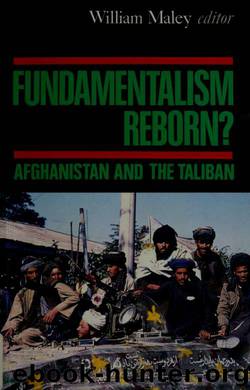
Fundamentalism reborn? : Afghanistan and the Taliban by Maley William 1957-
Author:Maley, William, 1957-
Language: eng
Format: epub
Tags: Taliban
Publisher: New York : New York University Press
Published: 2001-08-05T16:00:00+00:00
many warlords. The other theory argues that the Taliban movement was organised by Pakistan to promote her interests in Afghanistan. 18 Probably the combination of the two theories is closer to the truth than either one alone. The rise of the Taliban was certainly a response to the anarchic conditions in the Pushtun-populated areas, but without Pakistan's support, the movement would have not become so powerful as to defeat major warlords.
When the Taliban captured four provinces in the southwest in late 1994, they did not generate much controversy among the regional powers. Even though Pakistan quickly established good relations with the Taliban, Iran did not oppose the movement during the first few months of its rise. The Taliban's conflict with Iran began in March 1995 when the Taliban defeated Hekmatyar's Hezb-e Islami and Mazari's Hezb-e Wahdat forces-both allies of Iran-in the southern and western outskirts of Kabul, murdered Mazari himself, and threatened to capture Kabul from Rabbani and Massoud. It was at this juncture, when the Taliban movement emerged as a serious contender for national power, that Iran began to see the Taliban as an anti-Shia and anti-Iran force.
Consequently, Iran decided to cooperate with Rabbani and Massoud in opposing the Taliban. Rabbani and Massoud welcomed this opportunity to improve relations with Iran because, in spite of their efforts in the previous two years to align themselves with America, the United States was not forthcoming. Meanwhile the Taliban movement had gained control over a very large part of the country and was adamant about capturing Kabul. Iran had taken a public stand against the Taliban and was willing to provide financial and military support to their opponents. Thus, despite the fact that during 1993 and 1994, Massoud had accused Iran of supporting the opponents of the Kabul regime (the 'Council of Solidarity' alliance of Hekmatyar, Mazari, Dostum and Mojadiddi), after March 1995, Iran developed very close relations with Kabul. This change of relations between Iran and Kabul added coherence to Iran's position in western Afghanistan where Iran was supporting Ismail Khan's rule in Herat.
Ismail Khan was a member of the Rabbani-led Jamiat-e Islami organisation and was part of the Kabul administration. Iran's friendship with Rabbani and Massoud also facilitated the rise of an informal alliance between India, Russia, and Iran supporting the
For views about the identity and the rise of the Taliban, see John F. Burns and Steve LeVine's report in The New York Times, 31 December 1996, p.Al, 6; and Hasan Kakar 'Dar barai nawishtahi ghiv masuh shaghali Ghoriani wa digara' [A Response to Ghoriani and others], Afghan Mellat (in Persian, published in Peshawar, Pakistan), 13 May 1997, pp. 3-5.
Download
This site does not store any files on its server. We only index and link to content provided by other sites. Please contact the content providers to delete copyright contents if any and email us, we'll remove relevant links or contents immediately.
The Vikings: Conquering England, France, and Ireland by Wernick Robert(84248)
Ali Pasha, Lion of Ioannina by Eugenia Russell & Eugenia Russell(40263)
The Conquerors (The Winning of America Series Book 3) by Eckert Allan W(37475)
The Vikings: Discoverers of a New World by Wernick Robert(36981)
Cecilia; Or, Memoirs of an Heiress — Volume 1 by Fanny Burney(32563)
Cecilia; Or, Memoirs of an Heiress — Volume 2 by Fanny Burney(31962)
Cecilia; Or, Memoirs of an Heiress — Volume 3 by Fanny Burney(31945)
Empire of the Sikhs by Patwant Singh(23090)
The Secret History by Donna Tartt(19105)
Hans Sturm: A Soldier's Odyssey on the Eastern Front by Gordon Williamson(18596)
Cat's cradle by Kurt Vonnegut(15365)
Pimp by Iceberg Slim(14523)
Sapiens: A Brief History of Humankind by Yuval Noah Harari(14394)
Norse Mythology by Gaiman Neil(13379)
Talking to Strangers by Malcolm Gladwell(13377)
Leonardo da Vinci by Walter Isaacson(13342)
4 3 2 1: A Novel by Paul Auster(12405)
Underground: A Human History of the Worlds Beneath Our Feet by Will Hunt(12101)
The Radium Girls by Kate Moore(12036)
