Do No Harm by Henry Marsh
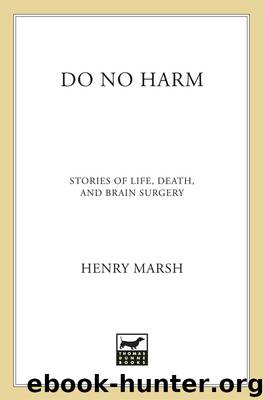
Author:Henry Marsh
Language: eng
Format: epub
ISBN: 9781466872806
Publisher: St. Martin's Press
12
GLIOBLASTOMA
n. the most aggressive type of brain tumour derived from non-nervous tissue.
I have little direct contact with death in my work despite its constant presence. Death has become sanitized and remote. Most of the patients who die under my care in the hospital have hopeless head injuries or cerebral haemorrhages. They are admitted in coma and die in coma in the warehouse space of the Intensive Care Unit after being kept alive for a while by ventilators. Death comes simply and quietly when they are diagnosed to be brain dead and the ventilator is switched off. There are no dying words or last breaths – a few switches are turned and the ventilator then stops its rhythmic sighing. If the cardiac monitor leads have been left attached – usually they are not – you can watch the heart on the ECG monitor – a graphic line in LED red that rises and falls with each heart beat – become increasingly irregular as the dying heart, starved of oxygen, struggles to survive. After a few minutes, in complete silence, it comes to a stop and the trace becomes a flat line. The nurses then remove the many tubes and wires connected to the now lifeless body and after a while two porters bring a trolley with a shallow box beneath it camouflaged by a blanket and wheel the body away to the mortuary. If the patient’s organs are to be used for donation the ventilator will be kept running after the brain’s death has been certified and the body will be taken to the operating theatres – usually at night. The organs are removed and only then is the ventilator switched off and the camouflaged trolley will come to take the corpse away.
The patients I treat with fatal brain tumours will die at home or in hospices or in their local hospital. Very occasionally one of these patients of mine with a brain tumour will die under my care while still in the hospital but they will be in coma, since they are dying because their brain is dying. If there are any discussions about death or dying it is with the family and not with the patient. I rarely have to confront death face to face, but occasionally I am caught out.
When I was a junior doctor it was very different. I was closely involved with death and with dying patients on a daily basis. In my first year as a doctor, working as a houseman at the bottom of the medical hierarchy, I would often be summoned, usually out of bed in the early hours, to certify the death of a patient. I would walk along the empty, anonymous corridors of the hospital, young and healthy and wearing a doctor’s white coat, to enter a dark ward and be directed by the nurses to a bed around which the curtains had been drawn. I would be aware of the other patients, usually old and frail, lying in the neighbouring
Download
This site does not store any files on its server. We only index and link to content provided by other sites. Please contact the content providers to delete copyright contents if any and email us, we'll remove relevant links or contents immediately.
Hit Refresh by Satya Nadella(9138)
When Breath Becomes Air by Paul Kalanithi(8447)
The Girl Without a Voice by Casey Watson(7889)
A Court of Wings and Ruin by Sarah J. Maas(7847)
Do No Harm Stories of Life, Death and Brain Surgery by Henry Marsh(6941)
Shoe Dog by Phil Knight(5270)
The Rules Do Not Apply by Ariel Levy(4970)
A Higher Loyalty: Truth, Lies, and Leadership by James Comey(4964)
Hunger by Roxane Gay(4928)
Tuesdays with Morrie by Mitch Albom(4784)
Everything Happens for a Reason by Kate Bowler(4743)
The Immortal Life of Henrietta Lacks by Rebecca Skloot(4589)
Millionaire: The Philanderer, Gambler, and Duelist Who Invented Modern Finance by Janet Gleeson(4478)
How to Change Your Mind by Michael Pollan(4357)
All Creatures Great and Small by James Herriot(4323)
The Money Culture by Michael Lewis(4207)
Man and His Symbols by Carl Gustav Jung(4137)
Elon Musk by Ashlee Vance(4128)
Tokyo Vice: An American Reporter on the Police Beat in Japan by Jake Adelstein(3996)
