Cuban Star by Adrian Burgos Jr
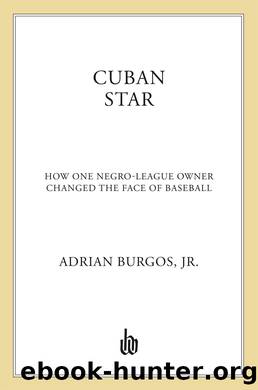
Author:Adrian Burgos, Jr.
Language: eng
Format: epub
Publisher: Farrar, Straus and Giroux
7
GLORY DAYS
The big league teams are taking most of them now, and I have a very small field to pick from.
âAlex Pompez, The Pittsburgh Courier, June 1945
The Brooklyn Dodgersâ signing of Jackie Robinson on October 24, 1945, shook the professional baseball world. A major-league team had finally taken a very real step, not just making a halfhearted offer of a tryout as the Pittsburgh Pirates had done in 1942, or hosting a sham tryout for talented black players as the Boston Red Sox did in April 1945, or offering coy denials about no rule, written or otherwise, that denied black players the opportunity to perform in the majors. Integration was in its infancy, and those who had long campaigned for the demolition of organized baseballâs color line rejoiced. Black baseball owners scrambled. They were in an unenviable position: as businesspeople, they operated an entity whose finished productâtalented black playersâwas now a desired commodity and in need of protection; as âraceâ men and women, they could not protest too vociferously that a formerly segregated institution had begun to open its doors to blacks. Thus, Pompez and his fellow Negro-league owners faced the monumental challenge of retooling what had been created as a âshadowâ institution to serve the nonwhite community of baseball fans into a league serviceable for the new integrated era. Critics and supporters alike told them to âget their house in order,â which proved much more difficult than expected.
NNL owners set out to disprove that theirs was more âa racketâ than a professional organization, as Brooklyn Dodgers president Branch Rickey had charged when he signed Robinson. At their January 1947 gathering at Harlemâs Hotel Theresa, NNL owners finally unseated Tom Wilson as league president and elected the circuitâs first independent top executive, Reverend John H. Johnson, chaplain of Harlemâs St. Martinâs Episcopal Church. The death of Cum Posey swung the vote that ended Wilsonâs decade-long hold on the leagueâs top post as Poseyâs replacement, Sonnyman Jackson, aligned himself with Pompez, Manley, and Semlerâall numbers men in the pastâin casting a 4â2 vote for Johnson; Wilson and Gottlieb, unsurprisingly, voted to retain the status quo.1
Johnsonâs election reflected the hope that new leadership could persuade those who wielded power within organized baseball of the mutual benefits of having the Negro leagues as a partner in desegregating the national pastime. The new NNL president joined the reelected vice president, Pompez, and instituted a series of reforms that raised the leagueâs professional standards and strove to build up the circuitâs good name. The reforms addressed concerns organized baseball officials previously expressed about the structure and operation of Negro-league baseball: the form of the official contract, the execution of the league schedule, the behavior and background of black baseball owners themselves. Johnson knew this rehabilition effort involved public relations, since major-league officials were hesitant to publicly partner up with Negro-league owners in the racial desegregation of organized baseball. Moving mountains seemed easier than budging Major League Baseball commissioner Albert âHappyâ Chandler and other big-league executives
Download
This site does not store any files on its server. We only index and link to content provided by other sites. Please contact the content providers to delete copyright contents if any and email us, we'll remove relevant links or contents immediately.
| Actors & Entertainers | Artists, Architects & Photographers |
| Authors | Composers & Musicians |
| Dancers | Movie Directors |
| Television Performers | Theatre |
Cecilia; Or, Memoirs of an Heiress — Volume 2 by Fanny Burney(31956)
Cecilia; Or, Memoirs of an Heiress — Volume 3 by Fanny Burney(31942)
Fanny Burney by Claire Harman(26603)
We're Going to Need More Wine by Gabrielle Union(19046)
Plagued by Fire by Paul Hendrickson(17413)
All the Missing Girls by Megan Miranda(16030)
Cat's cradle by Kurt Vonnegut(15359)
For the Love of Europe by Rick Steves(14121)
Bombshells: Glamour Girls of a Lifetime by Sullivan Steve(14077)
Leonardo da Vinci by Walter Isaacson(13337)
4 3 2 1: A Novel by Paul Auster(12393)
The remains of the day by Kazuo Ishiguro(9000)
Adultolescence by Gabbie Hanna(8927)
Note to Self by Connor Franta(7671)
Diary of a Player by Brad Paisley(7581)
Giovanni's Room by James Baldwin(7346)
What Does This Button Do? by Bruce Dickinson(6207)
Ego Is the Enemy by Ryan Holiday(5450)
Born a Crime by Trevor Noah(5383)
