Counter Jihad by Williams Brian Glyn;
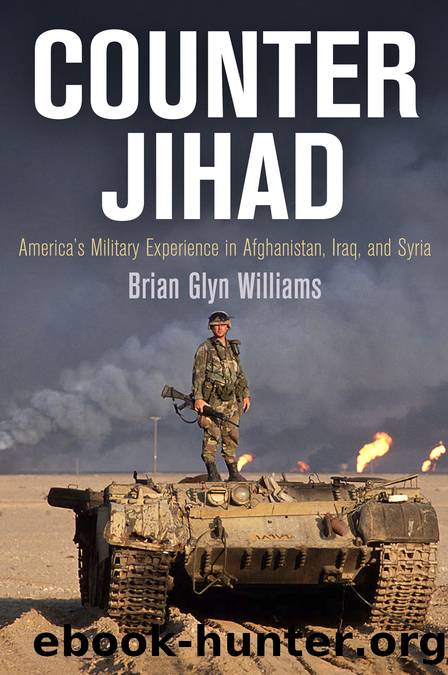
Author:Williams, Brian Glyn;
Language: eng
Format: epub
Publisher: University of Pennsylvania Press, Inc.
Published: 2017-11-15T00:00:00+00:00
The Rise of the Iraqi Insurgency
In the aftermath of the defeat of Saddam Husseinâs army, the Iraqi government collapsed, and everyone from forty thousand policemen to the ministers of oil melted away. As civil society collapsed, gangs of Iraqis came out to loot government buildings in Baghdad and across the country. Across Iraq, everything from electrical wiring, to telephones and chairs in government buildings, to police cars, to fire engines, to school desks, hospital equipment, and oil piping was looted. Fires raged, and all government buildings and most ministries were looted or gutted.
Among the lootersâ first targets in the postinvasion power vacuum was the National Museum in Baghdad, which housed one of the most valuable collections of ancient Mesopotamian artifacts in the world. Without police to maintain order, cars were carjacked, women were raped, people were kidnapped, billions of dollars was looted from banks, stores were burnt, ancient relics were stolen or destroyed, and anarchy prevailed in exactly the sort of scenario General Eric Shinseki had feared, and Rumsfeld had discounted.
At this time, many Iraqis who had disliked Hussein and were sitting on the fence came to associate the anarchy and loss of electricity, water, and security in the aftermath of the invasion with the now distrusted American invaders. When asked by a reporter about the chaos and looting, an unapologetic Rumsfeld dismissed the question by stating flatly that âdemocracy is messyâ and âstuff happens.â38 He also said, âFreedomâs untidy, and free people are free to make mistakes and commit crimes and do bad things.â39
But it need not have been that way had the Americans come with a much larger occupation force to step in and help police and maintain order in the country of the sort called for by Powell and Shinseki. Todd Purdum, author of a history of the Iraq war, described the unfolding Phase IV problems as follows:
The problems for the Americans was that, after the fall of the statue, there was no order in Baghdad, and they didnât have enough troops on the ground to enforce order. They didnât have enough civil affairs officers. They didnât have enough military policemen. The 4th Infantry was still making its way up from Kuwait. So if Rumsfeldâs vision of the war plan was a tactical success, some generals in the Pentagon began to worry if it mightnât have been a strategic failure, because the American forces did not have the capacity to enforce order in the all-important aftermath of the war.40
Download
This site does not store any files on its server. We only index and link to content provided by other sites. Please contact the content providers to delete copyright contents if any and email us, we'll remove relevant links or contents immediately.
The Vikings: Conquering England, France, and Ireland by Wernick Robert(84591)
Ali Pasha, Lion of Ioannina by Eugenia Russell & Eugenia Russell(40381)
The Conquerors (The Winning of America Series Book 3) by Eckert Allan W(39076)
The Vikings: Discoverers of a New World by Wernick Robert(37048)
Cecilia; Or, Memoirs of an Heiress — Volume 1 by Fanny Burney(32721)
Cecilia; Or, Memoirs of an Heiress — Volume 2 by Fanny Burney(32089)
Cecilia; Or, Memoirs of an Heiress — Volume 3 by Fanny Burney(32066)
Empire of the Sikhs by Patwant Singh(23204)
The Secret History by Donna Tartt(19470)
Hans Sturm: A Soldier's Odyssey on the Eastern Front by Gordon Williamson(18724)
Cat's cradle by Kurt Vonnegut(15556)
Pimp by Iceberg Slim(14796)
Sapiens: A Brief History of Humankind by Yuval Noah Harari(14553)
Norse Mythology by Gaiman Neil(13566)
Talking to Strangers by Malcolm Gladwell(13541)
Leonardo da Vinci by Walter Isaacson(13509)
4 3 2 1: A Novel by Paul Auster(12612)
Underground: A Human History of the Worlds Beneath Our Feet by Will Hunt(12231)
The Radium Girls by Kate Moore(12180)
