Chechnya's Terrorist Network by Pokalova Elena;
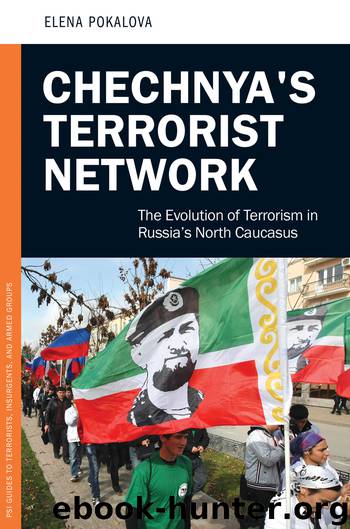
Author:Pokalova, Elena;
Language: eng
Format: epub
Publisher: ABC-CLIO, LLC
Published: 2015-04-09T04:00:00+00:00
Basayev’s suicide brigades widely employed psychological indoctrination techniques. Suicide bombers received training and were held away from people so as not to disrupt the indoctrination effect. Shahids were usually not involved in the planning of terrorist attacks but would arrive on the scene only a few days prior to the bombings.
However, while faith indisputably has played a role in recruiting shahids, in the North Caucasus revenge seems to have been a more powerful factor. Introduced under the foreign influence, the tactic of suicide bombing was built on a local tradition of blood feud. The trademark adat of blood feud functions on the principle of retribution for those killed by an enemy and is still widely practiced in the North Caucasus.45 In this respect revenge for those killed by federal forces during the two Chechen conflicts can be a powerful mechanism for recruiting suicide bombers. It has been established that the brutality of federal forces in the North Caucasus has pushed many people into the ranks of terrorists. President Maskhadov described federal troops in Chechnya acting as death squads: “Russian troops have virtually become punitive death squads that unleashed the unprecedented terror against our peaceful civilians: against women, children and the elderly.”46 As a result, as Akhmed Zakayev explained, many individuals were driven to the “extreme stage of despair” by Russia’s actions and felt they no longer had anything to lose.47 Indiscriminate zachistki operations often triggered revenge actions against Russian citizens. For instance, after the suicide bombing at Moscow metro station Avtozavodskaya in 2004, Kavkaz Center posted an anonymous message suggesting that the attack was perpetrated in revenge for a zachistka operation at Novye Aldy in Chechnya on February 5–6, 2000.48
Many of the Black Widows have been driven to avenge their husbands—usually insurgents killed in combat with federal forces or disappeared by security services—hence the very name given to the group by the media. For example, the suicide bomber who attacked the Moscow metro station Rizhskaia in 2004 was the widow of insurgent Idris Gloov who had been killed by the police.49 Alla Sapyrkina, who blew herself up together with a Dagestani sheikh in 2012, lost several husbands to federal forces. Many others were motivated by seeking revenge for their relatives; Aminat Nagaeva, a suicide terrorist on plane TU-134 that was bombed in 2004, lost her brother to the Chechen wars.
Further, revenge was a key factor that led to the increase in suicide attacks in Russia. In May 2003 Shamil Basayev announced the start of a shahid operation called Boomerang. The operation was introduced in retribution for the abductions of Chechen girls by federal forces. In retaliation for such acts Basayev vowed to target Russian cities that sent military detachments to Chechnya: “On our part we pledge to hold retaliation actions deploying our shahids in those cities, in those regions from where come the specific military detachments, police or other security groups.”50 Operation Whirlwind-Antiterror was launched concurrently as a large-scale subversive action campaign. This campaign justified the use of any available
Download
This site does not store any files on its server. We only index and link to content provided by other sites. Please contact the content providers to delete copyright contents if any and email us, we'll remove relevant links or contents immediately.
The Vikings: Conquering England, France, and Ireland by Wernick Robert(84468)
Ali Pasha, Lion of Ioannina by Eugenia Russell & Eugenia Russell(40351)
The Conquerors (The Winning of America Series Book 3) by Eckert Allan W(38302)
The Vikings: Discoverers of a New World by Wernick Robert(37030)
Cecilia; Or, Memoirs of an Heiress — Volume 1 by Fanny Burney(32684)
Cecilia; Or, Memoirs of an Heiress — Volume 2 by Fanny Burney(32042)
Cecilia; Or, Memoirs of an Heiress — Volume 3 by Fanny Burney(32027)
Empire of the Sikhs by Patwant Singh(23164)
The Secret History by Donna Tartt(19388)
Hans Sturm: A Soldier's Odyssey on the Eastern Front by Gordon Williamson(18686)
Cat's cradle by Kurt Vonnegut(15490)
Pimp by Iceberg Slim(14735)
Sapiens: A Brief History of Humankind by Yuval Noah Harari(14501)
Norse Mythology by Gaiman Neil(13501)
Talking to Strangers by Malcolm Gladwell(13490)
Leonardo da Vinci by Walter Isaacson(13442)
4 3 2 1: A Novel by Paul Auster(12559)
Underground: A Human History of the Worlds Beneath Our Feet by Will Hunt(12192)
The Radium Girls by Kate Moore(12128)
