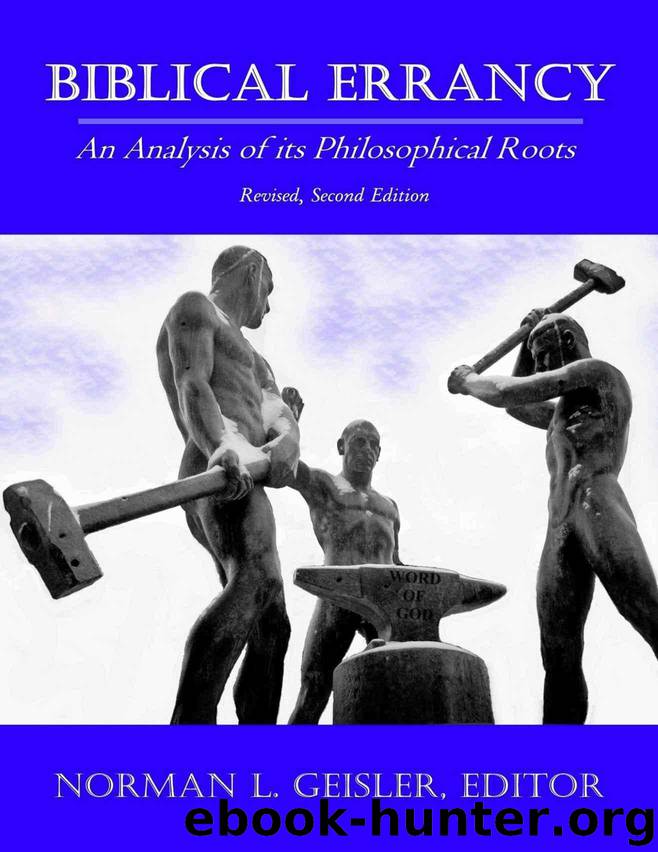
Biblical Errancy: An Analysis of Its Philosophical Roots by Norman L. Geisler
Author:Norman L. Geisler
Language: eng
Format: mobi, epub
Tags: Bibliology, Christian, Unpurchased, Theology, Religion, General, scripture
ISBN: 9781592447848
Publisher: Wipf & Stock Pub
Published: 2004-07-31T22:00:00+00:00
7 John S. Feinberg, Ph.D.
NONCOGNITIVISM: LUDWIG WITTGENSTEIN
Ludwig Wittgenstein
CHAPTER SUMMARY
THE PHILOSOPHY OF LUDWIG WITTGENSTEIN divides itself into two basic periods. The philosophy of his earlier period is reflected primarily in his Tractatus Logzco— Philosophicus, while the essence of his later thought is contained in Philosophical Investigations. Though Wittgenstein never discussed the matter of biblical inerrancy, there are many notions in both periods of his thought that, if adopted, would necessitate a rejection of inerrancy. While such notions could be used to deny inerrancy, the basic conclusion from a study of Wittgenstein's philosophy (earlier and later) is that he would have considered the whole debate over inerrancy nonsensical.
NONCOGNITIVISM: WITTGENSTEIN
Few people write serious philosophy. Even fewer produce a whole system of philosophy. Consequently, the genius of Ludwig Wittgenstein is truly remarkable, for during his lifetime he wrote two different systems of philosophy. Moreover, the second system is a corrective to the errors Wittgenstein himself perceived he had made in his earlier philosophical reflections.
Ludwig Wittgenstein led a most intriguing and unusual life. He was born in Vienna on April 26, 1889, to parents of mixed Jewish descent. Though they were partially of Jewish descent, they considered themselves Christians. Wittgenstein's mother was a Roman Catholic, and Wittgenstein was baptized and brought up in Roman Catholicism. He had various interests, such as music, aeronautics, engineering, and pure mathematics. At various stages in his life he was a soldier, a village schoolmaster in Lower Austria, a gardener in a monastery, a porter at a hospital during World War II, and a professor of philosophy at Cambridge University. It was Wittgenstein's interest in the philosophy of mathematics that led him to visit Frege and to study under Bertrand Russell at Cambridge. At Cambridge he also studied under G. E. Moore, and both Russell and Moore agreed that Wittgenstein was a brilliant student. Before long, they found themselves discussing philosophical issues with him on equal terms.
Wittgenstein left Cambridge to serve in the Austrian army when World War I broke out. While he was on leave from the army in 1918, he wrote his first book, which became known as Tractatus Logico-Philosophicus. Years later he submitted the work for his Doctor of Philosophy degree at Cambridge. The Tractatus had a considerable influence during Wittgenstein's lifetime as well as after. For example, the Vienna Circle claimed to be greatly influenced by it. Interestingly, Wittgenstein never thought himself a logical positivist. In fact, he claimed that the Vienna Circle never really understood his work in spite of their avowal of its influence on them.
Most of Wittgenstein's writings were published after his death in 1951. His later philosophy, contained in its essential dimensions in the Philosophical Investigations, has had a considerable influence on contemporary philosophy. Not only the brilliance of his solutions to philosophical problems but also his very method of approaching such problems has been greatly influential in shaping much of the work in philosophy in the British Isles and America during the 1960’s and 70’s.
Wittgenstein made a distinct impression not only through his writings but also through his personal lifestyle and his devotion to philosophy.
Download
Biblical Errancy: An Analysis of Its Philosophical Roots by Norman L. Geisler.epub
This site does not store any files on its server. We only index and link to content provided by other sites. Please contact the content providers to delete copyright contents if any and email us, we'll remove relevant links or contents immediately.
Whiskies (Collins Gem) by dominic roskrow(45485)
Spell It Out by David Crystal(36193)
Cecilia; Or, Memoirs of an Heiress — Volume 1 by Fanny Burney(32687)
Cecilia; Or, Memoirs of an Heiress — Volume 2 by Fanny Burney(32046)
Cecilia; Or, Memoirs of an Heiress — Volume 3 by Fanny Burney(32030)
Beautiful Disaster by McGuire Jamie(25415)
Trainspotting by Irvine Welsh(21899)
Chic & Unique Celebration Cakes by Zoe Clark(20125)
The Secret History by Donna Tartt(19395)
How High Can a Kangaroo Hop? by Jackie French(18831)
Twilight of the Idols With the Antichrist and Ecce Homo by Friedrich Nietzsche(18726)
All the Missing Girls by Megan Miranda(16493)
Cat's cradle by Kurt Vonnegut(15493)
Ready Player One by Cline Ernest(14837)
For the Love of Europe by Rick Steves(14749)
Fifty Shades Freed by E L James(13321)
4 3 2 1: A Novel by Paul Auster(12562)
Crooked Kingdom: Book 2 (Six of Crows) by Bardugo Leigh(12408)
Grundlagen Kreatives Schreiben (German Edition) by Helfferich Pia(10508)
