History Teaches Us to Hope by Charles P. Roland
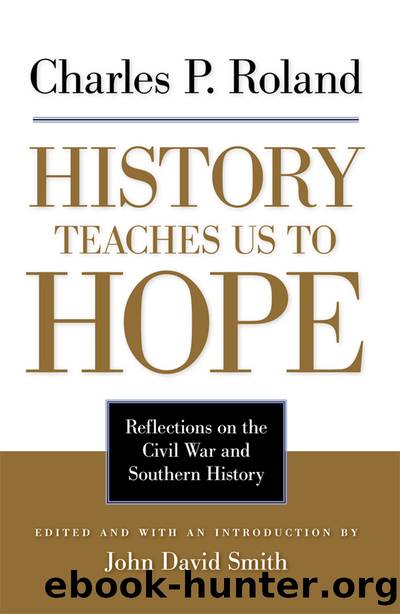
Author:Charles P. Roland
Language: eng
Format: epub
Publisher: The University Press of Kentucky
Published: 2007-10-15T00:00:00+00:00
For near a century, most students of the art of war have looked with unqualified admiration upon the generalship of Lee. Early Northern historians of the Civil War lavished praise upon him: James Ford Rhodes attributed chiefly to Leeâs talents the Southâs unsurpassed power of resistance; John C. Ropes said of Lee, âNo army commander on either side was so universally believed in, so absolutely trusted. Nor was there ever a commander who better deserved the support of his Government and the affection and confidence of his soldiers.â General Viscount Wolseley of England believed that Lee was the most skillful of American generals. Colonel G. F. R. Henderson, one of the nineteenth centuryâs most perceptive military analysts, called Lee âone of the greatest, if not the greatest, soldier who ever spoke the English tongue.â Sir Frederic Maurice, critic of strategy both ancient and modern, placed Lee among the most illustrious commanders of the ages. After studying the careers of the most renowned generals of the last hundred years, Cyril Falls concludes that Lee is the greatest of them all. âLee alone in a century of warfare deserves to be ranked with Hannibal and Napoleon,â says Falls. Denis W. Brogan, keenest of present European students of American history, says that Lee was the supreme military leader of the Civil War. Grantâs solutions were adequate but seldom elegant, says Brogan; Leeâs solutions were frequently elegant. The man who is perhaps todayâs greatest living scholar-warrior and surest connoisseur of military leadership seconds these exalted estimates of Lee. Winston Churchill writes, âLee was one of the greatest captains known to the annals of war.â38
Critics arise from time to time to challenge the grounds of Leeâs fame. They have found human failings in him; but frequently their complaints against his generalship cancel one another out. Lee was too rash and combative, says one: Lee was excessively slow and cautious, says another. Lee did not take advantage of the Southâs interior lines, says one: Lee clung to the obsolete concept of interior lines, says another. Lee failed to concentrate the forces of the Confederacy, says one: Lee was preoccupied with the outworn principle of concentration, says another. Lee was a slave to Jomini, says one: Lee violated Jominiâs fundamental principle of war, says another. Criticism of Lee thus often ends in a confusion of tongues.
Certainly Lee was mortal: notwithstanding remarkable accomplishments, his military leadership fell short of the abstract yardstick of perfection. Major criticisms of Lee as a strategist have already been considered in this essay: that he was too provincial to see the war as a whole, and too conservative to break the fetters of the past. Without laboring all of the minor criticisms of Lee, a few may be scrutinized here.39
It has been said that Lee did not see the relationship between strategy and statecraft in modern war. This is true in that Lee deferred excessively to Davis and refused to seize dictatorial authority in a belated effort to save the Confederacy. But on a higher plane the criticism is not true.
Download
This site does not store any files on its server. We only index and link to content provided by other sites. Please contact the content providers to delete copyright contents if any and email us, we'll remove relevant links or contents immediately.
The Vikings: Conquering England, France, and Ireland by Wernick Robert(84207)
Ali Pasha, Lion of Ioannina by Eugenia Russell & Eugenia Russell(40247)
The Conquerors (The Winning of America Series Book 3) by Eckert Allan W(37392)
The Vikings: Discoverers of a New World by Wernick Robert(36977)
Cecilia; Or, Memoirs of an Heiress — Volume 1 by Fanny Burney(32551)
Cecilia; Or, Memoirs of an Heiress — Volume 2 by Fanny Burney(31950)
Cecilia; Or, Memoirs of an Heiress — Volume 3 by Fanny Burney(31934)
Empire of the Sikhs by Patwant Singh(23078)
The Secret History by Donna Tartt(19065)
Hans Sturm: A Soldier's Odyssey on the Eastern Front by Gordon Williamson(18582)
Cat's cradle by Kurt Vonnegut(15343)
Pimp by Iceberg Slim(14492)
Sapiens: A Brief History of Humankind by Yuval Noah Harari(14375)
Talking to Strangers by Malcolm Gladwell(13355)
Norse Mythology by Gaiman Neil(13354)
Leonardo da Vinci by Walter Isaacson(13321)
4 3 2 1: A Novel by Paul Auster(12382)
Underground: A Human History of the Worlds Beneath Our Feet by Will Hunt(12093)
The Radium Girls by Kate Moore(12022)
