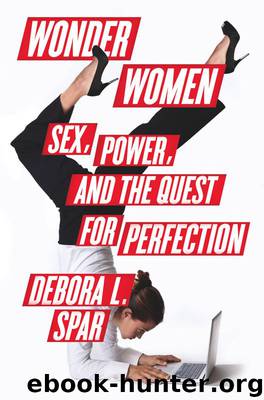
Wonder Women: Sex, Power, and the Quest for Perfection by Spar Debora L
Author:Spar, Debora L. [Spar, Debora L.]
Language: eng
Format: epub
Publisher: Farrar, Straus and Giroux
Published: 2013-09-17T00:00:00+00:00
The Madness of Mothering
Meanwhile, much of what’s driving our contemporary frenzy is the advent of übermothering. Parents today, and mothers in particular, are no longer just caring for their children, or even doting upon them. Instead they are investing massive amounts of time in managing their children’s lives, from the mobiles they watch in infancy to the triple majors they pursue in college. Seduced yet again by the cult of perfection, busy women—accomplished women, ambitious women—are heaving themselves onto their offspring, investing considerable chunks of their time, talents, and energy in the productions formerly known as kids.
Once upon a time—in, say, the golden days of the 1950s—the barriers between children and their parents were rigid and fairly wide. Parents were expected to love their children, of course, and to tend to them, but it was a hands-off kind of loving that was generally presumed, and a minimal amount of tending. Indeed, according to the bible of midcentury childrearing, Dr. Spock’s Common Sense Book of Baby and Child Care, “Bringing up your child won’t be a complicated job if you take it easy, trust your own instincts, and follow the directions that your doctor gives you.”25 It wasn’t quite the Victorian standard of children being seen but not heard, but neither was it a close and cuddly kind of love. Dr. Spock told his parents to be firm with their children rather than indulgent. To listen to them, but also to clearly lay out the rules. “It is easy,” Spock warns, “to fall into the habit of saying ‘Do you want to get into your high chair and have lunch?’ … The trouble is that the natural response of the child … is ‘No’ … It is better not to give him a choice.”26 June Cleaver, the archetypal wife of midcentury America, was a Spockian mom; so were Donna Reed and Carol Brady. Indeed, the Spockian mom hews fairly closely to the Good Wife ideal: the toys are in place, the home is tranquil, and the kids are washed, combed, and smiling. Just look at how the mothers of Mad Men are portrayed. They’re spending so much time playing cards and mixing martinis that they can barely find their children.
Today, by contrast, good mothers are expected not only to be able to find their children (which is surely a good thing) but indeed to be with them nearly every moment of the day, planning their activities, prompting their curiosity, and tending to their every need. Poor Dr. Spock has been relegated to the attic, replaced by counselors such as Penelope Leach and William Sears, who preach a far more intensive and all-consuming style. According to Leach, for example, the “pain of separation” that occurs each time a mother leaves her child with a new babysitter is akin to the “grieving of a baby who loses her one and only special person.”27 According to Sears, good mothers practice “attachment parenting,” a “close attachment after birth and beyond [that] allows the natural, biological
Download
This site does not store any files on its server. We only index and link to content provided by other sites. Please contact the content providers to delete copyright contents if any and email us, we'll remove relevant links or contents immediately.
| Anthropology | Archaeology |
| Philosophy | Politics & Government |
| Social Sciences | Sociology |
| Women's Studies |
Cecilia; Or, Memoirs of an Heiress — Volume 1 by Fanny Burney(32548)
Cecilia; Or, Memoirs of an Heiress — Volume 2 by Fanny Burney(31947)
Cecilia; Or, Memoirs of an Heiress — Volume 3 by Fanny Burney(31932)
The Great Music City by Andrea Baker(31917)
We're Going to Need More Wine by Gabrielle Union(19034)
All the Missing Girls by Megan Miranda(15959)
Pimp by Iceberg Slim(14488)
Bombshells: Glamour Girls of a Lifetime by Sullivan Steve(14058)
For the Love of Europe by Rick Steves(13915)
Talking to Strangers by Malcolm Gladwell(13350)
Norse Mythology by Gaiman Neil(13349)
Fifty Shades Freed by E L James(13233)
Mindhunter: Inside the FBI's Elite Serial Crime Unit by John E. Douglas & Mark Olshaker(9324)
Crazy Rich Asians by Kevin Kwan(9279)
The Lost Art of Listening by Michael P. Nichols(7494)
Enlightenment Now: The Case for Reason, Science, Humanism, and Progress by Steven Pinker(7306)
The Four Agreements by Don Miguel Ruiz(6745)
Bad Blood by John Carreyrou(6611)
Weapons of Math Destruction by Cathy O'Neil(6267)
