Why Can't I Get Better?: Solving the Mystery of Lyme and Chronic Disease by Richard Horowitz
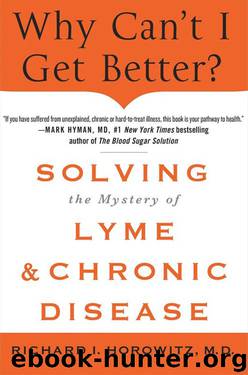
Author:Richard Horowitz [Horowitz, Richard]
Language: eng
Format: epub, mobi
Publisher: St. Martin's Press
Published: 2013-11-11T22:00:00+00:00
ADRENAL DYSFUNCTION
The next most common endocrine abnormality that occurs for MSIDS patients is adrenal dysfunction. In medical school I was taught that there were two main forms of adrenal disease: Addison’s syndrome, which is adrenal failure, and Cushing’s syndrome, which is due to an overactive adrenal gland. One could recognize Addison’s disease by its major clinical features of fatigue, weight loss, anorexia (loss of appetite), gastrointestinal complaints of nausea, vomiting, and occasional diarrhea, with hyperpigmentation, low sodium (hyponatremia), and mildly elevated potassium levels. Cushing’s disease, on the other hand, is due to elevated levels of cortisol and is responsible for obesity, hypertension, diabetes, hyperpigmentation (similar to the pigmentation seen in Addison’s disease), acne, hirsutism (increased hair growth), memory problems, and decreased resistance to infection. Yet we now know that there is a spectrum of adrenal dysfunction that lies between these two diseases, which is what typically presents in Lyme disease patients with MSIDS.
During times of extended or extreme stress, the adrenal glands go into a “fight or flight” mode and secrete high levels of hormones, such as DHEA, aldosterone, and cortisol. Cortisol’s main functions include a proactive mode, in which it helps coordinate circadian rhythms, such as sleeping and eating, and processes involved in attention, learning, and memory. But it also has a reactive mode, which enables us to adapt to and cope with stress. We know that Lyme disease patients are under huge amounts of stress, both mentally and physically. The stress can be caused by the multiple infections that they are dealing with as well as by the illness and its consequences on their jobs, families, and friends. Our patients often have elevated levels of cortisol, either throughout the day or at night, when they are desperately trying to get to sleep. These interfere with their already disturbed sleep patterns, worsening their insomnia. Giving the patients phosphatidylserine at night (and up to three times per day) with adaptogenic herbs during the day, such as rhodiola, ashwagandha, and ginseng, and B vitamins, vitamin C, and pantothenic acid will help lower the stress response and support and rebalance the adrenal glands.
Cortisol receptors are found throughout the central nervous system and are especially abundant in the limbic system and hippocampus, the parts of the brain involved with mood, learning, and memory. Chronically elevated levels of cortisol eventually may lead to adrenal fatigue and burnout. When cortisol levels are chronically too high or too low, the hippocampus, the center for memory and attention, is affected. Some research suggests that severe stress can even cause atrophy of the hippocampus, which is associated with recurrent clinical depression, posttraumatic stress disorder, and mild/moderate cognitive impairment, and may be associated with the breakdown of the blood-brain barrier. We know, for example, that severely stressed Vietnam veterans and women who are sexually abused display an 8 percent shrinkage in the hippocampus. Patients like these will experience fatigue, food cravings, mood changes, and memory problems, many of the same symptoms commonly seen in those with non-Lyme-MSIDS (especially with Mycoplasma spp.
Download
Why Can't I Get Better?: Solving the Mystery of Lyme and Chronic Disease by Richard Horowitz.mobi
This site does not store any files on its server. We only index and link to content provided by other sites. Please contact the content providers to delete copyright contents if any and email us, we'll remove relevant links or contents immediately.
Men In Love by Nancy Friday(5234)
Everything Happens for a Reason by Kate Bowler(4734)
The Immortal Life of Henrietta Lacks by Rebecca Skloot(4576)
Why We Sleep by Matthew Walker(4434)
The Sports Rules Book by Human Kinetics(4379)
Not a Diet Book by James Smith(3410)
The Emperor of All Maladies: A Biography of Cancer by Siddhartha Mukherjee(3148)
Sapiens and Homo Deus by Yuval Noah Harari(3066)
Day by Elie Wiesel(2780)
Angels in America by Tony Kushner(2652)
A Burst of Light by Audre Lorde(2597)
Endless Forms Most Beautiful by Sean B. Carroll(2473)
Hashimoto's Protocol by Izabella Wentz PharmD(2371)
Dirty Genes by Ben Lynch(2313)
Reservoir 13 by Jon McGregor(2300)
Wonder by R J Palacio(2203)
And the Band Played On by Randy Shilts(2197)
The Immune System Recovery Plan by Susan Blum(2057)
Stretching to Stay Young by Jessica Matthews(2036)
