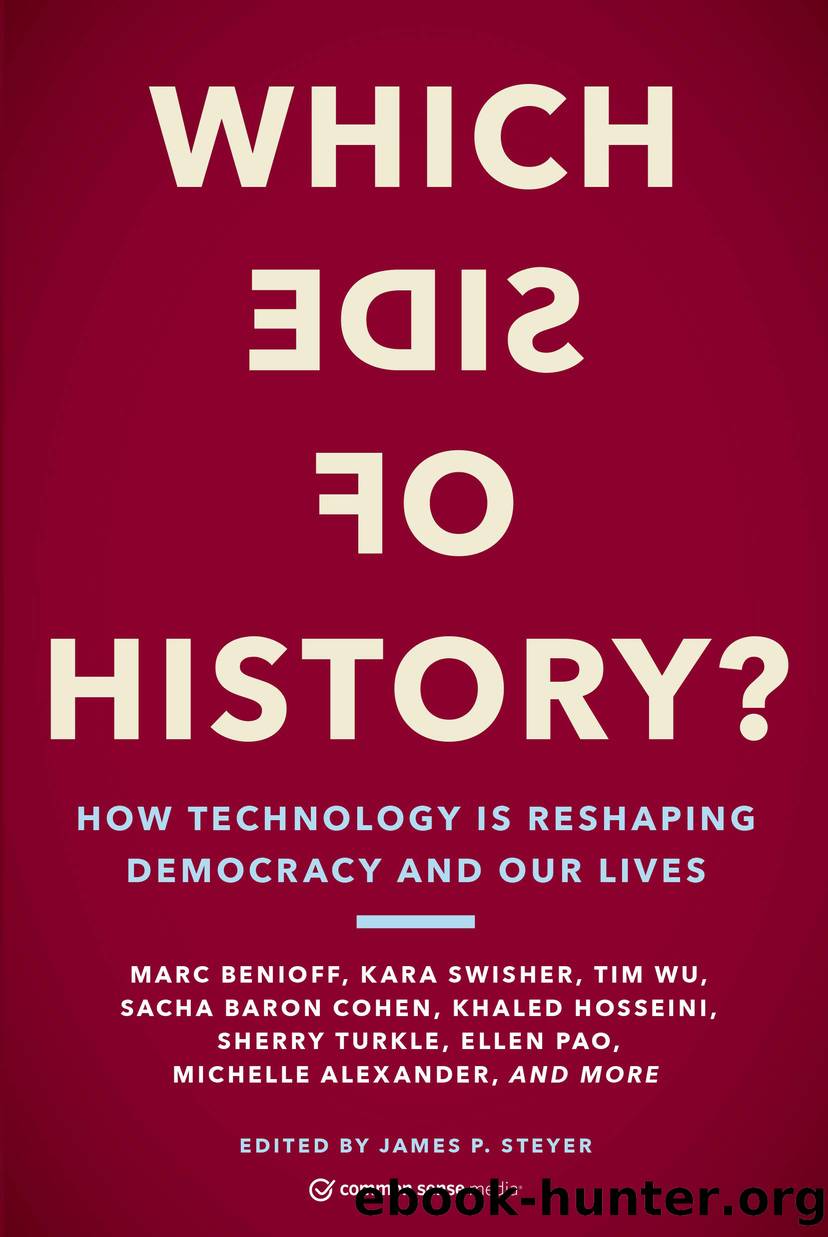
Which Side of History? by James P. Steyer
Author:James P. Steyer [James P. Steyer]
Language: eng
Format: epub
Publisher: Chronicle Books LLC
Published: 2020-08-16T05:19:58+00:00
Adapted from A Time to Build: From Family and Community to Congress and the Campus, How Recommitting to Our Institutions Can Revive the American Dream (New York: Basic Books, 2020).
Part 4
Where Big Tech Went Wrong
The Thief in Our Pockets: The Dark Side of Smart Tech
Laurie Santos
Laurie Santos is a professor of psychology, head of Silliman College at Yale University, and host of The Happiness Lab podcast.
Itâs January 9, 2007, and Steve Jobs is addressing a huge crowd at the MacWorld trade show conference. After an update about Appleâs ongoing work with Intel processors and Apple TV, Jobs looks away from the crowd and pauses. He takes a long sip of water and seems almost as though he is bracing himself for something big. âEvery once in a while,â he softly tells the crowd, âa revolutionary product comes along that changes everything. . . . Today, Apple is going to reinvent the phone, and here it is.â
That fateful afternoon, Apple introduced the world to the first iPhoneâââan entirely new kind of invention that combined mobile phone technology with a pocket-sized internet communications device. The iPhone also had the same kind of operating system and software as the best Mac computers, all the amazing music capabilities of the iPod, a state-of-the-art camera, and easy-to-use touchscreen controls. Each person on the planet could now have one of the most powerful technologies most human societies had ever known inside their pockets. Every song, video, news article, and fact on the internet was nowâââquite literallyâââat our swiping fingertips.
Jobsâs announcement boasted that the iPhone would reinvent the phone, but just over a decade later, itâs clear that his invention changed much more. We donât just use our smartphones to call a friend. Nowadays our phones are our photo albums, banks, cameras, newspapers, social clubs, camcorders, weather reports, alarm clocks, marketing departments, music libraries, televisions, movie theaters, travel agents, calendars, flashlights, video conferencing services, inboxes, magazines, maps, traffic reports, calculators, stock market experts, video game consoles, shopping carts, grocery stores, take-out counters, taxi services, step trackers, workout buddies, and porn collections. The smartphones of today have become the most captivating stimulus the human species has ever known. But what effect are these unprecedentedly huge bundles of information, entertainment, and services inside our pockets having on our real-life interactions?
A surprising hint comes from a rather unlikely economic indicatorâââchewing gum sales. In the decade since the iPhone hit our pockets in 2007, global gum sales have declined about 15 percent. To see why thatâs relevant, consider the last time you waited in line at the grocery store. If youâre like most people, you probably spent at least some of that time staring at your smartphone. In fact, one recent study found that 62 percent of people pulled out a device while waiting in line, and more than 80 percent of those people whipped that device out in less than twenty seconds. Just a few years earlier, standing in line felt very different. Back then, we felt boredâââso bored, in fact, that we wound up noticing the world around us.
Download
This site does not store any files on its server. We only index and link to content provided by other sites. Please contact the content providers to delete copyright contents if any and email us, we'll remove relevant links or contents immediately.
| Anthropology | Archaeology |
| Philosophy | Politics & Government |
| Social Sciences | Sociology |
| Women's Studies |
Cecilia; Or, Memoirs of an Heiress — Volume 1 by Fanny Burney(32558)
The Great Music City by Andrea Baker(32020)
Cecilia; Or, Memoirs of an Heiress — Volume 2 by Fanny Burney(31956)
Cecilia; Or, Memoirs of an Heiress — Volume 3 by Fanny Burney(31942)
We're Going to Need More Wine by Gabrielle Union(19049)
All the Missing Girls by Megan Miranda(16032)
Pimp by Iceberg Slim(14509)
For the Love of Europe by Rick Steves(14124)
Bombshells: Glamour Girls of a Lifetime by Sullivan Steve(14077)
Talking to Strangers by Malcolm Gladwell(13371)
Norse Mythology by Gaiman Neil(13370)
Fifty Shades Freed by E L James(13243)
Mindhunter: Inside the FBI's Elite Serial Crime Unit by John E. Douglas & Mark Olshaker(9344)
Crazy Rich Asians by Kevin Kwan(9293)
The Lost Art of Listening by Michael P. Nichols(7506)
Enlightenment Now: The Case for Reason, Science, Humanism, and Progress by Steven Pinker(7314)
The Four Agreements by Don Miguel Ruiz(6765)
Bad Blood by John Carreyrou(6623)
Weapons of Math Destruction by Cathy O'Neil(6281)
