When Helping Hurts: How to Alleviate Poverty Without Hurting the Poor . . . And Yourself by Steve Corbett & Brian Fikkert
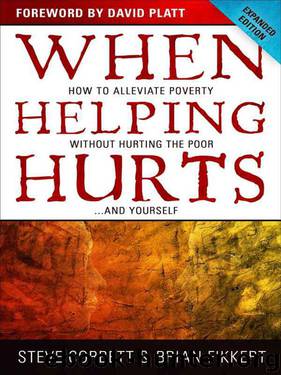
Author:Steve Corbett & Brian Fikkert [Corbett, Steve & Fikkert, Brian]
Language: eng
Format: epub
Tags: Non-Fiction, Religion, Spirituality
ISBN: 9780802457059
Goodreads: 6595233
Publisher: Moody Publishers
Published: 2009-06-24T00:00:00+00:00
Because of these types of pitfalls, many practitioners have abandoned the blueprint model in favor of a “learning process” approach to development, an approach that seeks to facilitate an action-reflection cycle in which poor people participate in all aspects of the project: proposing the best course of action, implementing the chosen strategy, evaluating how well things are working, and determining the appropriate modifications. The role of the outsider in this approach is not to do something to or for the economically poor individual or community but to seek solutions together with them.
A learning process approach increases the likelihood that the project will work well, for two main reasons. First, like all human beings, poor people are more likely to have a sense of enthusiasm for and ownership of a project if they have been full participants in it from the very beginning. When the project is “theirs,” they are more likely to sacrifice to make it work well and to sustain it over the long haul. Second, poor individuals and communities are highly complex and not well understood by the materially non-poor. Hence, the knowledge and skills of the insiders—the materially poor themselves—are vital to getting things done and to making things work well. People living in North American ghettos, in Appalachia, in slums in Mexico City, and in rural India really do know a lot of things about those contexts that outsiders will never understand. It is simply foolish to ignore their insights.
Ironically, while a learning process approach typically takes more time to produce tangible results than a blueprint approach, the learning process approach is often more efficient in the long run because it is more likely to result in workable and sustainable interventions. Put another way, participation can reduce the likelihood of unused equipment rusting away in the fields.
Download
This site does not store any files on its server. We only index and link to content provided by other sites. Please contact the content providers to delete copyright contents if any and email us, we'll remove relevant links or contents immediately.
| Anthropology | Archaeology |
| Philosophy | Politics & Government |
| Social Sciences | Sociology |
| Women's Studies |
Cecilia; Or, Memoirs of an Heiress — Volume 1 by Fanny Burney(32549)
Cecilia; Or, Memoirs of an Heiress — Volume 2 by Fanny Burney(31948)
Cecilia; Or, Memoirs of an Heiress — Volume 3 by Fanny Burney(31932)
The Great Music City by Andrea Baker(31918)
We're Going to Need More Wine by Gabrielle Union(19037)
All the Missing Girls by Megan Miranda(15965)
Pimp by Iceberg Slim(14489)
Bombshells: Glamour Girls of a Lifetime by Sullivan Steve(14061)
For the Love of Europe by Rick Steves(13950)
Norse Mythology by Gaiman Neil(13351)
Talking to Strangers by Malcolm Gladwell(13351)
Fifty Shades Freed by E L James(13233)
Mindhunter: Inside the FBI's Elite Serial Crime Unit by John E. Douglas & Mark Olshaker(9326)
Crazy Rich Asians by Kevin Kwan(9280)
The Lost Art of Listening by Michael P. Nichols(7497)
Enlightenment Now: The Case for Reason, Science, Humanism, and Progress by Steven Pinker(7307)
The Four Agreements by Don Miguel Ruiz(6747)
Bad Blood by John Carreyrou(6613)
Weapons of Math Destruction by Cathy O'Neil(6267)
