What You Are Getting Wrong About Appalachia by Elizabeth Catte
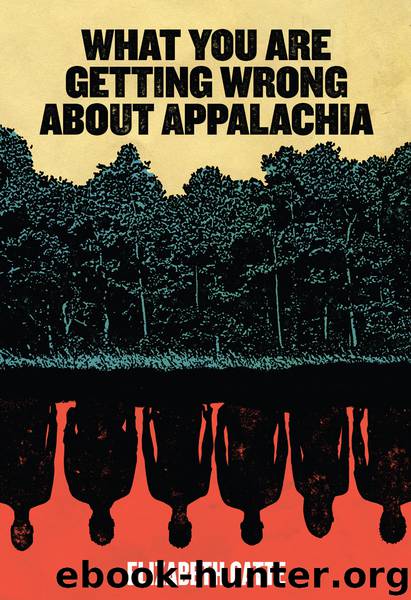
Author:Elizabeth Catte
Language: eng
Format: epub
Publisher: Belt Publishing
Published: 2018-02-15T00:00:00+00:00
THE (RE) DISCOVERY OF APPALACHIA
Before 2016, the last time the nation took such an obsessive interest in West Virginia’s politics was in 1960, when John F. Kennedy and Hubert Humphrey did battle during the state’s Democratic primary. Kennedy had had a promising but unconvincing first primary result in Wisconsin in April—his win came courtesy of the state’s substantial Catholic population—and West Virginia was next.
Kennedy campaigned throughout the entire state and by most accounts developed a genuine attachment to the people there, whom he often commended for their resilience in the face of economic distress. The people of West Virginia, in turn, awarded Kennedy with a victory in the state’s primary. His win in a state with a small Catholic population helped convince the Democratic establishment that he could be a viable presidential candidate and the rest, as they say, is history.
Images captured during Kennedy’s presidential campaign stops in West Virginia left an enduring impression on the nation. As Ronald Eller writes, “Kennedy’s visible alarm at the conditions of the Mountain State and the attention given to economic issues in the presidential campaign lured dozens of journalists in the months that followed the election. Stories of human tragedy, personal struggle, cruel injustice, and heroic perseverance abounded in Appalachia and provided grist for a growing media mill of articles about poverty in America.”
In August 1960, Julius Duscha wrote in the Washington Post, “Much of the Southern Appalachians is as underdeveloped, when compared with the affluence of the rest of the nation, as the newly independent countries of Africa.” His essay, “A Long Trail of Misery Winds the Proud Hills,” hinted at what would become a decidedly Cold War-era twist on long-standing narratives of Appalachian otherness: Appalachia as a third world within the heart of America.
This twist applied a particular post-war logic to the problems of Appalachia. If America was willing, this logic implied, to use its abundant wealth to help develop African countries striking out from their colonial pasts, then shouldn’t it apply the same effort and offer the same assistance to poor Appalachians at home? The myth of Appalachia as homogenous and white went far in capturing the attention of the nation. Photographers, journalists, and reformers stuck closely to this myth in capturing stories of an “other America” that would help fuel what would become the nation’s War on Poverty.
Into this moment came Kentucky writer and attorney Harry Caudill, a born and bred Appalachian spokesperson who had a storied career as the voice of a misunderstood region. In 1967, Caudill helped prosecute Hobart Ison for the murder of Hugh O’Connor, but in the early 1960s, he was at work on his exposé of coal mining, which he first published in 1962 in the Atlantic with the provocative title “The Rape of the Appalachians.”
Strip mining—the excavation of coal through the surface of soil and rock rather than via subterranean means—had recently become an established method of extraction in eastern Kentucky. This had resulted in broad changes to the landscape and labor practices in coal communities.
Download
This site does not store any files on its server. We only index and link to content provided by other sites. Please contact the content providers to delete copyright contents if any and email us, we'll remove relevant links or contents immediately.
| Anthropology | Archaeology |
| Philosophy | Politics & Government |
| Social Sciences | Sociology |
| Women's Studies |
The Great Music City by Andrea Baker(33662)
Cecilia; Or, Memoirs of an Heiress — Volume 1 by Fanny Burney(32724)
Cecilia; Or, Memoirs of an Heiress — Volume 2 by Fanny Burney(32090)
Cecilia; Or, Memoirs of an Heiress — Volume 3 by Fanny Burney(32067)
We're Going to Need More Wine by Gabrielle Union(19173)
All the Missing Girls by Megan Miranda(16724)
For the Love of Europe by Rick Steves(14922)
Pimp by Iceberg Slim(14800)
Bombshells: Glamour Girls of a Lifetime by Sullivan Steve(14220)
Norse Mythology by Gaiman Neil(13573)
Talking to Strangers by Malcolm Gladwell(13556)
Fifty Shades Freed by E L James(13352)
Mindhunter: Inside the FBI's Elite Serial Crime Unit by John E. Douglas & Mark Olshaker(9527)
Crazy Rich Asians by Kevin Kwan(9420)
The Lost Art of Listening by Michael P. Nichols(7622)
Enlightenment Now: The Case for Reason, Science, Humanism, and Progress by Steven Pinker(7432)
The Four Agreements by Don Miguel Ruiz(6915)
Bad Blood by John Carreyrou(6731)
Weapons of Math Destruction by Cathy O'Neil(6469)
