What Is Philosophy? (European Perspectives: A Series in Social Thought and Cultural Criticism) by Gilles Deleuze & Félix Guattari
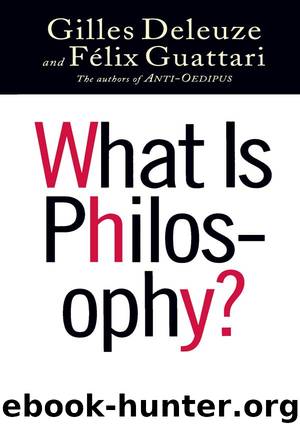
Author:Gilles Deleuze & Félix Guattari [Deleuze, Gilles]
Language: eng
Format: mobi
Tags: Surveys/General, PHI027000, Philosophy/Movements/Deconstruction, Philosophy/History &, PHI009000
Publisher: Columbia University Press
Published: 2014-12-08T16:00:00+00:00
6. Prospects and Concepts
Logic is reductionist not accidentally but essentially and necessarily: following the route marked out by Frege and Russell, it wants to turn the concept into a function. But this means first of all not only that the function must be defined in a mathematical or scientific proposition but that it characterizes a more general order of the proposition as what is expressed by the sentences of a natural language. Thus a new, specifically logical type of function must be invented. The propositional function âx is humanâ clearly shows the position of an independent variable that does not belong to the function as such but without which the function is incomplete. The complete function is made up of one or more âordered pairs.â A relation of dependence or correspondence (necessary reason) defines the function, so that âbeing humanâ is not itself the function, but the value of f(a) for a variable x. It hardly matters that most propositions have several independent variables or even that the notion of variable, insofar as it is linked to an indeterminate number, is replaced by that of argument, implying a disjunctive assumption within limits or an interval. The relation of the propositional function to the independent variable or argument defines the propositionâs reference or the functionâs truth value (âtrueâ or âfalseâ) for the argument: John is a man, but Bill is a cat. The set of a functionâs truth values that determine true affirmative propositions constitutes a conceptâs extension: the conceptâs objects occupy the place of variables or arguments of the propositional function for which the proposition is true, or its reference satisfied. Thus the concept itself is the function for the set of objects that constitute its extension. In this sense every complete concept is a set and has a determinate number; the conceptâs objects are the elements of the set.1
It is still necessary to determine the conditions of reference that provide the limits or intervals into which a variable enters in a true proposition: x is a man, John is a man, because he did this, because he appears in this way. Such conditions of reference constitute not the conceptâs comprehension but its intension. They are presentations or logical descriptions, intervals, potentials, or âpossible worlds,â as the logicians say, coordinate axes, states of affairs or situations, the conceptâs subsets: evening star and morning star. For example, a concept with a single element, the concept of Napoleon I, has for its intension âthe victor at Jena,â âthe one who was defeated at Waterloo.â There is no qualitative difference between intension and extension here since both concern reference, intension being simply the condition of reference and constituting an endoreference of the proposition, extension constituting the exoreference. Reference is not left behind by ascending to its condition; we remain within extensionality. The question is rather one of knowing how, through these intensional presentations, we arrive at a univocal determination of objects or elements of the concept, of propositional variables, and of arguments of the function from the point of view of exoreference (or of the representation).
Download
This site does not store any files on its server. We only index and link to content provided by other sites. Please contact the content providers to delete copyright contents if any and email us, we'll remove relevant links or contents immediately.
| Anthropology | Archaeology |
| Philosophy | Politics & Government |
| Social Sciences | Sociology |
| Women's Studies |
Cecilia; Or, Memoirs of an Heiress — Volume 1 by Fanny Burney(32548)
Cecilia; Or, Memoirs of an Heiress — Volume 2 by Fanny Burney(31947)
Cecilia; Or, Memoirs of an Heiress — Volume 3 by Fanny Burney(31932)
The Great Music City by Andrea Baker(31917)
We're Going to Need More Wine by Gabrielle Union(19035)
All the Missing Girls by Megan Miranda(15962)
Pimp by Iceberg Slim(14489)
Bombshells: Glamour Girls of a Lifetime by Sullivan Steve(14058)
For the Love of Europe by Rick Steves(13934)
Talking to Strangers by Malcolm Gladwell(13350)
Norse Mythology by Gaiman Neil(13349)
Fifty Shades Freed by E L James(13233)
Mindhunter: Inside the FBI's Elite Serial Crime Unit by John E. Douglas & Mark Olshaker(9324)
Crazy Rich Asians by Kevin Kwan(9280)
The Lost Art of Listening by Michael P. Nichols(7494)
Enlightenment Now: The Case for Reason, Science, Humanism, and Progress by Steven Pinker(7306)
The Four Agreements by Don Miguel Ruiz(6745)
Bad Blood by John Carreyrou(6612)
Weapons of Math Destruction by Cathy O'Neil(6267)
