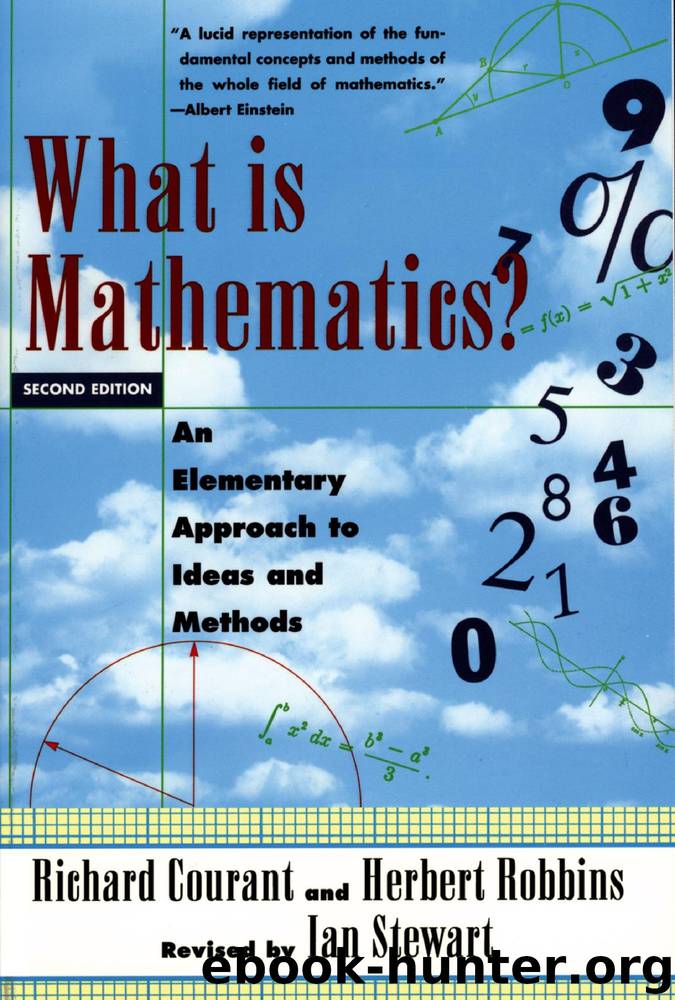
What Is Mathematics?: An Elementary Approach to Ideas and Methods, Second Edition by Richard Courant & Herbert Robbins & Ian Stewart
Author:Richard Courant & Herbert Robbins & Ian Stewart [Courant, Richard & Robbins, Herbert & Stewart, Ian]
Language: eng
Format: epub
Tags: Mathematics, General, Science & Math
ISBN: 9780195105193
Google: _kYBqLc5QoQC
Goodreads: 584620
Publisher: Oxford University Press
Published: 1996-01-02T06:00:00+00:00
Fig. 143. Closed surfaces defined by coördination of edges in plane figure.
Fig. 144. Three-dimensional torus defined by boundary identification.
Fig. 145. Another representation of three-dimensional torus. (Figure cut to show identification.)
APPENDIX
*1. The Five Color Theorem
On the basis of Euler’s formula, we can prove that every map on the sphere can be properly colored by using at most five different colors. (According to p. 247, a map is regarded as properly colored if no two regions having a whole segment of their boundaries in common receive the same color.) We shall confine ourselves to maps whose regions are bounded by simple closed polygons composed of circular arcs. We may also suppose that exactly three arcs meet at each vertex; such a map will be called regular. For if we replace every vertex at which more than three arcs meet by a small circle, and join the interior of each such circle to one of the regions meeting at the vertex, we obtain a new map in which the multiple vertices are replaced by a number of triple vertices. The new map will contain the same number of regions as the original map. If this new map, which is regular, can be properly colored with five colors, then by shrinking the circles down to points we shall have the desired coloring of the original map. Thus it suffices to prove that any regular map on the sphere can be colored with five colors.
First we show that every regular map must contain at least one polygon with fewer than six sides. Denote by Fn the number of regions of n sides in a regular map; then, if F denotes the total number of regions,
(1) F = F2 + F3 + F4 + · · ·.
Each arc has two ends, and three arcs end at each vertex. Hence, if E denotes the number of arcs in the map, and V the number of vertices,
(2) 2E = 3V.
Furthermore, a region bounded by n arcs has n vertices, and each vertex belongs to three regions, so that
(3) 2E = 3V = 2F2 + 3F3 + 4F4 + · · ·.
By Euler’s formula, we have
V – E + F = 2, or 6V – 6E + 6F = 12.
From (2), we see that 6V = 4E, so that 6F – 2E = 12.
Hence, from (1) and (3),
6(F2 + F3 + F4 + · · ·) – (2F2 + 3F3 + 4F4 + · · ·) = 12,
or
(6 – 2)F2 + (6 – 3)F3 + (6 – 4)F4 + (6 – 5)F5 + (6 – 6)F6 + (6 – 7)F7 + · · · = 12.
Hence at least one of the terms on the left must be positive, so that at least one of the numbers F2, F3, F4, F5 is positive, as we wished to show.
Now to prove the five color theorem. Let M be any regular map on the sphere with n regions in all. We know that at least one of these regions has fewer than six sides.
Download
This site does not store any files on its server. We only index and link to content provided by other sites. Please contact the content providers to delete copyright contents if any and email us, we'll remove relevant links or contents immediately.
The Art of Coaching by Elena Aguilar(53483)
Thinking, Fast and Slow by Kahneman Daniel(12463)
The Art of Thinking Clearly by Rolf Dobelli(10646)
The 5 Love Languages: The Secret to Love That Lasts by Gary Chapman(9943)
Mindhunter: Inside the FBI's Elite Serial Crime Unit by John E. Douglas & Mark Olshaker(9454)
When Breath Becomes Air by Paul Kalanithi(8539)
Periodization Training for Sports by Tudor Bompa(8362)
Becoming Supernatural by Dr. Joe Dispenza(8312)
Turbulence by E. J. Noyes(8151)
Bodyweight Strength Training by Jay Cardiello(7994)
Nudge - Improving Decisions about Health, Wealth, and Happiness by Thaler Sunstein(7780)
Therapeutic Modalities for Musculoskeletal Injuries, 4E by Craig R. Denegar & Ethan Saliba & Susan Saliba(7756)
The Road Less Traveled by M. Scott Peck(7690)
Mastermind: How to Think Like Sherlock Holmes by Maria Konnikova(7469)
Enlightenment Now: The Case for Reason, Science, Humanism, and Progress by Steven Pinker(7375)
Win Bigly by Scott Adams(7295)
Kaplan MCAT General Chemistry Review by Kaplan(7014)
Why We Sleep: Unlocking the Power of Sleep and Dreams by Matthew Walker(6803)
The Way of Zen by Alan W. Watts(6695)
