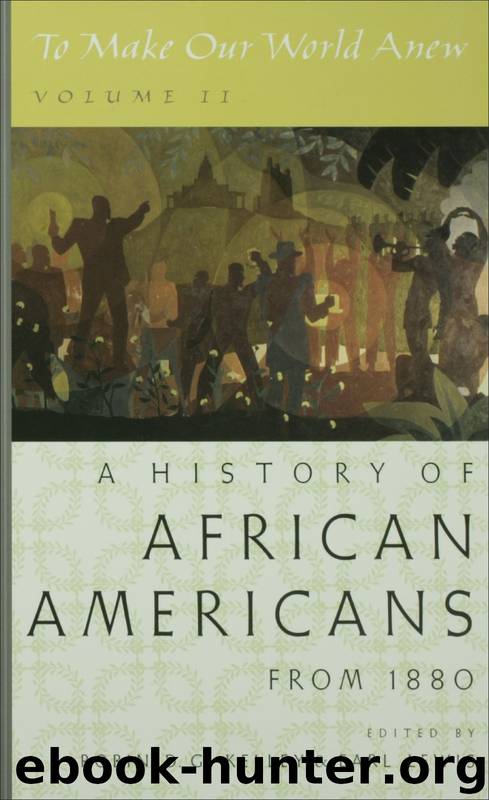
To Make Our World Anew by Kelley Robin D. G.; Lewis Earl;
Author:Kelley, Robin D. G.; Lewis, Earl;
Language: eng
Format: epub
Publisher: Oxford University Press USA - OSO
Published: 2000-05-21T04:00:00+00:00
Finally, on December 20, the Supreme Court mandate made its way to Montgomery, affirming the people and their audacious struggle. The next morning a restrained but happy group, including King, Abernathy, and Smiley, boarded the first desegregated bus, beginning a new phase of the long journey toward freedom and justice for all.
Old Order, New Order
By the time the victory was won in Montgomery, the struggle had lasted for more than a year. All along the way there were dramatic, compelling new events, bombings, indictments, rallies in other cities, and courtroom trials reminding people, especially black people, that the Montgomery movement was alive. Black folks had stuck together and grown together in the longest sustained campaign for justice that the nation had ever seen.
And, of course, the movement’s prime symbol, Martin Luther King, Jr., seemed to be everywhere, proclaiming and exemplifying the emergence of a new people and a new time. By the time the legal victory was announced in Montgomery, it appeared that King was right: It was far more than a victory for the black walkers of Montgomery (although that victory certainly needed to be savored and celebrated), and wherever people claimed the fruits of the long ordeal, a powerful energy of hope and a sense of new possibilities appeared.
Sometimes the Montgomery connections to other places in the nation was obvious. In cities such as Mobile and Birmingham, Alabama, and nearby Tallahassee, Florida, ministers tried to repeat the Montgomery success with their own bus boycotts. In January 1957 King and the Fellowship of Reconciliation brought together some sixty representatives of these and other boycott movements to a conference in Atlanta. They discussed the possibility of forming a regional organization based on the Montgomery experience. Before the summer of 1957 was over, King and his fellow black ministers had established the Southern Christian Leadership Conference (SCLC).
The major early accomplishments of SCLC were the sponsorship of several conferences and organizing, with Bayard Rustin and A. Philip Randolph, a “prayer pilgrimage” of about twenty thousand people in Washington, D.C., who were calling for civil rights legislation. SCLC also hoped to undertake a “Crusade for Citizenship,” projected as a massive Southwide voter-registration campaign based in the black churches. Due to lack of personnel, planning, and finances, this campaign never materialized.
Even with its provocative founding announcement that “we have come to redeem the soul of America” and the predictable choice of King as president, the mostly Baptist group was not, however, able to focus and mobilize the new energies in the ways that King, his Alabama comrades, and his Northern allies had hoped. This was partly because the approximately one hundred men (there were only men in mainstream black church leadership) who formed the core of the SCLC were only a small minority of the black ministers of the South. And, besides, SCLC’s ministers had had no real experience in forming a regional organization that would be both flexible and open to new strategies yet also structured enough to mount a sustained challenge to the system of legal segregation.
Download
This site does not store any files on its server. We only index and link to content provided by other sites. Please contact the content providers to delete copyright contents if any and email us, we'll remove relevant links or contents immediately.
| Anthropology | Archaeology |
| Philosophy | Politics & Government |
| Social Sciences | Sociology |
| Women's Studies |
The Great Music City by Andrea Baker(32739)
Cecilia; Or, Memoirs of an Heiress — Volume 1 by Fanny Burney(32665)
Cecilia; Or, Memoirs of an Heiress — Volume 2 by Fanny Burney(32029)
Cecilia; Or, Memoirs of an Heiress — Volume 3 by Fanny Burney(32012)
We're Going to Need More Wine by Gabrielle Union(19128)
All the Missing Girls by Megan Miranda(16443)
Pimp by Iceberg Slim(14720)
For the Love of Europe by Rick Steves(14686)
Bombshells: Glamour Girls of a Lifetime by Sullivan Steve(14154)
Norse Mythology by Gaiman Neil(13483)
Talking to Strangers by Malcolm Gladwell(13477)
Fifty Shades Freed by E L James(13314)
Mindhunter: Inside the FBI's Elite Serial Crime Unit by John E. Douglas & Mark Olshaker(9455)
Crazy Rich Asians by Kevin Kwan(9371)
The Lost Art of Listening by Michael P. Nichols(7573)
Enlightenment Now: The Case for Reason, Science, Humanism, and Progress by Steven Pinker(7377)
The Four Agreements by Don Miguel Ruiz(6861)
Bad Blood by John Carreyrou(6694)
Weapons of Math Destruction by Cathy O'Neil(6406)
