ThermoPoetics by Gold Barri J
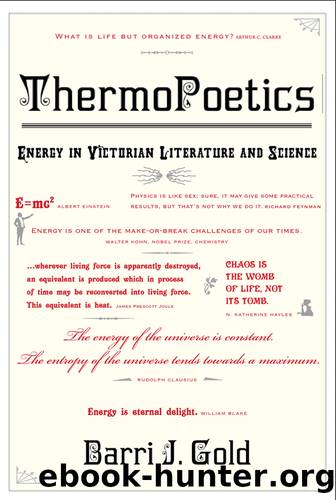
Author:Gold, Barri J. [Gold, Barri J.]
Language: eng
Format: epub
ISBN: 9780262288279
Publisher: MIT Press
Published: 2010-11-15T00:00:00+00:00
III The Engine and the Demon: Transformations
5 Bleak House: The Novel as Engine
We may regard the Universe in the light of a vast physical machine.
âBalfour Stewart1
In this house, we obey the laws of thermodynamics.
âHomer Simpson (on Lisaâs discovery of a perpetual motion machine)2
Engineering Entropy
If the first law of thermodynamics was born of religious conviction,3 the second was the discovery of frustrated engineers. Jouleâs experiments, Kelvinâs articulations, Clausiusâs nomenclatureâall of these attempt to account for the heat loss driving engineers a little batty since before the time of Sadi Carnot. Engineers struggled to make more efficient engines; heat loss kept getting in the way. One could put fuel in and get work out, but always less than was hoped for or even expected and never reversibly. But not for lack of trying. And the trying, after all, turns out to be very important. Sydney Carton, as we have seen, quite effectively manages to produce more work than was expected. He is Dickensâs tool for producing novelistic order within the constraints of thermodynamicsâfor manufacturing what some like to call a happy ending. But Carton is not the production of a moment. By the time Dickens wrote A Tale of Two Cities, he had already done quite a bit of tinkering with producing order in spite of entropy. In Dickensâs Bleak House we find evidence of this tinkering. For while A Tale gestures back toward an earlier time and physical sensibility, mostly critically (as in the case of Monseigneur) but also with some nostalgia (as with Mr. Lorryâs watch), Bleak House was actually published about seven years earlier.4 And in spite of Dickensâs well-known, if qualified optimism, one might reasonably expect Bleak House to be bleak. Nor does the novel disappoint. It does, in fact, manifest a profound sense of entropic decay. Like so many of the decadent texts of the late century (more on these in the next chapter), it seems almost overwhelmed by entropy. How, we may reasonably ask, is this possible? After all, the term entropy was a decade away. But engineers were struggling to make better engines long before the scientific object entropy came into being. And like them, Bleak House struggles with the list of features that will become entropyâthe tendency of all systems to decay, the difficulty of maintaining order or producing work.5 But at the moment of its emergence, the new scientific object has ââno other shape than this listââ of answers to laboratory trials, this list of what it does when you do stuff to it. As Bruno Latour says, ââIf you add an item to this list, you redefine the object, that is, you give it a new shape.ââ6 Energy is precisely the list of things it can do: the things it turns into, the fact that it is always conserved. Something that could be suddenly created or destroyed by ââmanâs agencyââ alone would not be the scientific object we have come to know and love as energy. Similarly, if it decreases spontaneously (without, say, someone putting work into the system), I donât know what it is, but itâs not entropy.
Download
This site does not store any files on its server. We only index and link to content provided by other sites. Please contact the content providers to delete copyright contents if any and email us, we'll remove relevant links or contents immediately.
Whiskies Galore by Ian Buxton(42169)
Introduction to Aircraft Design (Cambridge Aerospace Series) by John P. Fielding(33250)
Rewire Your Anxious Brain by Catherine M. Pittman(18810)
Craft Beer for the Homebrewer by Michael Agnew(18360)
Cat's cradle by Kurt Vonnegut(15565)
Sapiens: A Brief History of Humankind by Yuval Noah Harari(14558)
Leonardo da Vinci by Walter Isaacson(13530)
The Tidewater Tales by John Barth(12756)
Thinking, Fast and Slow by Kahneman Daniel(12538)
Underground: A Human History of the Worlds Beneath Our Feet by Will Hunt(12237)
The Radium Girls by Kate Moore(12193)
The Art of Thinking Clearly by Rolf Dobelli(10721)
Mindhunter: Inside the FBI's Elite Serial Crime Unit by John E. Douglas & Mark Olshaker(9532)
A Journey Through Charms and Defence Against the Dark Arts (Harry Potter: A Journey Throughâ¦) by Pottermore Publishing(9340)
Tools of Titans by Timothy Ferriss(8602)
Wonder by R. J. Palacio(8249)
Turbulence by E. J. Noyes(8220)
Change Your Questions, Change Your Life by Marilee Adams(7938)
Nudge - Improving Decisions about Health, Wealth, and Happiness by Thaler Sunstein(7863)
