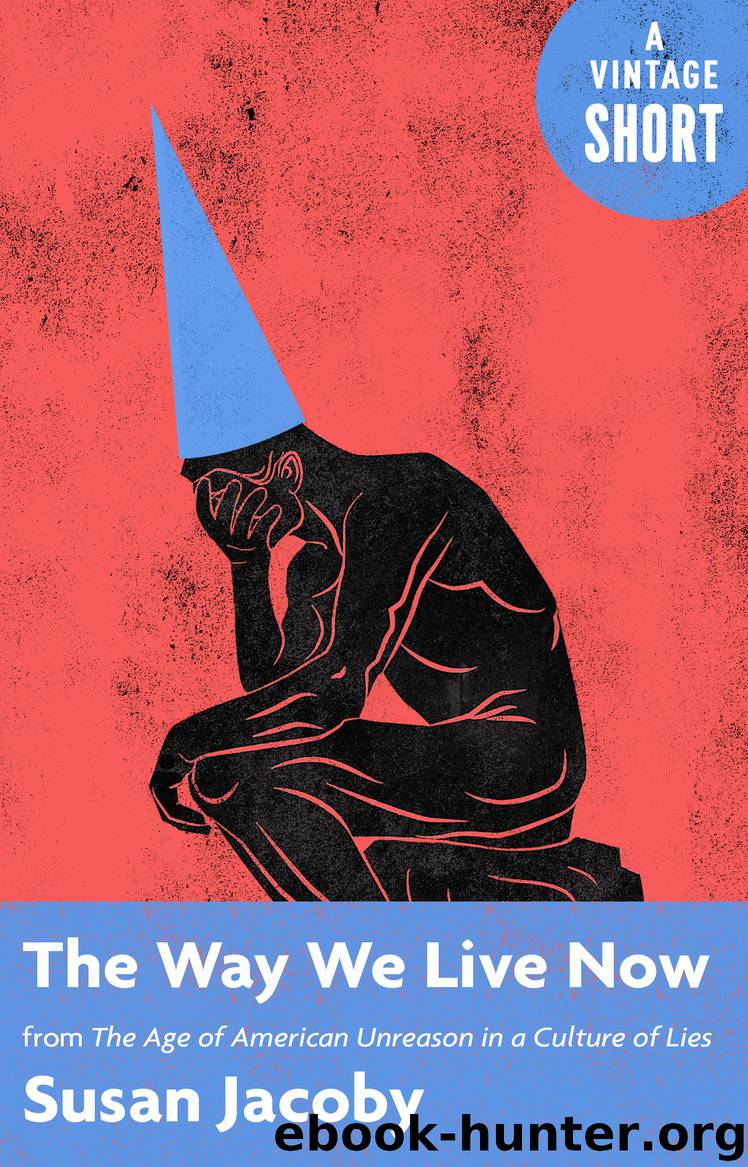
The Way We Live Now by Susan Jacoby
Author:Susan Jacoby
Language: eng
Format: epub
Publisher: Knopf Doubleday Publishing Group
Published: 2018-10-01T16:00:00+00:00
* * *
—
THE SECOND MAJOR spur to anti-intellectualism during the past forty years has been the resurgence of fundamentalist religion. Modern media, with their overt and covert appeal to emotion rather than reason, are ideally suited to assist in the propagation of a form of faith that stands opposed to most of the great rationalist insights that have transformed Western civilization since the beginning of the Enlightenment. Triumphalist Christian fundamentalism, mainly though not entirely Protestant, is based on the conviction that every word in the Bible is literally true and was handed down by God Himself. Public opinion polls conducted during the past four years have consistently found that more than one third of Americans believe in a literal interpretation of the Bible, while nearly six in ten believe that the bloody predictions in the Book of Revelation—which involve the massacre of everyone who has not accepted Jesus as the Messiah—will come true.11
Beginning with the radio evangelist Billy Sunday in the twenties, American fundamentalists, with their black-and-white view of every issue, have made effective use of each new medium of mass communication. Liberal religion, with its many shades of gray and determination to make room for secular knowledge in the house of faith, does not lend itself as readily to media packaging and is at an even greater disadvantage in the visual media than it was on the radio. From the rantings of Pat Robertson on the 700 Club to Mel Gibson’s 2004 movie The Passion of the Christ, religion comes across most powerfully on video when it is unmodified by secular thought and learning, makes an attempt to appeal to anything but emotion, and leaves no room for doubt. Gibson’s Passion, for instance, is rooted in a Roman Catholic brand of fundamentalism, long rejected by the Vatican itself, that takes the Gospel of Matthew literally and blames Jews for the crucifixion of Jesus. The core audience for the immensely popular movie in the United States was drawn not from mainstream Catholics, whose faith does not rest on biblical literalism, but from right-wing Protestants.
Even when the entertainment media are not promoting a particular version of religion, they do promote and capitalize on widespread American credulity regarding the supernatural. In recent years, television has commissioned an unceasing stream of programs designed to appeal to a vast market of viewers who believe in ghosts, angels, and demons. More than half of American adults believe in ghosts, one third believe in astrology, three quarters believe in angels, and four fifths believe in miracles.12 The American marketing of the Apocalypse is a multimedia production, capitalizing on fundamentalism and paranoid superstition. Mainstream denominations have long downplayed the predictions in Revelation, which modern biblical scholars say was written at least sixty years after the death of the historical Jesus and has only the most tenuous relationship to the Gospels. One of the many rational developments rejected by fundamentalism, however, is biblical scholarship since the mid-nineteenth century. Who cares what some pointy-headed intellectual has to say about
Download
This site does not store any files on its server. We only index and link to content provided by other sites. Please contact the content providers to delete copyright contents if any and email us, we'll remove relevant links or contents immediately.
| Africa | Americas |
| Arctic & Antarctica | Asia |
| Australia & Oceania | Europe |
| Middle East | Russia |
| United States | World |
| Ancient Civilizations | Military |
| Historical Study & Educational Resources |
Cat's cradle by Kurt Vonnegut(15363)
Pimp by Iceberg Slim(14520)
4 3 2 1: A Novel by Paul Auster(12400)
Underground: A Human History of the Worlds Beneath Our Feet by Will Hunt(12101)
The Radium Girls by Kate Moore(12035)
Wiseguy by Nicholas Pileggi(5793)
The Fire Next Time by James Baldwin(5452)
Perfect Rhythm by Jae(5410)
American History Stories, Volume III (Yesterday's Classics) by Pratt Mara L(5310)
Paper Towns by Green John(5195)
Pale Blue Dot by Carl Sagan(5012)
A Higher Loyalty: Truth, Lies, and Leadership by James Comey(4966)
The Mayflower and the Pilgrims' New World by Nathaniel Philbrick(4507)
The Doomsday Machine by Daniel Ellsberg(4492)
Killers of the Flower Moon: The Osage Murders and the Birth of the FBI by David Grann(4449)
The Sympathizer by Viet Thanh Nguyen(4396)
Too Much and Not the Mood by Durga Chew-Bose(4351)
The Borden Murders by Sarah Miller(4330)
Sticky Fingers by Joe Hagan(4204)
