The War That Forged a Nation by McPherson James M.;
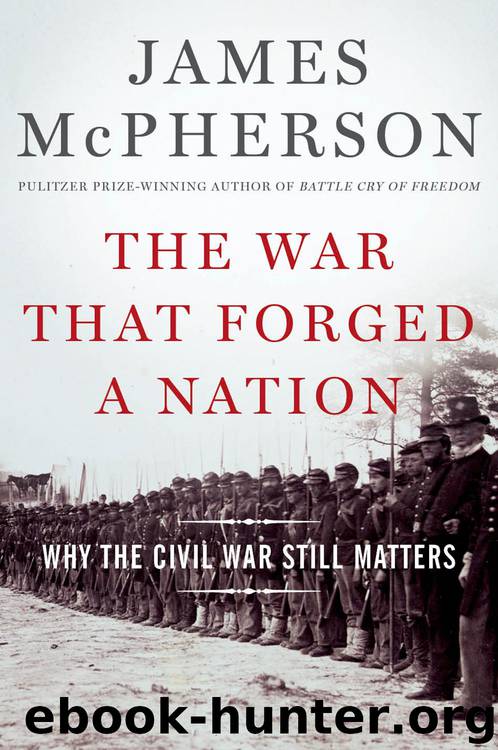
Author:McPherson, James M.;
Language: eng
Format: epub
Publisher: Oxford University Press
Published: 2015-01-13T05:00:00+00:00
chapter 9
A. Lincoln, Commander in Chief
When the American Civil War began with the Confederate attack on Fort Sumter, U.S. president Abraham Lincoln was far less prepared for the task of commander in chief than his Southern adversary. Jefferson Davis had graduated from West Point, served in the regular army for seven years, commanded a regiment that fought intrepidly at Buena Vista in the Mexican War, and compiled a record as an outstanding secretary of war in the Franklin Pierce administration from 1853 to 1857. Lincoln’s only military experience had come twenty-nine years earlier, when he was captain of a militia unit that saw no action in the Black Hawk War. During Lincoln’s one term in Congress, he made a speech in 1848 mocking his military career. “Did you know I am a military hero?” he said. “I fought, bled, and came away” after “charges upon the wild onions” and “a good many bloody struggles with the Musquetoes.”1
When he called state militias into federal service on April 15, 1861, to put down “combinations too powerful to be suppressed by the ordinary course of judicial proceedings,” Lincoln therefore faced a steep learning curve as commander in chief. He went at the task diligently. His experience as a largely self-taught lawyer with a keen analytical mind who had mastered Euclidean geometry for mental exercise enabled him to learn on the job. He read and absorbed works on military history and strategy; he observed the successes and failures of his own and the enemy’s military commanders and drew apt conclusions; he made mistakes and learned from them; he applied his large quotient of common sense to slice through the obfuscations and excuses of military subordinates. By 1862 his grasp of strategy and operations was firm enough almost to justify the overstated but not entirely wrong conclusion of the historian T. Harry Williams in 1952: “Lincoln stands out as a great war president, probably the greatest in our history, and a great natural strategist, a better one than any of his generals.”2 This assertion was incorrect in one respect: Lincoln was not a “natural strategist”; he had to work hard to achieve a grasp of strategy.
Williams belonged to a generation of historians who recognized that Lincoln’s role as commander in chief was central to his place in history. The sixteenth president has been (so far) the only one whose presidency was wholly bounded by war. On the day Lincoln took office, the first document placed on his desk was a letter from Major Robert Anderson at Fort Sumter, informing him that the garrison there must be withdrawn or resupplied at the risk of war. Lincoln chose to take that risk. Four years later he was assassinated five days after General Robert E. Lee surrendered at Appomattox but while several other Confederate armies were still in the field.
During those four years Lincoln spent more time in the War Department telegraph office than anywhere else except the White House or his summer residence at the Soldiers’ Home. Military matters required more of his time and energy than anything else.
Download
This site does not store any files on its server. We only index and link to content provided by other sites. Please contact the content providers to delete copyright contents if any and email us, we'll remove relevant links or contents immediately.
| Africa | Americas |
| Arctic & Antarctica | Asia |
| Australia & Oceania | Europe |
| Middle East | Russia |
| United States | World |
| Ancient Civilizations | Military |
| Historical Study & Educational Resources |
Cat's cradle by Kurt Vonnegut(15359)
Pimp by Iceberg Slim(14508)
4 3 2 1: A Novel by Paul Auster(12393)
Underground: A Human History of the Worlds Beneath Our Feet by Will Hunt(12099)
The Radium Girls by Kate Moore(12030)
Wiseguy by Nicholas Pileggi(5787)
The Fire Next Time by James Baldwin(5448)
Perfect Rhythm by Jae(5404)
American History Stories, Volume III (Yesterday's Classics) by Pratt Mara L(5308)
Paper Towns by Green John(5191)
Pale Blue Dot by Carl Sagan(5010)
A Higher Loyalty: Truth, Lies, and Leadership by James Comey(4964)
The Mayflower and the Pilgrims' New World by Nathaniel Philbrick(4504)
The Doomsday Machine by Daniel Ellsberg(4490)
Killers of the Flower Moon: The Osage Murders and the Birth of the FBI by David Grann(4448)
The Sympathizer by Viet Thanh Nguyen(4393)
Too Much and Not the Mood by Durga Chew-Bose(4348)
The Borden Murders by Sarah Miller(4325)
Sticky Fingers by Joe Hagan(4202)
