The Sputnik Challenge by Divine Robert A.;
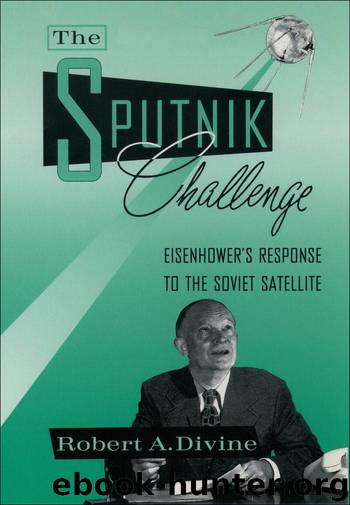
Author:Divine, Robert A.; [Divine, Robert A.;]
Language: eng
Format: epub
ISBN: 9780195050080
Publisher: Oxford University Press
Published: 1993-01-15T07:00:00+00:00
II
In the early months of 1958, Dwight Eisenhower went through his winter of discontent. He could not seem to shake off a nagging cold. His throat was sore and his voice husky, and the result, noted his secretary, Ann Whitman, was “a correspondingly bad temper.” In January Sherman Adams called the White House staff together, asking everyone to work as hard as possible to relieve the president of unnecessary burdens. “This man is not what he was,” Adams confessed. James Killian recalled that in a meeting in early February, stung by the constant chorus of criticism, Ike put his head down on his desk and “remarked that he didn’t know whether his poor brain was going to be able to take it or not.”12
The press quickly picked up hints of the president’s malaise. John Fischer, the editor of Harper’s, issued a call for his resignation. Citing Eisenhower’s heart attack, ileitis, and recent stroke, Fischer felt that it would be best for both Ike and the nation for him to step down. At a time when the country desperately needed someone in charge, we had “a leaky ship, with a committee on the bridge and a crippled captain sending occasional whispers up the speaking tube from his sick bay.” Periodicals on the left, ranging from the Progressive to the New Republic, also wanted Ike to resign, but others, such as the Reporter, feared that Nixon would offer little improvement.
The most serious sign of public disenchantment came in late February when Time, usually the president’s strongest booster, expressed deep concern over Eisenhower’s stamina and ability to lead the nation. Reporting that he had spent most of the month on George Humphrey’s Georgia plantation recuperating from his cold, the story portrayed Ike as playing bridge, napping, and doing very little work each day. White House aides claimed that the president still worked hard when he was in Washington but admitted that he tended to run out of steam as the day progressed. Time’s most damaging disclosure was the staff estimate that the president had cut back about 25 percent on his workload since his November stroke.13
On February 25 Eisenhower returned to the White House to face his critics. Ann Whitman noted that he had shaken off the cold completely and seemed to be “in better spirits than any time in the last three months.” An old army friend, General Alfred Gruenther, thought Ike had never “looked better, either mentally or physically.” When a thorough medical exam showed him fully recovered from the stroke, Ann Whitman commented, “Certainly he seems to be—he looks wonderfully well, and most importantly, has regained his sense of humor and desire to get into things.” The president himself, asked at a press conference about Time’s claim that he had cut back 25 percent on his work schedule, flashed his famous grin and replied, “I wish it were reduced, but—no, I don’t think it has at all.”14
Public opinion polls taken in the winter of 1958 reflected an ambivalent attitude toward Eisenhower’s leadership.
Download
This site does not store any files on its server. We only index and link to content provided by other sites. Please contact the content providers to delete copyright contents if any and email us, we'll remove relevant links or contents immediately.
| Africa | Americas |
| Arctic & Antarctica | Asia |
| Australia & Oceania | Europe |
| Middle East | Russia |
| United States | World |
| Ancient Civilizations | Military |
| Historical Study & Educational Resources |
Cat's cradle by Kurt Vonnegut(15362)
Pimp by Iceberg Slim(14514)
4 3 2 1: A Novel by Paul Auster(12396)
Underground: A Human History of the Worlds Beneath Our Feet by Will Hunt(12100)
The Radium Girls by Kate Moore(12033)
Wiseguy by Nicholas Pileggi(5791)
The Fire Next Time by James Baldwin(5451)
Perfect Rhythm by Jae(5408)
American History Stories, Volume III (Yesterday's Classics) by Pratt Mara L(5309)
Paper Towns by Green John(5194)
Pale Blue Dot by Carl Sagan(5012)
A Higher Loyalty: Truth, Lies, and Leadership by James Comey(4965)
The Mayflower and the Pilgrims' New World by Nathaniel Philbrick(4506)
The Doomsday Machine by Daniel Ellsberg(4492)
Killers of the Flower Moon: The Osage Murders and the Birth of the FBI by David Grann(4449)
The Sympathizer by Viet Thanh Nguyen(4396)
Too Much and Not the Mood by Durga Chew-Bose(4349)
The Borden Murders by Sarah Miller(4328)
Sticky Fingers by Joe Hagan(4204)
