The Rhetoric of Racist Humour by Weaver Simon
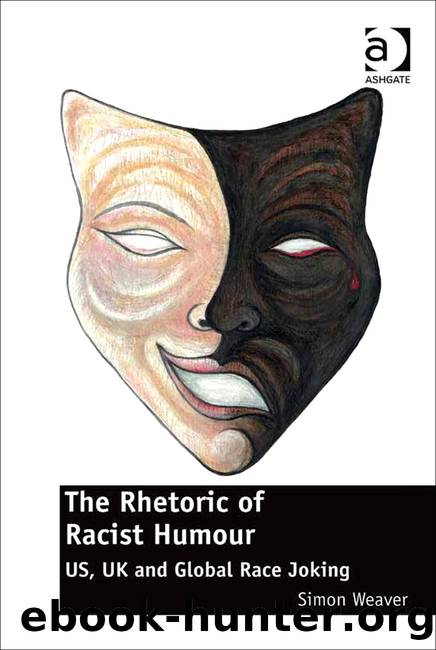
Author:Weaver, Simon.
Language: eng
Format: epub
Publisher: Taylor & Francis (CAM)
Published: 2011-11-15T00:00:00+00:00
2) National Identity and Boundary Maintenance â Space and Exclusion in Humour
The second rhetorical theme that seeks resolution in culturally racist humour focuses on the âotherâ as a transgressor of national boundaries. This is primarily an ambivalence or anxiety generated if the âotherâ is perceived to cross these boundaries, and becomes the subject of humour coupled with proteophobic expression. In being connected to nationalism, it is one of the more prominent subjects of cultural racism.
The theme focuses on frontiers, which are highlighted as the dichotomous nature of national boundaries. This can be extended to include a number of regional or super-national boundaries. The âotherâ who moves into the home territory across the national frontier can create racist anxiety. Humour offers a rhetorical expression of this anxiety and a resolution of the âproblemâ through an imaginary placement of the âotherâ in the âcorrectâ category. As Marotta suggests â[t]he Other or the stranger, from the perspective of the will-to-order, epitomizes chaos and thus is a potential threat to the stable and fixed boundariesâ (2002: 39). Cultural racism represents a reductionist account of the incompatibility of different cultures, and in its worst form, is a racism that sees cultural segregation as necessary (Miles 1989: 62â4). In humour, the theme of segregation is given rhetorical strength through its enactment in the realm of linguistic fantasy. This appears as the expression of proteophobia in culturally racist joking. These jokes move through various types of segregation, which include preventing the arrival, the removal, and in the extreme form, the death of the cultural âotherâ. Each stage of proteophobia can allow an additional rhetorical strengthening, aside from that resolution offered in co-agitation, by removing the âotherâ that is responsible for its generation. Once again, when coupled with humorous co-agitators, they provide a strengthened rhetorical resolution of the âproblemsâ confronted by cultural racism.
Parekh summarises the culturally racist view of nationalism and boundary maintenance, obsessed with the idea of national decline, that consists of beliefs that see a âloss of national identity, a weakening of the sense of patriotism and the decline of public culture and spiritâ (1986: 34). The perspective of this âweakenedâ Britishness is reasserted and attached to an image of a natural or essential British culture (1986: 35). Parekh describes culturally racist constructions of Britishness as incoherent. He states that it âis so obviously incoherent and confused that, had it not found some support in influential circles, one would leave it alone to collapse under the weight of its own contradictionsâ (1986: 38â9). What such commentators omit is that this incoherence can be rhetorically supported or resolved by humour, which helps prevent its âcollapseâ.3
The âothersâ who transgress national boundaries are described in several ways â the asylum seeker, the illegal immigrant, the refugee and the immigrant worker. Balibar proposes that cultural racism will actually substitute arguments of race for those of immigration as a part of its coding exercise (1991: 20). He argues that â[t]he functioning of the category of immigration [acts] as a substitute for the notion of raceâ (1991: 20.
Download
This site does not store any files on its server. We only index and link to content provided by other sites. Please contact the content providers to delete copyright contents if any and email us, we'll remove relevant links or contents immediately.
| Anthropology | Archaeology |
| Philosophy | Politics & Government |
| Social Sciences | Sociology |
| Women's Studies |
Cecilia; Or, Memoirs of an Heiress — Volume 1 by Fanny Burney(32544)
Cecilia; Or, Memoirs of an Heiress — Volume 2 by Fanny Burney(31942)
Cecilia; Or, Memoirs of an Heiress — Volume 3 by Fanny Burney(31928)
The Great Music City by Andrea Baker(31915)
We're Going to Need More Wine by Gabrielle Union(19033)
All the Missing Girls by Megan Miranda(15944)
Pimp by Iceberg Slim(14481)
Bombshells: Glamour Girls of a Lifetime by Sullivan Steve(14050)
For the Love of Europe by Rick Steves(13894)
Talking to Strangers by Malcolm Gladwell(13345)
Norse Mythology by Gaiman Neil(13344)
Fifty Shades Freed by E L James(13232)
Mindhunter: Inside the FBI's Elite Serial Crime Unit by John E. Douglas & Mark Olshaker(9317)
Crazy Rich Asians by Kevin Kwan(9275)
The Lost Art of Listening by Michael P. Nichols(7488)
Enlightenment Now: The Case for Reason, Science, Humanism, and Progress by Steven Pinker(7306)
The Four Agreements by Don Miguel Ruiz(6744)
Bad Blood by John Carreyrou(6610)
Weapons of Math Destruction by Cathy O'Neil(6264)
