The Republic: The Fight for Irish Independence, 1918-1923 by Townshend Charles
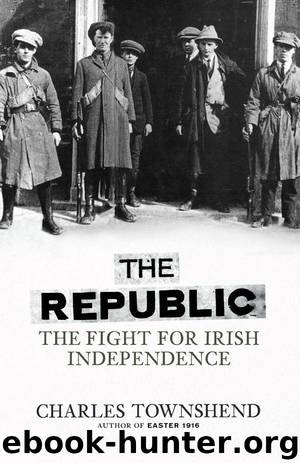
Author:Townshend, Charles [Townshend, Charles]
Language: eng
Format: mobi
ISBN: 9780241003497
Publisher: Penguin Books Ltd
Published: 2013-09-25T23:00:00+00:00
‘TINKERING WITH THE HONOUR OF THE NATION’
In March GHQ set out to assess ‘the war as a whole’. It divided the country into four – the ‘War Zone’ (the area under martial law in the south-west), the secondary country areas, the Dublin area and ‘Ulster’. Surprisingly, perhaps, it classed the south-west, formidable as its forces were in comparison to those in the rest of the country outside Dublin, as ‘a secondary theatre’. This was because its ‘geographical circumstances’ made it ‘impossible to ever secure a decision within it’. GHQ argued that if ‘feeding the battle in the War Zone resulted in a real deprivation of other areas, then it would mean that the Enemy had secured the initiative and was making us conform to his strategy’ (though just what that was GHQ sensibly did not say). An ‘exact balance’ must be achieved. The factor GHQ identified as vital was that, unlike any previous struggle for independence, ‘the National Military Command is securely established in Dublin.’ In all previous efforts, the English hold on the capital had ‘turned the scale’.65
Its grand strategy therefore hinged entirely on Dublin. ‘The grip of our forces on Dublin must be maintained and strengthened at all costs,’ while ‘strong flanking units’ in the rural hinterland should ‘bring the Capital into closer touch with the Country’. Ulster, which had now become the ‘vital bridgehead’ for the English with their ‘loss’ of Dublin, must be ‘attacked steadily and persistently’. But the message was unequivocal – ‘it cannot be too clearly stated that no number or any magnitude of victories in any distant provincial areas have any value if Dublin is lost in a military sense.’66 The terminology used here – like ‘flanks’, ‘bridgeheads’ and ‘winning’ and ‘losing’ a city – lay at an odd tangent to the IRA’s developing doctrine of guerrilla warfare, the war ‘without fronts’. It was indeed potentially quite misleading if it was read in a technical rather than metaphorical sense, and it would perhaps have a bearing on GHQ’s eventual view of the possibilities of continued resistance.
It is not easy to evaluate the IRA’s performance at the height of the war. The repeated failure of operations did not necessarily indicate weakness. Attempted ambushes, even if abandoned, arguably showed that the Volunteers were in business, that public support was keeping their movements safe, and perhaps that the Crown forces were keeping out of the way.67 This may have been particularly true in urban areas like Cork and Dublin, where guerrilla action was difficult, police and military were present in strength and could more easily vary their patrol routes. Even so, most Volunteers probably did not see things like that. They hankered after dramatic action. There was a hope, even in ‘quiet areas’ – of which there were too many, as GHQ well knew – of emulating the most aggressive Volunteer units. But the odds against doing this were lengthening rather than shortening in 1921. Despite GHQ’s persistent efforts, the War Zone was never significantly enlarged.
Download
This site does not store any files on its server. We only index and link to content provided by other sites. Please contact the content providers to delete copyright contents if any and email us, we'll remove relevant links or contents immediately.
| Africa | Americas |
| Arctic & Antarctica | Asia |
| Australia & Oceania | Europe |
| Middle East | Russia |
| United States | World |
| Ancient Civilizations | Military |
| Historical Study & Educational Resources |
Room 212 by Kate Stewart(5211)
The Crown by Robert Lacey(4886)
Endurance: Shackleton's Incredible Voyage by Alfred Lansing(4872)
The Iron Duke by The Iron Duke(4430)
The Rape of Nanking by Iris Chang(4286)
Joan of Arc by Mary Gordon(4181)
Killing England by Bill O'Reilly(4069)
Say Nothing by Patrick Radden Keefe(4066)
I'll Give You the Sun by Jandy Nelson(3526)
Shadow of Night by Deborah Harkness(3442)
Hitler's Monsters by Eric Kurlander(3417)
Eleanor & Park by Rainbow Rowell(3287)
Blood and Sand by Alex Von Tunzelmann(3264)
Mary, Queen of Scots, and the Murder of Lord Darnley by Alison Weir(3261)
Darkest Hour by Anthony McCarten(3192)
Margaret Thatcher: The Autobiography by Thatcher Margaret(3139)
Book of Life by Deborah Harkness(3006)
Red Famine: Stalin's War on Ukraine by Anne Applebaum(2986)
The One Memory of Flora Banks by Emily Barr(2921)
