The Religious Worlds of the Laity in Late Antique Gaul by Lisa Kaaren Bailey;
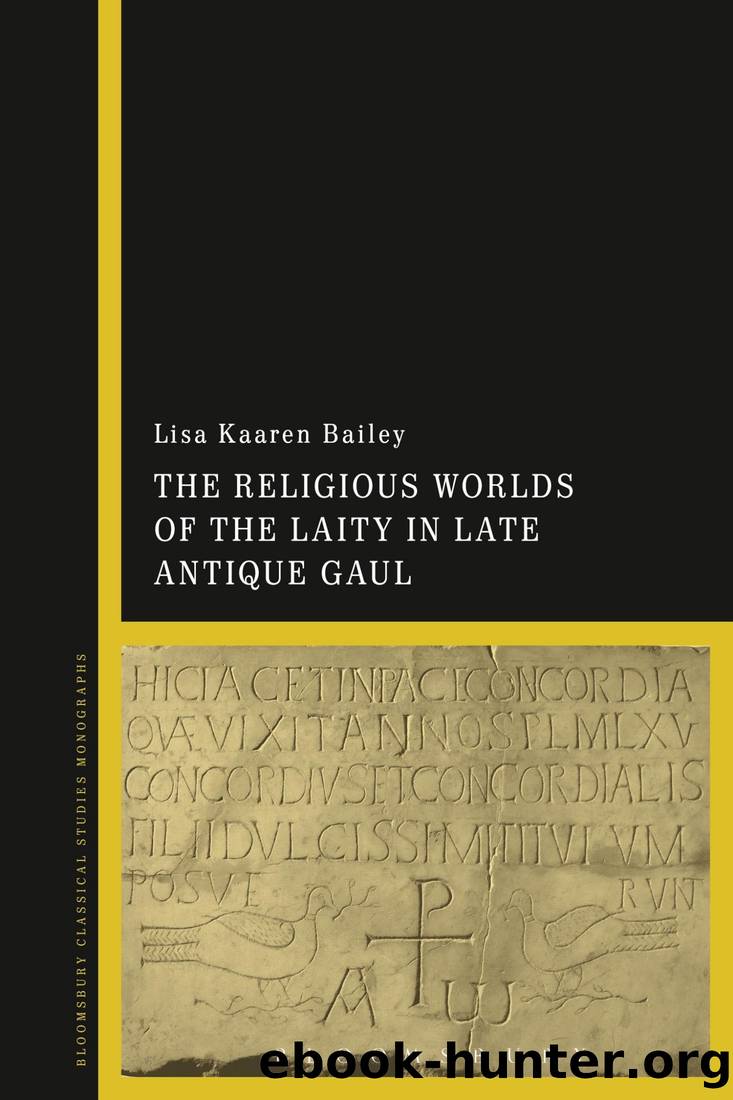
Author:Lisa Kaaren Bailey; [Bailey, Lisa Kaaren]
Language: eng
Format: epub
ISBN: 9781472519047
Publisher: Bloomsbury
Published: 2016-01-27T06:00:00+00:00
Men who are not able to give rather abundant alms should at least with a good intention dispense a little something according to their strength. Those who are unable to retain the glory of virginity should at least, with Godâs help, strive to observe chastity with their own wives ⦠Now these and similar actions, dearly beloved, are proven not to be excessively difficult or insupportable.36
Caesarius repeatedly emphasized that God did not expect more from anyone than they were capable of giving â if you cannot fast, or keep vigils, you can love your enemies and give charity.37 If you cannot give charity, give wise counsel, or a cup of cold water.38 As a result, married lay people could also find their path to heaven. âMarried people who have observed mutual fidelity ⦠if they continually give alms and observe Godâs precepts as well as they can, will merit happily to be associated with holy Job, Sara, and Susanna, along with the patriarchs and prophets.â39
As all of this makes clear, Caesarius did not expect the same from all Christians. He was explicit that the expectations upon clergy and ascetics were significantly higher than upon lay Christians. Marriage, he explained, was the lowest of the three professions within the church available to women, the higher two being widowhood and virginity.40 As an ascetic and a cleric, Caesarius still thoroughly endorsed a hierarchy within Christian communities. Nonetheless, in sermon 135 he made it clear that commitments at every level had to be taken seriously. âThere is, indeed, a common standard for all men. Not to commit adultery is a precept for married people (nuptae) as well as for religious (sanctimoniali) ⦠Not to steal is a precept for all men.â41 The same, he went on to point out, was true for drunkenness, pride and murder. The ascetic path was not the only way to virtue. Perhaps, he worried, when he was preaching, someone would reflect and say: âI am young and married, how can I cut my hair or assume the religious habit?â Caesarius hastened to assure such an anxious person that this would not be required. âHow can a married man be harmed if he is willing to change his evil habits to good and noble works, and if by almsgiving, fasting and prayer he is anxious to restore the wounds of his sins to their former healthy condition? For such a man it is enough to have a true conversion without any change of garments.â42 Living entirely without sin was impossible even for saints.43 Lay people, in Caesariusâ mind, should simply strive to do the best they could, and hope that God would judge them kindly.
Caesariusâ approach to lay virtue was to provide lists of ideal behaviours, but not all preachers took the same tack. The sermons in the Eusebius Gallicanus collection offered very few lists of approved behaviours or sets of moral instructions. On the whole, the tone of this collection was far more meditative and vague, with sermons extolling general principles of common decency, rather than prescriptions for heaven.
Download
This site does not store any files on its server. We only index and link to content provided by other sites. Please contact the content providers to delete copyright contents if any and email us, we'll remove relevant links or contents immediately.
| Belgium | France |
| Germany | Great Britain |
| Greenland | Italy |
| Netherlands | Romania |
| Scandinavia |
Room 212 by Kate Stewart(5211)
The Crown by Robert Lacey(4886)
Endurance: Shackleton's Incredible Voyage by Alfred Lansing(4872)
The Iron Duke by The Iron Duke(4430)
The Rape of Nanking by Iris Chang(4286)
Joan of Arc by Mary Gordon(4181)
Killing England by Bill O'Reilly(4069)
Say Nothing by Patrick Radden Keefe(4066)
I'll Give You the Sun by Jandy Nelson(3527)
Shadow of Night by Deborah Harkness(3442)
Hitler's Monsters by Eric Kurlander(3417)
Eleanor & Park by Rainbow Rowell(3288)
Blood and Sand by Alex Von Tunzelmann(3264)
Mary, Queen of Scots, and the Murder of Lord Darnley by Alison Weir(3263)
Darkest Hour by Anthony McCarten(3192)
Margaret Thatcher: The Autobiography by Thatcher Margaret(3139)
Book of Life by Deborah Harkness(3006)
Red Famine: Stalin's War on Ukraine by Anne Applebaum(2986)
The One Memory of Flora Banks by Emily Barr(2921)
