The Old Regime and the French Revolution by Alexis de Tocqueville
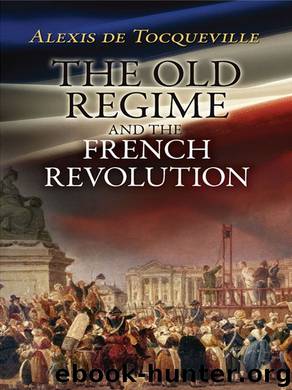
Author:Alexis de Tocqueville
Language: eng
Format: epub
ISBN: 9780486117522
Publisher: Dover Publications
Published: 2012-10-16T04:00:00+00:00
CHAPTER XV.
HOW THE FRENCH SOUGHT REFORMS BEFORE LIBERTIES.
IT is noteworthy that of all the ideas and feelings which prepared the Revolution, the idea of political liberty, properly so called, was the last to make its appearance, as the desire for it was the first to vanish.
The old edifice of government had long been insecure; it shook, though no man struck it. Voltaire was hardly thinking of it. Three years’ residence in England had enabled him to understand that country without falling in love with it. He was delighted with the skeptical philosophy that was freely taught among the English, but he was not struck with their political laws, which he rather criticised than praised. His letters on England, which are one of his master-pieces, hardly contain any allusion to Parliament: he envies the English their literary liberty, but cares little for their political liberty, as though the one could exist for any length of time without the other.
About the middle of the century, a class of writers devoted their attention to administrative questions; they had many points in common, and were hence distinguished by the general name of economists or physiocrats. They are less conspicuous in history than the philosophers; they exercised a less direct influence in causing the Revolution, but still I think its true nature can best be studied in their writings. The philosophers confined themselves, for the most part, to abstract and general theories on the subject of government; the economists dealt in theories, but also deigned to notice facts. The former furnished ideal, the latter practical schemes of reform. They assailed alternately all the institutions which the Revolution abolished; not one of them found favor in their eyes. All those, on the other hand, which are credited especially to the Revolution, were announced beforehand and warmly lauded by them: it is not easy to mention one whose substantial features are not to be found in some of their writings.
Their books, moreover, breathe that democratic and revolutionary spirit with which we are so familiar. They hate, not certain specific privileges, but all distinctions of classes; they would insist upon equality of rights in the midst of slavery. Obstacles they regard as only fit to be trampled on. They respect neither contracts nor private rights; indeed, they hardly recognize individual rights at all in their absorbing devotion to the public good. Yet they were quiet, peaceable men, of respectable character, honest magistrates, able administrators; they were carried away by the peculiar spirit of their task.
Their contempt for the past was unbounded. “ The nation,” said Letronne, “ is governed on wrong principles; every thing seems to have been left to chance.” Starting from this idea, they set to work to demand the demolition of every institution, however old and time-honored, which seemed to mar the symmetry of their plans. Forty years before the Constituent Assembly divided France into departments, one of the economists suggested the alteration of all existing territorial divisions and of the names of all the provinces.
Download
This site does not store any files on its server. We only index and link to content provided by other sites. Please contact the content providers to delete copyright contents if any and email us, we'll remove relevant links or contents immediately.
| Africa | Americas |
| Arctic & Antarctica | Asia |
| Australia & Oceania | Europe |
| Middle East | Russia |
| United States | World |
| Ancient Civilizations | Military |
| Historical Study & Educational Resources |
Room 212 by Kate Stewart(5130)
The Crown by Robert Lacey(4821)
Endurance: Shackleton's Incredible Voyage by Alfred Lansing(4790)
The Iron Duke by The Iron Duke(4367)
The Rape of Nanking by Iris Chang(4224)
Joan of Arc by Mary Gordon(4119)
Killing England by Bill O'Reilly(4008)
Say Nothing by Patrick Radden Keefe(3992)
I'll Give You the Sun by Jandy Nelson(3452)
Shadow of Night by Deborah Harkness(3377)
Hitler's Monsters by Eric Kurlander(3352)
Mary, Queen of Scots, and the Murder of Lord Darnley by Alison Weir(3216)
Blood and Sand by Alex Von Tunzelmann(3207)
Eleanor & Park by Rainbow Rowell(3185)
Darkest Hour by Anthony McCarten(3137)
Margaret Thatcher: The Autobiography by Thatcher Margaret(3087)
Book of Life by Deborah Harkness(2943)
Red Famine: Stalin's War on Ukraine by Anne Applebaum(2940)
The One Memory of Flora Banks by Emily Barr(2871)
