The Medieval Tournament As Spectacle by Alan V. Murray;Karen Watts; & Karen Watts
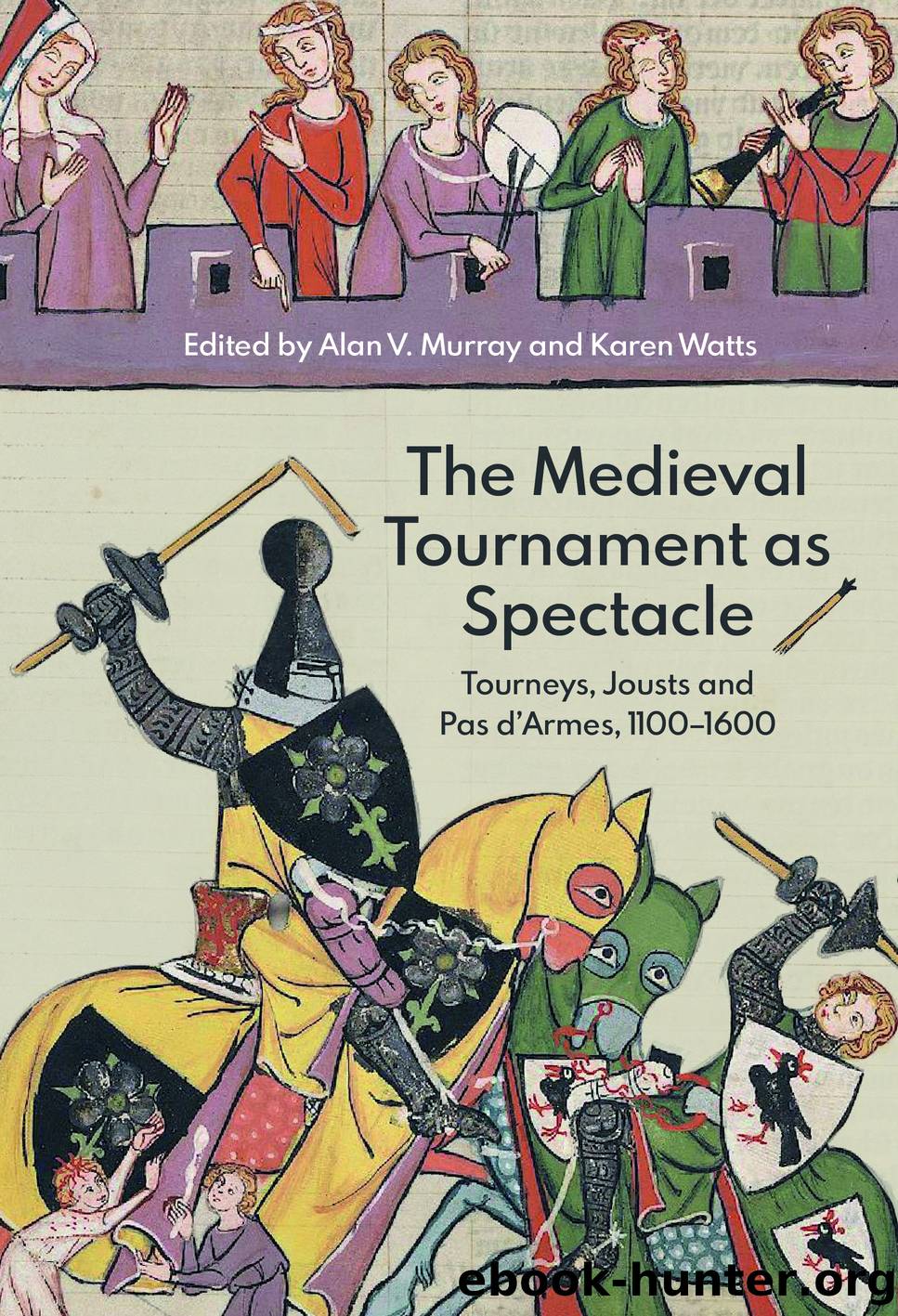
Author:Alan V. Murray;Karen Watts; & Karen Watts
Language: eng
Format: epub
Publisher: Boydell & Brewer
Published: 2020-08-21T00:00:00+00:00
6
Between Sport and Theatre: How Spectacular was the Pas dâarmes?
Catherine Blunk
Picture medieval knights and squires charging towards each other on horseback, striking helmets or shields and breaking lances: it is spectacular. Men in shining armour striking each other with swords or poleaxes, and groups of men exchanging blows in a mêlée must have been spectacular as well, even if their weapons were blunted. Noblemen performing deeds of arms in pas dâarmes during the fifteenth century competed in all three types of combat. Yet it is generally thought by those familiar with the pas dâarmes that it was more spectacular than other jousts and emprises due to its theatricality.1
Definitions of the pas dâarmes commonly indicate that theatrical production is one of its defining features. The following passage, for example, is emblematic of definitions found both in general studies on medieval chivalry and in specialised analyses of pas dâarmes: âThis form of deed of arms, sprung from the custom of a knight holding a bridge or gate against all comers, is attested as early as the eleventh century and probably has Germanic roots. In the fifteenth century, such deeds took on the form of state theater â though the combat was no less real or intense.â2 The second sentence suggests that although the pas dâarmes consisted of real combat (and indeed people were hurt and occasionally killed), an accompanying theatrical production or performance was one of its defining properties. The introduction to the most recent critical edition of a pas dâarmes states that a pas dâarmes is half theatre, half sport, a theatrical representation with elaborate decoration and rich costumes, careful staging, and dialogues written in advance.3 However, examination of the accounts of twenty-three events commonly found in corpora established by scholars investigating pas dâarmes reveals that, while many did in fact feature such theatrical representation, the descriptions of several of these events mention little or no theatrical production at all. Is it appropriate to define a pas dâarmes by saying that it was a type of medieval tournament whose spectacular character was enhanced by theatrics, including actors in character and in costume performing dialogue, careful stage production, and decoration according to a fictional scenario developed in its governing document? Even if the theatrical productions did exist, why did the authors of so many of their accounts choose not to mention or emphasise them? What did they emphasise instead, and how can the answers to these questions inform our understanding of the pas dâarmes? More generally speaking, to what extent was the pas dâarmes more spectacular than other emprises or peace-time deeds of arms?
The corpus studied here is set out in the chart below, which includes the court and the year in which the events took place. The chart is divided into two columns indicating the theatricality of each event according to its extant accounts. The descriptions of the events in the right column do not indicate, I would argue, a type of production meeting the above definition. The question marks identify events that I am not certain were pas dâarmes.
Download
This site does not store any files on its server. We only index and link to content provided by other sites. Please contact the content providers to delete copyright contents if any and email us, we'll remove relevant links or contents immediately.
| Belgium | France |
| Germany | Great Britain |
| Greenland | Italy |
| Netherlands | Romania |
| Scandinavia |
Room 212 by Kate Stewart(5211)
The Crown by Robert Lacey(4886)
Endurance: Shackleton's Incredible Voyage by Alfred Lansing(4871)
The Iron Duke by The Iron Duke(4430)
The Rape of Nanking by Iris Chang(4285)
Joan of Arc by Mary Gordon(4181)
Killing England by Bill O'Reilly(4069)
Say Nothing by Patrick Radden Keefe(4066)
I'll Give You the Sun by Jandy Nelson(3526)
Shadow of Night by Deborah Harkness(3442)
Hitler's Monsters by Eric Kurlander(3417)
Eleanor & Park by Rainbow Rowell(3287)
Blood and Sand by Alex Von Tunzelmann(3264)
Mary, Queen of Scots, and the Murder of Lord Darnley by Alison Weir(3261)
Darkest Hour by Anthony McCarten(3192)
Margaret Thatcher: The Autobiography by Thatcher Margaret(3139)
Book of Life by Deborah Harkness(3006)
Red Famine: Stalin's War on Ukraine by Anne Applebaum(2986)
The One Memory of Flora Banks by Emily Barr(2921)
