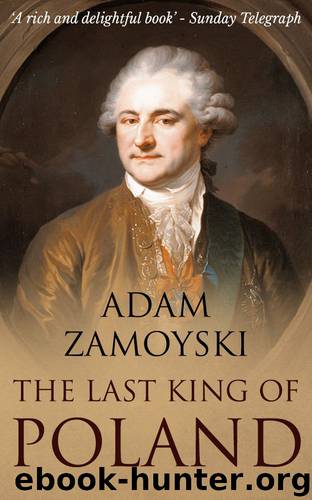
The Last King of Poland by Adam Zamoyski
Author:Adam Zamoyski
Language: eng
Format: mobi, epub
Publisher: Endeavour Press
Published: 2014-11-19T23:00:00+00:00
Chapter Seventeen – The Romantic Challenge
Stanisław had accepted collaboration with Russia in the conviction that it represented the only option for the survival of Poland. But he did not follow this line of reasoning through to its logical end, and allowed emotional factors to affect his conduct. Instead of adopting an attitude of unswerving loyalty to Russia and using the power this would have given him to crush all nonconformity in Poland, he remained a reluctant collaborator, siding at heart with the opposition, which was also, in effect, opposition to his rule. This policy bore the seeds of its own destruction. Russia remained wary of him and measured out her support sparingly, while many Poles found it difficult to see in him anything other than the agent of a foreign power. Stanisław could not act otherwise. However rational and realistic his assessment of the situation, his reactions were conditioned by his wariness of Russia, by the Polish political traditions to which he was heir, by his patriotism, and by his emotional instincts.
In many respects, the system established in 1776 was highly beneficial. It provided the stability necessary for reconstruction and economic growth. The Treasury, which had struggled to raise an annual revenue of 12 million złoty before the partition, was drawing 21 million by 1787 from a country reduced by one-third. This only allowed for an army of just over 20,000 men, but Stanisław’s Military Office, directed by General Jan Komarzcwski, transformed it into a regular modern army, equipped to the highest standard. The buying of ranks was abolished in 1782, and it was henceforth staffed by professional officers. The political stability also allowed a couple of generations to pass through the new educational system in peace. The existence of non-political salaried jobs in the Departments of the Permanent Council and its other offshoots contributed to the emergence of an administrative cadre. Poland was beginning to function as a state. People grew used to the existence of a regular government, even if they resented the Permanent Council. From 1778 onwards there was no more need to confederate the Seym, as nobody even considered using the veto.
Most of the opponents of the Permanent Council’s rule were those whose interests had suffered. The hetmans Ksawery Branicki, Michał Ogiński and Seweryn Rzewuski continually attacked the Council’s Military Department, to which they had lost most of their prerogatives. Ministers resisted the encroachments of the Council and its departments on their respective domains. Other magnates merely resented the inroads the organs of state were making into their freedom of action, whittling away their pool of client szlachta, who were gradually transferring their loyalty from them to the state.
The new system defied their attempts at troublemaking. They lobbied Stackelberg and even went to Russia in search of support against the king. The ambitious young Ignacy Potocki, for instance, badgered Panin in order to obtain the vice-chancellorship of Poland, which Stanisław intended for one of his own supporters.[564] This sort of thing made life difficult, and even
Download
This site does not store any files on its server. We only index and link to content provided by other sites. Please contact the content providers to delete copyright contents if any and email us, we'll remove relevant links or contents immediately.
| Africa | Americas |
| Arctic & Antarctica | Asia |
| Australia & Oceania | Europe |
| Middle East | Russia |
| United States | World |
| Ancient Civilizations | Military |
| Historical Study & Educational Resources |
Room 212 by Kate Stewart(5130)
The Crown by Robert Lacey(4821)
Endurance: Shackleton's Incredible Voyage by Alfred Lansing(4790)
The Iron Duke by The Iron Duke(4367)
The Rape of Nanking by Iris Chang(4224)
Joan of Arc by Mary Gordon(4119)
Killing England by Bill O'Reilly(4008)
Say Nothing by Patrick Radden Keefe(3992)
I'll Give You the Sun by Jandy Nelson(3452)
Shadow of Night by Deborah Harkness(3377)
Hitler's Monsters by Eric Kurlander(3352)
Mary, Queen of Scots, and the Murder of Lord Darnley by Alison Weir(3216)
Blood and Sand by Alex Von Tunzelmann(3207)
Eleanor & Park by Rainbow Rowell(3185)
Darkest Hour by Anthony McCarten(3137)
Margaret Thatcher: The Autobiography by Thatcher Margaret(3087)
Book of Life by Deborah Harkness(2943)
Red Famine: Stalin's War on Ukraine by Anne Applebaum(2940)
The One Memory of Flora Banks by Emily Barr(2871)
