The King's Two Bodies by Kantorowicz Ernst; Leyser Conrad; Jordan William Chester
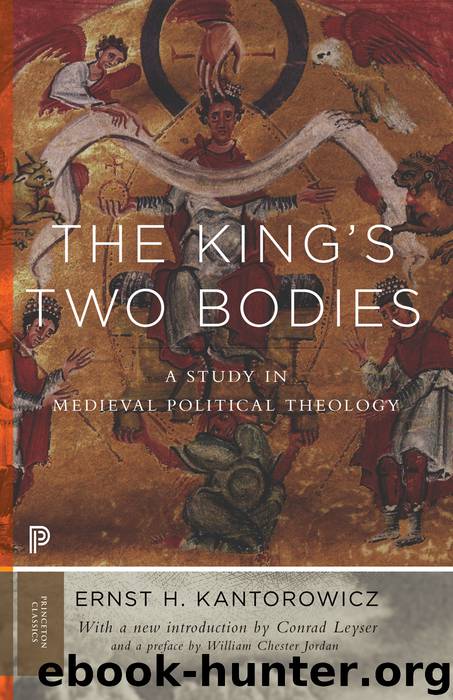
Author:Kantorowicz, Ernst; Leyser, Conrad; Jordan, William Chester
Language: eng
Format: epub
Publisher: Princeton University Press
Published: 2016-07-15T16:00:00+00:00
CHAPTER VI
ON CONTINUITY AND CORPORATIONS
1. Continuity
UNDOUBTEDLY the concept of the “king’s two bodies” camouflaged a problem of continuity. This was less evident, or perhaps only more concealed, in the earlier Middle Ages. But the truly essential point became manifest as well as articulate when, as a result of the reception of the Aristotelian doctrine of the “eternity of the world” and its more radical Averroist interpretation, the question of perpetual continuity itself became a philosophic problem of the first order.
The revival of the doctrine of the eternity of the world, which captivated Western minds after the middle of the thirteenth century,1 coincided with analogous, if independent, tendencies towards “continuity” in the constitutional and legal-political spheres. For it would be a mistake to assume that the new philosophic tenet produced, caused, or created a new belief in the perpetual continuity of political bodies. Facts of chronology would preclude such a hypothesis anyhow, because the development towards continuity in the fields of law and politics was already in full swing before an influence of the new philosophy could have been effective. Practice, as usual, preceded theory; but existing practice made the minds all the more receptive for a new theory. However, simultaneity does not imply causality, and all that can be said is that the philosophy defending the infinite continuum of Time made its appearance as a concomitant of related trends in other fields; further, that the ground was peculiarly well prepared to receive a doctrine which confirmed and justified what one thought or did anyhow, and thereby intensified and accelerated existing conditions; finally, that both strands—the philosophic-scholastic theory and the politico-legal practice—together decisively influenced the general pattern of Western social and political thought in its formative period.
For all those restrictions it would be nevertheless inexcusable to ignore the impact of the new trends in philosophy, because such neglect would whittle down our capability of understanding more profoundly the corresponding phenomena in other sectors of thought—constitutional, legal, or political. The heated arguments between philosophers and theologians about meaning and effects of an infinite continuity contributed, to say the least, to the articulation of some phenomena which previously had been difficult to express, or had not been expressed at all because they had not penetrated the conscious mind. Now, in the wake of the Aristotelian revival, the Averroist extremists, the moderate Aristotelians, and the anti-Aristotelians had each to produce their reasons for and against an eternity of the world. The very fact that the definition of continuity, duration, perpetuity, sempiternity, eternity, and related notions formed, over and over again, a matter for discussion and argument seems telling enough: it reveals to the historian that something formerly stable and settled had become unstable and unsettled—or even questionable—and that some serious change was taking place within the realm of Time, and in man’s relation to Time.
Whereas the philosophic aspects of that change have been studied frequently and are known well enough, the historical inferences of that new attitude toward Time, difficult to substantiate as they are, have hardly been investigated.
Download
This site does not store any files on its server. We only index and link to content provided by other sites. Please contact the content providers to delete copyright contents if any and email us, we'll remove relevant links or contents immediately.
| Africa | Americas |
| Arctic & Antarctica | Asia |
| Australia & Oceania | Europe |
| Middle East | Russia |
| United States | World |
| Ancient Civilizations | Military |
| Historical Study & Educational Resources |
Room 212 by Kate Stewart(5124)
The Crown by Robert Lacey(4817)
Endurance: Shackleton's Incredible Voyage by Alfred Lansing(4784)
The Iron Duke by The Iron Duke(4357)
The Rape of Nanking by Iris Chang(4214)
Joan of Arc by Mary Gordon(4115)
Killing England by Bill O'Reilly(4005)
Say Nothing by Patrick Radden Keefe(3988)
I'll Give You the Sun by Jandy Nelson(3448)
Shadow of Night by Deborah Harkness(3369)
Hitler's Monsters by Eric Kurlander(3343)
Mary, Queen of Scots, and the Murder of Lord Darnley by Alison Weir(3210)
Blood and Sand by Alex Von Tunzelmann(3205)
Eleanor & Park by Rainbow Rowell(3178)
Darkest Hour by Anthony McCarten(3133)
Margaret Thatcher: The Autobiography by Thatcher Margaret(3083)
Book of Life by Deborah Harkness(2939)
Red Famine: Stalin's War on Ukraine by Anne Applebaum(2934)
The One Memory of Flora Banks by Emily Barr(2864)
