The Invention of Brownstone Brooklyn by Osman Suleiman;
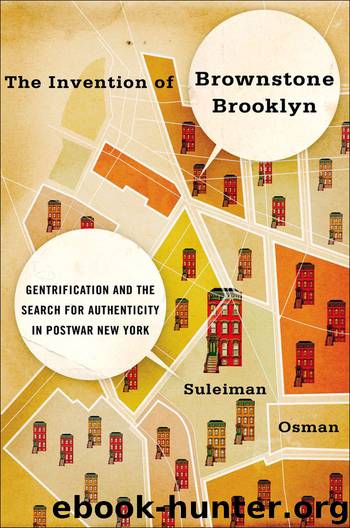
Author:Osman, Suleiman;
Language: eng
Format: epub
Publisher: Oxford University Press
Published: 2011-04-05T04:00:00+00:00
6 Inventing Brownstone Brooklyn
In October 1973, Brooklyn Heights’ Bossert Hotel, once the site for the seminal CCIC anti-urban-renewal rally, hosted the city’s first Brownstone Fair. Organized by the Brooklyn Brownstone Conference, a new middle-class civic group, the fair advertised itself as a showcase for “Everything You Always Wanted to Know About Brooklyn Brownstones.” More than two thousand attendees strolled past fifty exhibits run by enthusiastic volunteers. Instructional booths offered tips on old electrical wiring, stonemasonry, architectural ornamentation, and carpentry. Gardeners and horticulturists gave instructions on tree planting and care, community gardening, and negotiation strategies with the city park department. The Community Bookstore, started by Park Slope brownstoners, displayed more than a dozen “brownstone books” penned by Brooklyn’s new middle class, ranging from local histories to renovation guides. Fledgling neighborhood and block associations invited potential home buyers to visit their new enclaves. The most popular exhibit was the mortgage information table, where experienced brownstone buyers offered tips on procuring financing from reluctant banks. To cap off the event, Brooklyn Union Gas sponsored a fleet of buses to take fair attendees on tours of Brooklyn brownstone neighborhoods.1
Much had changed in South Brooklyn in the fifteen years since the first battle against Robert Moses. Looking outward from the Bossert Hotel in 1973, fair attendees could see two seemingly contradictory landscapes produced by the same economic restructuring. On one hand, they could see a struggling industrial district becoming increasingly black, Spanish-speaking, and poor. Since the 1950s, black and Puerto Rican home buyers and renters had been steadily migrating into the tenements and brownstones surrounding Brooklyn Heights on the heels of white working-class residents departing for the suburbs. With choices limited by discrimination and little leverage to pressure landlords for better services, black and Puerto Rican residents of Brownstone Brooklyn quickly found themselves trapped in overcrowded, dilapidated, and paradoxically high-rent buildings. While individual buildings were over-packed, much of Brownstone Brooklyn appeared deserted. In the late 1960s, landlords saddled with high interest rates and taxes, increased pressure by the city to improve conditions, and poor relations with nonwhite tenants abandoned their rental properties in droves. Scores of desperate owners seeking insurance, along with some frustrated residents, deliberately burned down dilapidated buildings. Merchants shut down stores. By the mid-1970s, black and Latino sections of Brownstone Brooklyn appeared a tragic patchwork of abandoned wrecks of buildings sitting next to overcrowded tenements. On once-bustling residential strips such as Fifth Avenue in Park Slope, scores of storefronts were empty. On other blocks children played in rubble-strewn empty lots. While entrepreneurial black and Latino migrants replaced some businesses with their own institutions, such as storefront Pentecostal churches, bodegas, and insurgent political clubs, the outflow of capital outpaced the influx. While Brooklyn Heights remained upscale, other sections of brownstone Brooklyn began to resemble a bombed-out city.2
As nonwhite migrants competed for housing and increasingly scarce manufacturing jobs with white ethnics, race relations in South Brooklyn deteriorated. While decades earlier white Protestant residents had complained about the influx of impoverished Italian and Irish renters
Download
This site does not store any files on its server. We only index and link to content provided by other sites. Please contact the content providers to delete copyright contents if any and email us, we'll remove relevant links or contents immediately.
| Africa | Americas |
| Arctic & Antarctica | Asia |
| Australia & Oceania | Europe |
| Middle East | Russia |
| United States | World |
| Ancient Civilizations | Military |
| Historical Study & Educational Resources |
Cat's cradle by Kurt Vonnegut(15480)
Pimp by Iceberg Slim(14720)
4 3 2 1: A Novel by Paul Auster(12554)
Underground: A Human History of the Worlds Beneath Our Feet by Will Hunt(12180)
The Radium Girls by Kate Moore(12125)
Wiseguy by Nicholas Pileggi(5879)
The Fire Next Time by James Baldwin(5541)
Perfect Rhythm by Jae(5505)
American History Stories, Volume III (Yesterday's Classics) by Pratt Mara L(5354)
Paper Towns by Green John(5269)
Pale Blue Dot by Carl Sagan(5104)
A Higher Loyalty: Truth, Lies, and Leadership by James Comey(5042)
The Doomsday Machine by Daniel Ellsberg(4583)
The Mayflower and the Pilgrims' New World by Nathaniel Philbrick(4576)
Killers of the Flower Moon: The Osage Murders and the Birth of the FBI by David Grann(4499)
The Sympathizer by Viet Thanh Nguyen(4468)
Too Much and Not the Mood by Durga Chew-Bose(4415)
The Borden Murders by Sarah Miller(4410)
Sticky Fingers by Joe Hagan(4277)
