The Free State of Jones by Bynum Victoria E.;
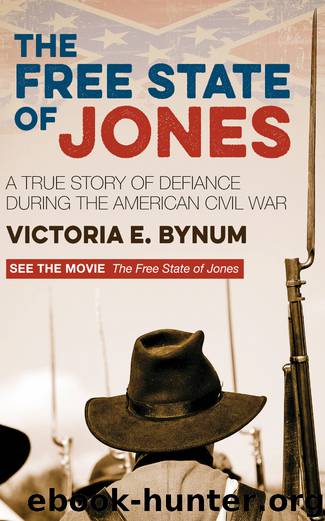
Author:Bynum, Victoria E.;
Language: eng
Format: epub
ISBN: 4778880
Publisher: Gerald Duckworth & Co
Anna Knight. Photograph courtesy of Minneola Dixon, Oakwood Archives and Museum, Oakwood College, Huntsville, Alabama.
Apparently on the strength of Tom Knight’s testimony as to Rachel’s race, the Jones County Circuit Court convicted Davis Knight of miscegenation on December 17, 1948. Attorney Quitman Ross immediately requested a new trial, citing several procedural errors and “for the additional reason that the statute under which the defendant was tried and convicted is unconstitutional.” The court denied his motion, and on December 20 Davis Knight appealed to the state supreme court. Fourteen citizens, including Wiley Jackson and John Stringer, posted his $2,500 bond.32
Since Ross had argued in the circuit trial that Davis was legally white and therefore had not questioned the constitutionality of Mississippi’s miscegenation statutes, no issue of constitutionality was addressed by the state supreme court in Knight’s appeal. On November 14, 1949, the high court reversed the lower court’s verdict and remanded the case, concurring with Ross that the state had failed to prove beyond a reasonable doubt that “the party in question [Davis Knight] had one-eighth or more of Negro (or Mongolian) blood” and therefore was African American. Ross’s original decision not to raise issues of constitutionality allowed the high court to base its decision strictly on laws governing racial identification, thereby circumventing criticism from civil rights groups. Since the case was not tried again, the high court, in effect, granted Davis Knight legal status as a white man.33
In the aftermath of their ordeal, mixed-race Knights differed in the way they racially identified themselves. For example, Davis Knight lived as a white man until his accidental death on August 8, 1959, in Houston, Texas, but his cousin Anna Knight spent twenty-six years as the president of the Seventh-Day Adventists’ National Colored Association of Teachers. She died in 1972 at her beloved Oakwood College in Huntsville, Alabama. Until the very end of her ninety-eight years, she combined religious work with efforts to advance African American education and social mobility.34
Davis Knight’s legal victory enabled his sister, Louvenia Knight, to wage a successful battle between 1960 and 1965 to have her two sons admitted to a white school. Just as Davis had collided in 1948 with a racial system of “strange paradoxes and hopelessly irreconcilable contradictions,” so, too, did Louvenia in the 1960s. And, as in the case of her brother, those contradictions ultimately won her a victory. Arguing that she was legally white, she attempted in the midst of Mississippi’s violent struggle over school integration to enroll her children in a nearby white school. She claimed that she did so because she opposed racial integration. After all, the children could not attend a “Negro” school if they were white.35
White members of the community insisted, however, that Louvenia’s children were “Negroes.” On that basis the West Jasper County School Board voted not to admit the boys, warning that violence might erupt if they did. After investigating Louvenia’s case, the Mississippi State Sovereignty Commission struggled to break the stalemate between Louvenia and the school board.
Download
This site does not store any files on its server. We only index and link to content provided by other sites. Please contact the content providers to delete copyright contents if any and email us, we'll remove relevant links or contents immediately.
| Africa | Americas |
| Arctic & Antarctica | Asia |
| Australia & Oceania | Europe |
| Middle East | Russia |
| United States | World |
| Ancient Civilizations | Military |
| Historical Study & Educational Resources |
Cat's cradle by Kurt Vonnegut(15365)
Pimp by Iceberg Slim(14522)
4 3 2 1: A Novel by Paul Auster(12405)
Underground: A Human History of the Worlds Beneath Our Feet by Will Hunt(12101)
The Radium Girls by Kate Moore(12036)
Wiseguy by Nicholas Pileggi(5795)
The Fire Next Time by James Baldwin(5454)
Perfect Rhythm by Jae(5411)
American History Stories, Volume III (Yesterday's Classics) by Pratt Mara L(5312)
Paper Towns by Green John(5196)
Pale Blue Dot by Carl Sagan(5013)
A Higher Loyalty: Truth, Lies, and Leadership by James Comey(4967)
The Mayflower and the Pilgrims' New World by Nathaniel Philbrick(4508)
The Doomsday Machine by Daniel Ellsberg(4493)
Killers of the Flower Moon: The Osage Murders and the Birth of the FBI by David Grann(4451)
The Sympathizer by Viet Thanh Nguyen(4398)
Too Much and Not the Mood by Durga Chew-Bose(4353)
The Borden Murders by Sarah Miller(4330)
Sticky Fingers by Joe Hagan(4207)
