The Forgotten Prophet by Johnson Andre E.;
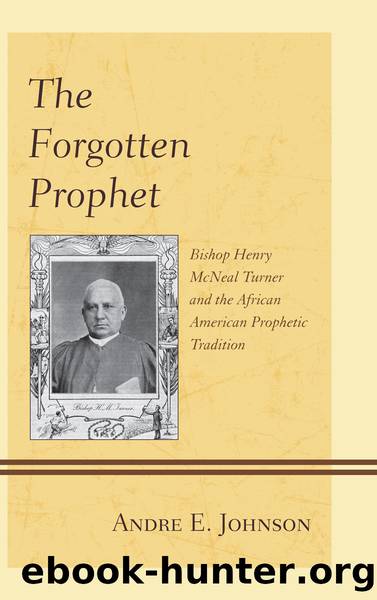
Author:Johnson, Andre E.;
Language: eng
Format: epub
ISBN: 1037802
Publisher: Lexington Books/Fortress Academic
Instead of speaking about literal monuments, Turner spoke about symbolic ones. First, Turner spoke about the âmonuments of fireâ that could have been built during the war. As in his earlier Emancipation Day speech, Turner deployed one of the rhetorical strategies blacks used to illicit sympathy from whites, which was to invoke the response of Southern blacks during the war. Many blacks argued that slaves could have run away or destroyed their masterâs property while they were away fighting in the war, but because of an obedient and docile nature, blacks did not take that course of action. Why did slaves not take this action? Turner answered the question when he explained that blacks did not want to destroy the âgood opinionâ they had with their friends, and blacks were at work building monuments of docility, obedience, respect, and self-control.
Turner invoked the docile Negro myth. While contemporary scholars have debunked the myth of the âdocile negro,â it is important to understand rhetorically why Turner found this to be an important rhetorical strategy.5 Cal Logue has written about the rhetorical construction of blacks during Reconstruction. He suggested three ways that whites rhetorically constructed blacks that helped shape pubic opinion about African Americans during this period. The first construction was that blacks were barbaric, the second that they were immoral, and finally that they were not fit for self-government (Rhetorical Ridicule).
What Turner did when he drew upon the docile Negro myth was to counterattack these rhetorical constructions. Turner attempted to demonstrate within the speech that blacks were not the wild, crazy beasts that many thought they were, while at the same time addressing the prevailing belief that blacks were immoral. For Turner, not burning woods, barns, and fences when blacks had the chance to do so, proved that they were respectful and in control of their actions. Finally, the fact that Turner spoke in the House that day as well as all of his work previously for the Republican Party and the Constitutional Convention proved that he, as a black person, could govern. Therefore, Turnerâs use of the docile Negro myth had profound rhetorical implications as part of his strategy to refute the social prejudices of his day.
However, the docile Negro myth also served another function, especially in the rhetoric of Turner. Since Turner adopted a prophetic persona, the docile Negro myth allowed him to seek out and stand on the moral high ground and to place blacks in the role of persecuted saints. When framed this way, Turner could juxtapose the actions of black and whites through a compare and contrast strategy. When blacks had an opportunity during the war to oppress whites, they did not; however, when whites now have an opportunity to oppress and persecute blacks by denying them seats in the Legislature, whites followed through with their threats. Therefore, Turner demonstrated that African Americans were not the ones who were barbaric and immoral, but that his white opponents were.
However, unlike others who have used the docile Negro myth to construct weakness, Turnerâs use of it reclaimed agency and choice for African Americans.
Download
This site does not store any files on its server. We only index and link to content provided by other sites. Please contact the content providers to delete copyright contents if any and email us, we'll remove relevant links or contents immediately.
| Anthropology | Archaeology |
| Philosophy | Politics & Government |
| Social Sciences | Sociology |
| Women's Studies |
Cecilia; Or, Memoirs of an Heiress — Volume 1 by Fanny Burney(32561)
The Great Music City by Andrea Baker(32021)
Cecilia; Or, Memoirs of an Heiress — Volume 2 by Fanny Burney(31958)
Cecilia; Or, Memoirs of an Heiress — Volume 3 by Fanny Burney(31944)
We're Going to Need More Wine by Gabrielle Union(19051)
All the Missing Girls by Megan Miranda(16043)
Pimp by Iceberg Slim(14519)
For the Love of Europe by Rick Steves(14155)
Bombshells: Glamour Girls of a Lifetime by Sullivan Steve(14079)
Talking to Strangers by Malcolm Gladwell(13375)
Norse Mythology by Gaiman Neil(13374)
Fifty Shades Freed by E L James(13245)
Mindhunter: Inside the FBI's Elite Serial Crime Unit by John E. Douglas & Mark Olshaker(9346)
Crazy Rich Asians by Kevin Kwan(9295)
The Lost Art of Listening by Michael P. Nichols(7507)
Enlightenment Now: The Case for Reason, Science, Humanism, and Progress by Steven Pinker(7315)
The Four Agreements by Don Miguel Ruiz(6767)
Bad Blood by John Carreyrou(6625)
Weapons of Math Destruction by Cathy O'Neil(6283)
