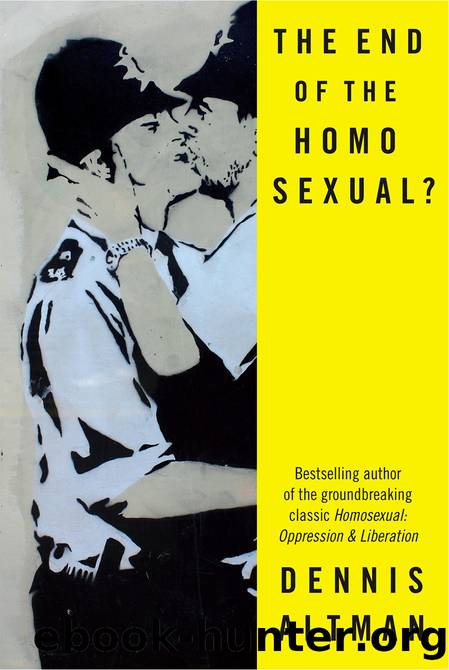
The End of the Homosexual? by Dennis Altman
Author:Dennis Altman [Altman, Dennis]
Language: eng
Format: epub
Published: 2013-06-19T00:00:00+00:00
The Queer Moment and Reborn radicalism?
The April 1992 issue of Outrage posed a question on its cover: âQueer, Gay or Homosexual?â The accompanying story was written by the British cultural critic Simon Watney, who pointed to the emergence of groups such as Queer Nation in the United States and Outrage in Britain as signs of a reborn activism, critical of the more accommodationist style that seemed to have taken over the lesbian and gay movement.
Interestingly, Simon read this as, in part, a generational debate, a rejection by younger âqueersâ of older men and women. Indeed, there was in the flush of radical enthusiasm in that period an element of âslaying the fatherâ, as I experienced rather unpleasantly when I was booed while speaking at a Sydney Gay Lobby dinner in April 1991. It was never clear why this incident occurred, and it probably meant no more than that a group of diners was uninterested in an after-dinner speech, but it epitomised a time in which the community was both tense and angry. There were echoes of this mood in Melbourne the following year, when drag queen Barbra Quicksand ran for state parliament as an independent and was repudiated by a number of âcommunity leadersâ, who were quickly termed âALP daddiesâ.
Perhaps unconsciously, I acted out Simonâs analysis, rejecting queer as anything but useful for aesthetic reasons, and arguing strongly that it undermined the need to organise specifically around our common homosexuality. Ironically, given my own history, I was also troubled by the unproblematic import of an American fashion, which to me seemed less relevant in the local context. (Looking back, I recognise that the same could have been said of the desire to insist on a specific âgay liberationâ movement in the early 1970s, as distinct from the groupings around CAMP.)
In any case, âqueerâ quickly took on a variety of uses, united by the desire to escape specific identities while retaining a sense of opposition to the dominant sexual and gender order. It remains useful for avoiding the ever-growing âalphabet soupâ terminology (usually cut back to âLGBTIâ), and itâs a term that I have used throughout this book.
For a number of younger homosexual intellectuals, queer theory was an electrifying revelation, offering a new perspective from which to interpret the ways in which their sexuality intersected with broader social and cultural streams. It built on the radical ideas of gay liberation (often without acknowledgment), but melded them with other strands; post-modernism and deconstruction, were, after all, the dominant themes of the humanities in the 1990s. Steven Seidman summed up the aspirations of queer theory as seeking âto transform homosexual theory into a general social theory or one standpoint from which to analyse social dynamicsâ.1
Now, a couple of decades later, it is easier to see that queer theory was far more useful as a theoretical and scholarly device than as an organising principle, even though the term remains in events such as queer film festivals, where it acts as a catch-all term for sexual and gender dissidence.
Download
This site does not store any files on its server. We only index and link to content provided by other sites. Please contact the content providers to delete copyright contents if any and email us, we'll remove relevant links or contents immediately.
| Anthropology | Archaeology |
| Philosophy | Politics & Government |
| Social Sciences | Sociology |
| Women's Studies |
Cecilia; Or, Memoirs of an Heiress — Volume 1 by Fanny Burney(32544)
Cecilia; Or, Memoirs of an Heiress — Volume 2 by Fanny Burney(31942)
Cecilia; Or, Memoirs of an Heiress — Volume 3 by Fanny Burney(31929)
The Great Music City by Andrea Baker(31916)
We're Going to Need More Wine by Gabrielle Union(19034)
All the Missing Girls by Megan Miranda(15946)
Pimp by Iceberg Slim(14484)
Bombshells: Glamour Girls of a Lifetime by Sullivan Steve(14052)
For the Love of Europe by Rick Steves(13899)
Talking to Strangers by Malcolm Gladwell(13346)
Norse Mythology by Gaiman Neil(13345)
Fifty Shades Freed by E L James(13232)
Mindhunter: Inside the FBI's Elite Serial Crime Unit by John E. Douglas & Mark Olshaker(9318)
Crazy Rich Asians by Kevin Kwan(9277)
The Lost Art of Listening by Michael P. Nichols(7490)
Enlightenment Now: The Case for Reason, Science, Humanism, and Progress by Steven Pinker(7306)
The Four Agreements by Don Miguel Ruiz(6744)
Bad Blood by John Carreyrou(6611)
Weapons of Math Destruction by Cathy O'Neil(6264)
